made his
pp. 23-58 · Read in the full issue
Lifelong toil made his dreams come true
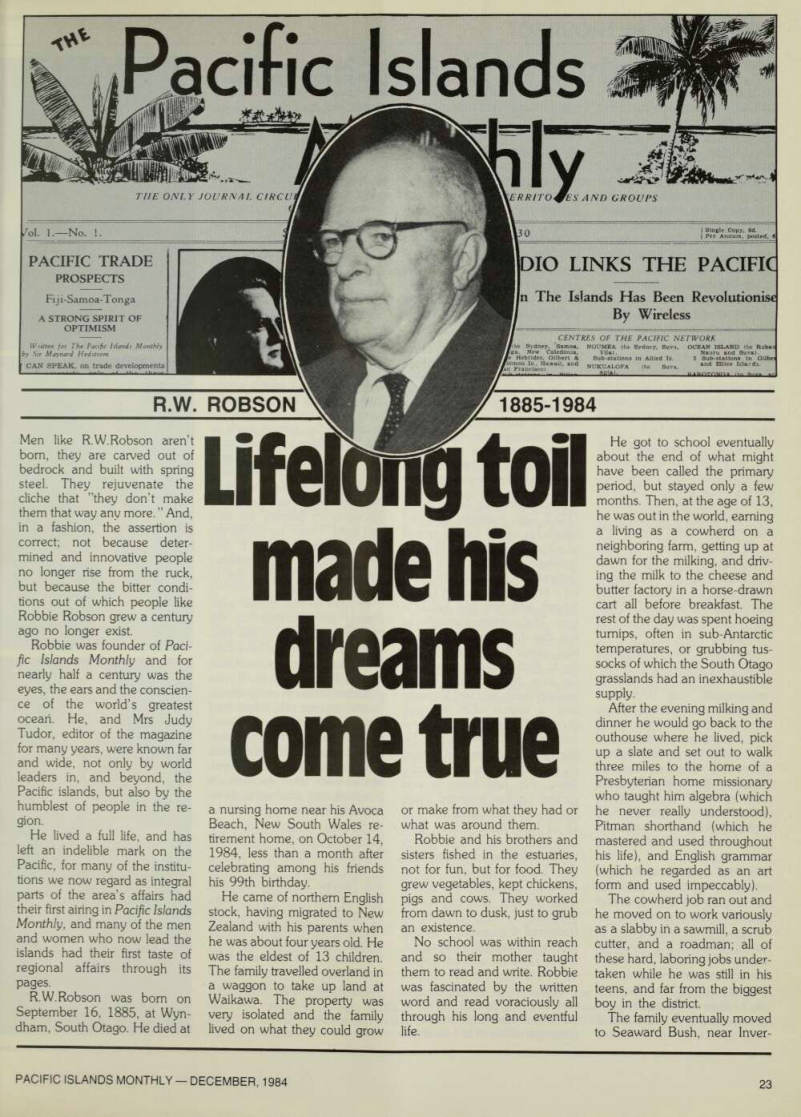
R.W. Robson
1885-1984
Men like R.W.Robson aren’t bom, they are carved out of bedrock and built with spring steel. They rejuvenate the cliche that ’’they don’t make them that way any more. ” And, in a fashion, the assertion is correct; not because deter mined and innovative people no longer rise from the ruck, but because the bitter condi tions out of which people like Robbie Robson grew a century ago no longer exist.
Robbie was founder of Paci fic Islands Monthly and for nearly half a century was the eyes, the ears and the conscien ce of the world’s greatest ocean. He, and Mrs Judy Tudor, editor of the magazine for many years, were known far and wide, not only by world leaders in, and beyond, the Pacific islands, but also by the humblest of people in the re gion.
He lived a full life, and has left an indelible mark on the Pacific, for many of the institu tions we now regard as integral parts of the area’s affairs had their first airing in Pacific Islands Monthly, and many of the men and women who now lead the islands had their first taste of regional affairs through its pages.
R.W.Robson was bom on September 16, 1885, at Wyn dham, South Otago. He died at
a nursing home near his Avoca Beach, New South Wales re tirement home, on October 14, 1984, less than a month after celebrating among his friends his 99th birthday, He came of northern English stock, having migrated to New Zealand with his parents when he was about four years old. He was the eldest of 13 children, The family travelled overland in a waggon to take up land at Waikawa. The property was very isolated and the family lived on what they could grow
or make from what they had or what was around them.
Robbie and his brothers and sisters fished in the estuaries, not for fun, but for food. They grew vegetables, kept chickens, pigs and cows. They worked from dawn to dusk, just to grub an existence.
No school was within reach and so their mother taught them to read and write. Robbie was fascinated by the written word and read voraciously all through his long and eventful life.
He got to school eventually about the end of what might have been called the primary period, but stayed only a few months. Then, at the age of 13, he was out in the world, earning a living as a cowherd on a neighboring farm, getting up at dawn for the milking, and driv ing the milk to the cheese and butter factory in a horse-drawn cart all before breakfast. The rest of the day was spent hoeing turnips, often in sub-Antarctic temperatures, or grubbing tus socks of which the South Otago grasslands had an inexhaustible supply.
After the evening milking and dinner he would go back to the outhouse where he lived, pick up a slate and set out to walk three miles to the home of a Presbyterian home missionary who taught him algebra (which he never really understood), Pitman shorthand (which he mastered and used throughout his life), and English grammar (which he regarded as an art form and used impeccably).
The cowherd job ran out and he moved on to work variously as a slabby in a sawmill, a scrub cutter, and a roadman; all of these hard, laboring jobs under taken while he was still in his teens, and far from the biggest boy in the district.
The family eventually moved to Seaward Bush, near Inver
cargill, where Robbie got a job with a fishmonger, gutting the daily catch. Then he went to a bakery, sleeping on a cot in the bakehouse so that he could get up at 4 a.m. to light the wood fire in the oven. When the bread was baked he would hitch horse to waggon and set off on his delivery round. That done, and the horse watered, groomed and fed, he had some time to himself which he used in preparing for the Junior Civil Service examination. This, when he passed it, was his step up to his first white-collar job, as a clerk in the local education board. In those days it was an achievement of enormous proportion for a poor boy from the bush whose general appearance was so wild and his hair so unruly, that the town kids would jeer ’’tussocks” at him as he walked by.
The very few photographs of him as a child do not indicate anything odd about his appear ance, but the feeling of inferior ity and insecurity which his lack of town manners produced in him stayed with Robbie for many years. Always he was thrifty. Even in his new-found eminence as an education board clerk he was careful and persuaded the board to let him live in one of its office rooms for a pound a week.
Journalism was, even then, his great interest. Even at the age of 12 he had contributed to newspapers, the Wyndham sheet and the weekly, Otago Witness. He tried several times to win a job on the Southland Times, who just as often turned him down. Then he went to Dunedin, the ’’big city” of the area and the experience so excited his imagination he promptly resigned his govern ment job and set out to make his fortune.
By this time he had taught himself to type and used this skill to get a job as a typewriter salesman. But the infernal in vention had not caught on with Dunedin’s dour and cautious businessmen and he nearly starved before, in some de speration, he applied for, and got, a job as a debt collector on the newspaper in Balclutha, a small town south of Dunedin.
In that curious fashion the career of a great news paperman finally began, for while he collected subscriptions and advertising money he also picked up news stories. As soon as he could he moved to Oamiru to work on the Mail and from there to Dunedin on the Evening Star. He was sacked from this job, largely, he used to allege, because he upset the local chief detective, a friend of the Stars editor. Robbie went straight over to the Otago Daily Times, still one of New Zea land’s major newspapers, and, having explained his problem, was promptly hired.
He produced his first book about this time, a paperback entitled The Story of Amy Bock, a lively documentary about a woman who lived as a man so completely that she even managed to marry an other woman. Her unmasking was a great story of the day and the book sold very well.
Also during his days on the O.D.T. an incident occurred which his oldest friends regard as a fine example of the Robson foresight, determination and dedication. A tourist ship had hit a pinnacle of rock in Dusky Sound and tom out her bot tom. The captain managed to run the ship up on a swampy islet where they were safe, but up to their hocks in water and far from home. News of the mishap finally reached Dunedin and a rescue ship set out, carrying Robson and a reporter from the rival Evening Star. By the time their ship had battled its way around to the sound a Navy ship had been in and picked up the stranded ones.
But it was still a great story for all of New Zealand and Rob bie’s problem was to get it back to Dunedin before his opposi tion. His ship was slow and he knew it would not reach port in time for his morning paper deadline. Thus, near Bluff, he badgered the captain until that worthy, thoroughly enraged, finally hove to, and let Robbie off in a small boat. He hopped over the rocks, wet to the skin from the surf, and set out to run through the bush to the nearest telegraph office. He found the
road but was just about ex hausted when the local baker’s van caught up with him and carried him the final few miles.
He reached the post office in time, filed his story and then went to the pub for a beer.
Back in Dunedin he was warmly congratulated by his editor, for his story had handily scooped the Star, and given what they saw as a handsome reward, a pound note.
Robson was married in 1908 and soon afterwards moved to the Wairarapa Daily Times, in Masterton, in the centre of the North Island, as managing edi tor. But his immediate under ling was a man Robbie de scribed as ”a supercilious uni versity graduate” who appears to have disliked taking orders from someone he considered a rural yokel and his social in ferior. Robbie moved back to the South Island to work on a variety of publications, ending with some sort of travel booklet which made him enough money to pay fares on a ship to Auckland for himself, his wife and child. There, he joined the New Zealand Herald. It was 1912 and, in fact, another plateau on the Robson rise to Pacific eminence.
In 1914 he was chosen from among the reporters on the Herald to accompany the then Governor-General of New Zea land, Lord Liverpool, on a tour of the Pacific islands. It was Robbie’s first look at the South Pacific, an area which had fired his imagination since boyhood and it was on this trip that Pacific Islands Monthly was conceived. Gestation took much work and another 16 years, during which time Rob bie moved away from Auckland to Sydney, a city for which he held a love rivalled only by his absorption with the Pacific.
After a couple of trips across the Tasman Robbie eventually won a job on the Sydney Morning Herald in 1916, work ing as a political and feature writer, a position he held for about two years. He moved, for better pay, to the now defunct Sydney Evening News, but
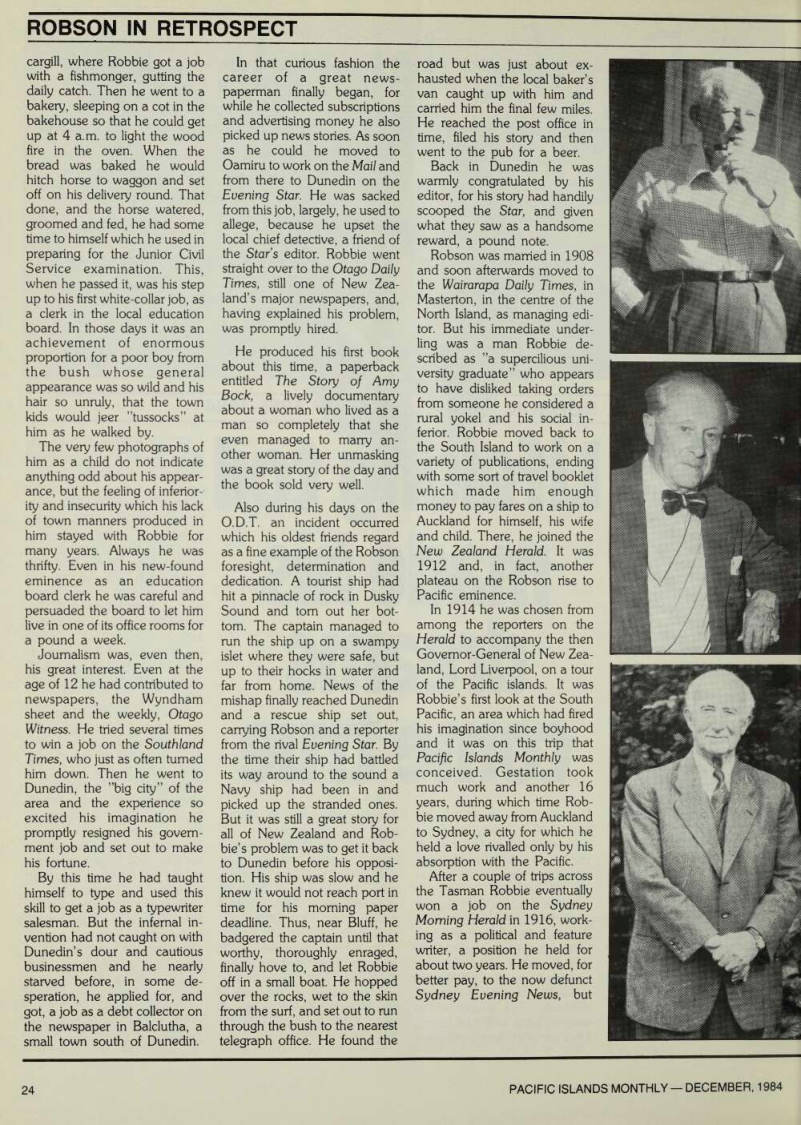
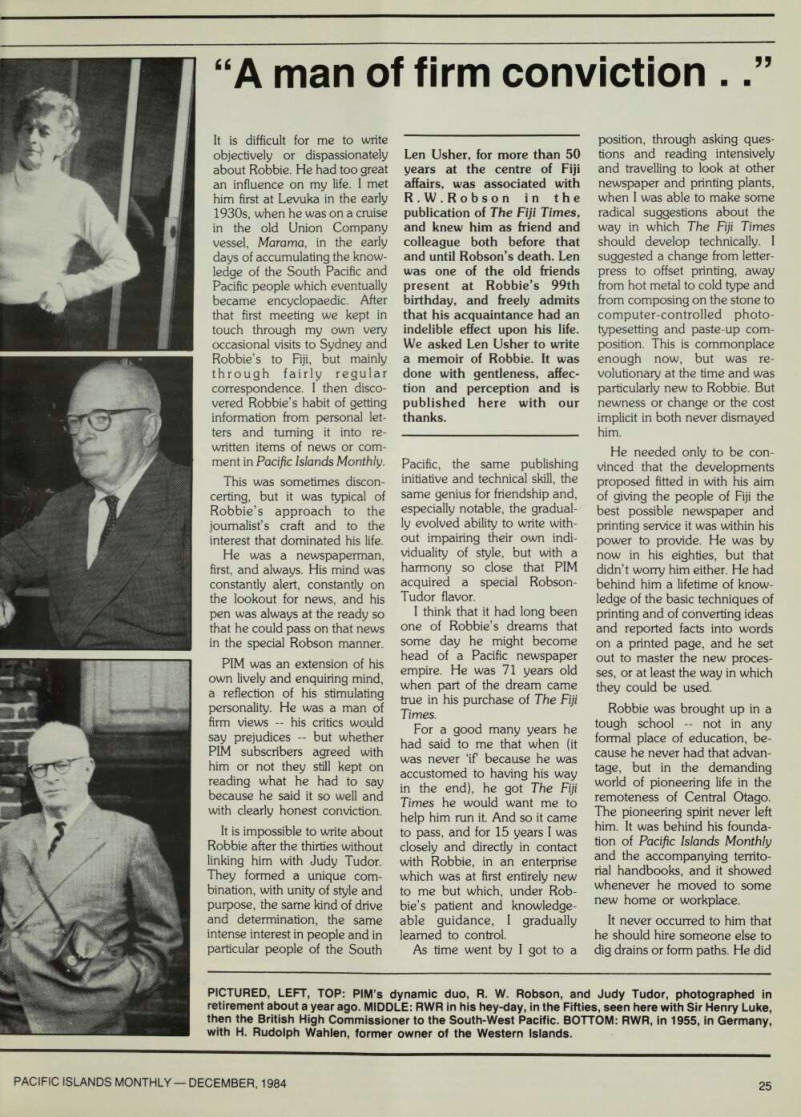
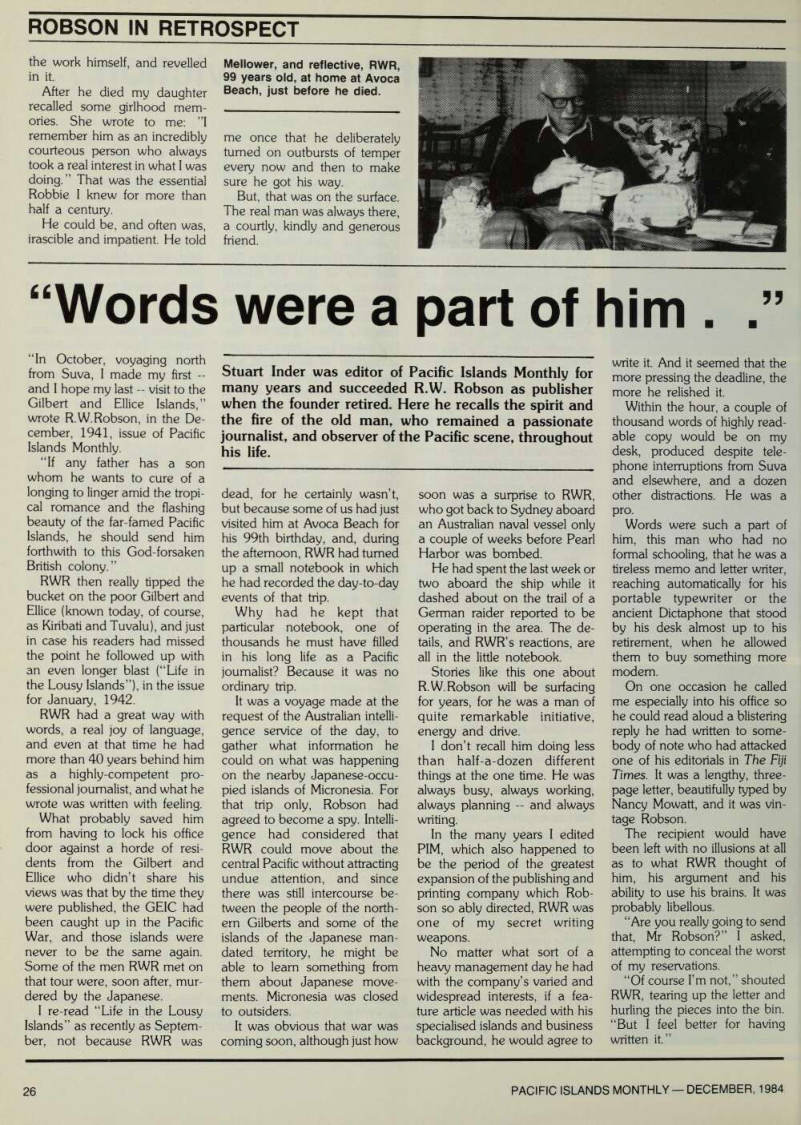
PICTURED, LEFT, TOP: PlM’s dynamic duo, R. W. Robson, and Judy Tudor, photographed in retirement about a year ago. MIDDLE: RWR in his hey-day, in the Fifties, seen here with Sir Henry Luke, then the British High Commissioner to the South-West Pacific. BOTTOM: RWR, in 1955, in Germany, with H. Rudolph Wahlen, former owner of the Western Islands.
didn’t like afternoon news papering and left that to spend a year looking after the trade journals run by the Sydney and Melbourne Publishing Com pany while its proprietor went overseas, an expedition of ma jor proportions in those days of steamships.
From there he went to the Daily Telegraph as assistant general manager under Watkin Wynn. Wynn had opposed the appointment, did not like Rob bie, made no secret of the fact, and banished him to the news room where he spent his time writing political news and com mentaries. But, within a few months, Wynn dropped dead and Robbie became general manager which, he often said, resulted in three and a half years of almost total frustration.
In those days the youngest director on the Telegraph was 69 and the ages of the five men who ran the newspaper with total autocracy ranged up to 91.
One of these decisions was to appoint to the editor’s chair one Dudley Disraeli Brougham, formerly leader writer on the Times of London. Robson was incensed. Brougham, he fumed, was devoid of ideas, knew nothing of Australia, and was quite unsatisfactory. Rob bie spent most of his time trying to get rid of him. When that task was accomplished the board appointed W. Farmer White as editor which, Robbie said acid ly, was even worse. Thus bested, Robbie took a post as London representative of the Daily Telegraph , the Mel bourne Age and some other newspapers. It was 1923. He endured Fleet Street and the London climate for two years before he returned to Sydney.
As near as one can gather of Robson’s activities in this period he spent some time doing odd jobs for the Sydney Morning Herald and then, for a couple of years, was public relations officer for the National Party, forerunners of today’s Liberals.
In 1928 he met, by chance, David Yaffa, of Yaffa Syndicate fame, and agreed to launch a newspaper news magazine for
him, provided that when it was successfully launched Yaffa would, in turn, help Robbie get the long-planned Pacific Islands Monthly under way. News paper News was such a success that Yaffa lost interest in the PIM idea. Seeing this, Robbie determined to go it alone and, in 1930, quit Yaffa, and pub lished the first issue of Pacific Islands Monthly.
That done, Robbie went to London to organise a service known as Ocean News, which was set up by the leading newspapers and Reuters to supply the passenger liners with news bulletins. It lasted until the radio blackout was introduced at the beginning of the Second World War.
Pacific Islands Monthly con tinued to make gains and, to wards the end of the 1930 s Robson bought the Sydney and Melbourne Publishing Com pany in order to get a printing plant. Mauri Brothers and Thomson, now part of the Burns Philp Group, were share holders, too.
The war was hard on Pacific Publications as the Japanese intruded further and further into the Pacific. Communications were difficult, markets shrank, advertisers diminished, and subscribers either fled to safety, or were made prisoners. Yet, for many in the great ocean PIM remained their most reli able source of news about the conflict and even today, visitors to the offices in Sydney, talk of the eagerness with which they waited for chance copies of the magazine they regarded as their regional bible.
Robson, Judy Tudor and the others kept PIM together de spite the war’s difficulties and, when hostilities were over, were able to begin expanding again.
They bought out the other shareholders in the Sydney and Melbourne Publishing Com pany and then, in 1956, Rob son finally persuaded Sir Alport Barker to sell him the Fiji Times and Herald, Ltd., a property Robbie had sought for years.
He ran it, and Pacific Publica tions, until 1976 when the group was bought by the Herald and Weekly Times, Ltd., of Melbourne.