Only the verbiage
pp. 19-22 · Read in the full issue


1984 Spc Conference
Only the verbiage was lush
A plethora of politics, conducted over an agenda of less than riveting interest, left observers of the 24th South Pacific Conference, held in Noumea in October hoping for better luck next year. Yet, within the tropically lush verbiage, some major matters lay hidden, as PIM correspondent, Helen Fraser, here reports.
It is a commentary on the 24th South Pacific Confer ence, held in Noumea for a week in October, that of all the subjects discussed, the most time-consuming and the most intense was a matter of whether the SPC’s secretary-general should have his appointment extended when it finishes in July.
The conference had two hits at the subject, first at the session of the Committee of Repre sentatives of Governments and Administrations (CRGA) which immediately preceded the full conference, and then again at the full conference.
The CRGA session argued about it for two days, and the conference went over most of the same ground when it de voted another half day to it.
All -of this seems to indicate three things (a) that as this meeting was the first confer ence in which all states and territories had equal voting rights, the smaller territories were determined to take advan tage of their new equality by expressing opinions at length, (b) there is a lot of politics played at the conference, and (c) there were not any real issues to discuss at this confer ence.
Most delegates with long ex perience of these conferences certainly agreed that there was a lack of interesting subjects for discussion. They found it a bit of a grind, and a bore.
They suggested that the con ferences might temporarily have run out of steam following
the victory in the battle for equality, which was won at the 23rd conference held last year in Saipan, in the Northern Marianas, and that they will come good again.
We will know next year, after the 25th conference to be held in Honiara. (In an unusual development, the conference also received nominations from French Polynesia for the 1986 confer ence in Papeete, the Cook Islands for the 1987 conference in Rarotonga, and “noted” them. The conference is not empowered to accept nomina tions so far ahead and thus couldn’t approve them formal ly, but the feeling certainly was that both nominations should be accepted, with both hands.) The issue of the secretary general came up because the present S-G, Francis Bugotu, asked the conference to extend his term so that he could finish a program, already begun, of reorganising the commission. It was best, he suggested, that the same man be allowed to do the job he had embarked upon. He asked for another full three year term.
Some delegates at the CRGA session (notably the Amer icans), were opposed to either a new term, or an extension of the present one, but the main argument finally revolved around just how long an exten sion should be. It was agreed that Bugotu’s term should be extended to the close of the 26th conference (presumably in Papeete, in October, 1986),
which would give him another 15 or 16 months from the end of his term next July.
Should the 26th conference not have been concluded by the end of October, the term of office of Bugotu would certainly not extend beyond December 31, 1986, the committee re commended.
The committee also agreed that all subsequent terms of office for an S-G should be limited to a single three-year term without the possibility of reappointment for a new term or extension of the existing one.
Further, when Bugotu’s term ended, Mr Palauni Tuiasosopo, of American Samoa, should, in the committee’s view, be appointed to succeed him. The committee called upon mem bers of CRGA, who will meet just before next year’s Honiara conference, to reaffirm this re commendation about the suc cessor.
“Brownie” Tuiasosopo, assistant to Governor Peter Coleman, of American Samoa, has been the American Sa moan representative to SPC meetings for many years. He was nominated for the S-G’s post when it was last discussed at the Port Moresby conference in 1981, but stood down in favor of Francis Bugotu.
It was felt then, among other things, that as the previous S-G, Young Vivian, of Niue, was a Polynesian, it was time for a Melanesian to be appointed rather than another Polynesian.
This question of Polynesians versus Melanesians (and versus
Micronesians, for that matter) was one of the arguments used in the debate about whether Bugotu should get his extension or not. But there was also some strong opinion expressed in opposition to secretaries-gen eral, or anybody else, being selected on regional grounds, the view being that it surely should be the best man for the job, irrespective of what island region he came from.
The full extent of opinions was not made public, because the CRGA sessions are held in camera and, in an unusual development, the debate on the question by the full confer ence was also closed to obser vers—including, of course, the press, but, surprisingly, also the SRC staff.
One or two of the more distinguished of the overseas observers were less than pleased at being ejected with out notice, without any idea of when they might be allowed in again. As it happened they were out for a full morning, which they could better have used elsewhere in Noumea.
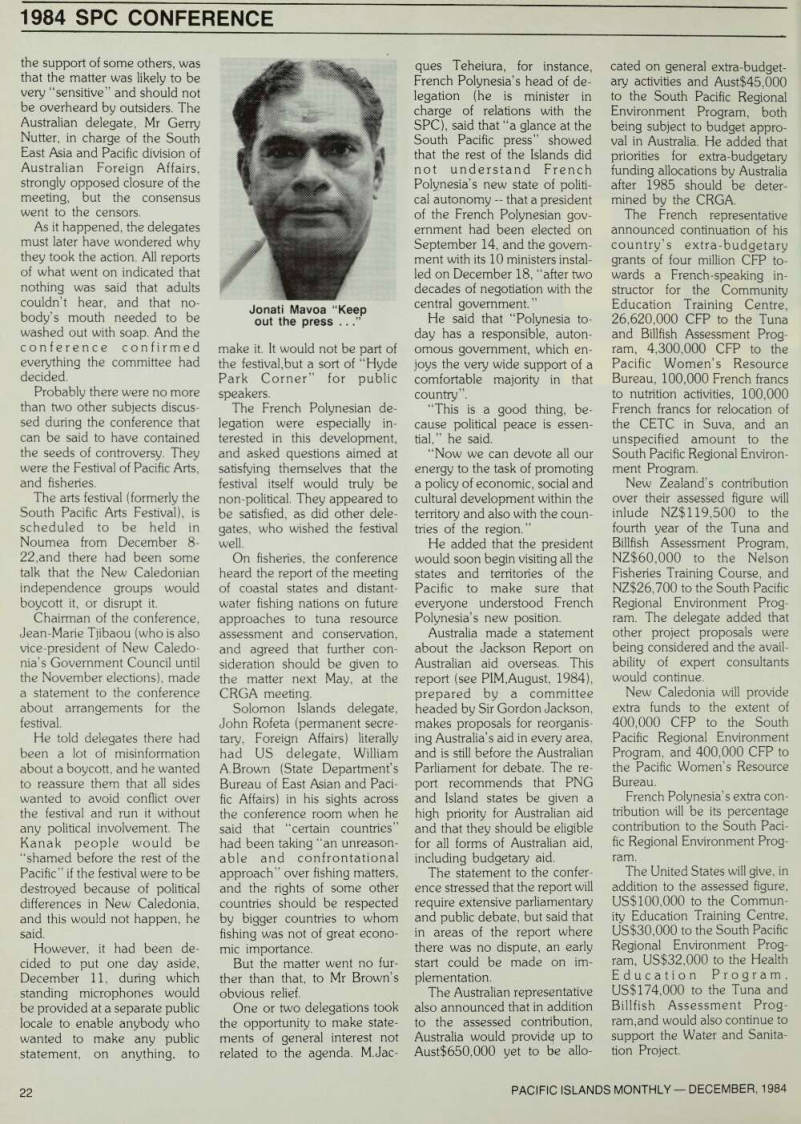
A move to ban the presence of observers during the S-G debate had been made the previous afternoon, but had been rejected. But, just before the debate was due to begin the next morning, the matter was brought up again by Fiji foreign minister, Jonati Mavoa, promptly, and strongly, sup ported by the UK High Com missioner for Fiji Mr R.A.R.
Barltrop.
Their argument, which got
the support of some others, was that the matter was likely to be very “sensitive” and should not be overheard by outsiders. The Australian delegate, Mr Gerry Nutter, in charge of the South East Asia and Pacific division of Australian Foreign Affairs, strongly opposed closure of the meeting, but the consensus went to the censors.
As it happened, the delegates must later have wondered why they took the action. All reports of what went on indicated that nothing was said that adults couldn’t hear, and that no body’s mouth needed to be washed out with soap. And the conference confirmed everything the committee had decided.
Probably there were no more than two other subjects discus sed during the conference that can be said to have contained the seeds of controversy. They were the Festival of Pacific Arts, and fisheries.
The arts festival (formerly the South Pacific Arts Festival), is scheduled to be held in Noumea from December 8- 22,and there had been some talk that the New Caledonian independence groups would boycott it, or disrupt it.
Chairman of the conference, Jean-Marie Tjibaou (who is also vice-president of New Caledo nia’s Government Council until the November elections), made a statement to the conference about arrangements for the festival.
He told delegates there had been a lot of misinformation about a boycott, and he wanted to reassure them that all sides wanted to avoid conflict over the festival and run it without any political involvement. The Kanak people would be “shamed before the rest of the Pacific” if the festival were to be destroyed because of political differences in New Caledonia, and this would not happen, he said.
However, it had been de cided to put one day aside, December 11, during which standing microphones would be provided at a separate public locale to enable anybody who wanted to make any public statement, on anything, to
make it. It would not be part of the festival,but a sort of “Hyde Park Corner” for public speakers.
The French Polynesian de legation were especially in terested in this development, and asked questions aimed at satisfying themselves that the festival itself would truly be non-political. They appeared to be satisfied, as did other dele gates, who wished the festival well.
On fisheries, the conference heard the report of the meeting of coastal states and distant water fishing nations on future approaches to tuna resource assessment and conservation, and agreed that further con sideration should be given to the matter next May, at the CRGA meeting.
Solomon Islands delegate, John Rofeta (permanent secre tary, Foreign Affairs) literally had US delegate, William A.Brown (State Department’s Bureau of East Asian and Paci fic Affairs) in his sights across the conference room when he said that “certain countries” had been taking “an unreason able and confrontational approach” over fishing matters, and the rights of some other countries should be respected by bigger countries to whom fishing was not of great econo mic importance.
But the matter went no fur ther than that, to Mr Brown’s obvious relief.
One or two delegations took the opportunity to make state ments of general interest not related to the agenda. M.Jac
ques Teheiura, for instance, French Polynesia’s head of de legation (he is minister in charge of relations with the SPC), said that “a glance at the South Pacific press” showed that the rest of the Islands did not understand French Polynesia’s new state of politi cal autonomy - that a president of the French Polynesian gov ernment had been elected on September 14, and the govern ment with its 10 ministers instal led on December 18, “after two decades of negotiation with the central government.”
He said that “Polynesia to day has a responsible, auton omous government, which en joys the very wide support of a comfortable majority in that country”.
“This is a good thing, be cause political peace is essen tial,” he said.
“Now we can devote all our energy to the task of promoting a policy of economic, social and cultural development within the territory and also with the coun tries of the region.”
He added that the president would soon begin visiting all the states and territories of the Pacific to make sure that everyone understood French Polynesia’s new position.
Australia made a statement about the Jackson Report on Australian aid overseas. This report (see PlM,August, 1984), prepared by a committee headed by Sir Gordon Jackson, makes proposals for reorganis ing Australia’s aid in every area, and is still before the Australian Parliament for debate. The re port recommends that PNG and Island states be given a high priority for Australian aid and that they should be eligible for all forms of Australian aid, including budgetary aid.
The statement to the confer ence stressed that the report will require extensive parliamentary and public debate, but said that in areas of the report where there was no dispute, an early start could be made on im plementation.
The Australian representative also announced that in addition to the assessed contribution, Australia would provide up to Austs6so,ooo yet to be allo
cated on general extra-budget ary activities and Austs4s,ooo to the South Pacific Regional Environment Program, both being subject to budget appro val in Australia. He added that priorities for extra-budgetary funding allocations by Australia after 1985 should be deter mined by the CRGA.
The French representative announced continuation of his country’s extra-budgetary grants of four million CFP to wards a French-speaking in structor for the Community Education Training Centre, 26.620.000 CFP to the Tuna and Billfish Assessment Prog ram, 4,300,000 CFP to the Pacific Women’s Resource Bureau, 100,000 French francs to nutrition activities, 100,000 French francs for relocation of the CETC in Suva, and an unspecified amount to the South Pacific Regional Environ ment Program.
New Zealand’s contribution over their assessed figure will inlude NZ5119,500 to the fourth year of the Tuna and Billfish Assessment Program, NZ$6O,OOO to the Nelson Fisheries Training Course, and NZ526,700 to the South Pacific Regional Environment Prog ram. The delegate added that other project proposals were being considered and the avail ability of expert consultants would continue.
New Caledonia will provide extra funds to the extent of 400.000 CFP to the South Pacific Regional Environment Program, and 400,000 CFP to the Pacific Women’s Resource Bureau.
French Polynesia’s extra con tribution will be its percentage contribution to the South Paci fic Regional Environment Prog ram.
The United States will give, in addition to the assessed figure, US$lOO,OOO to the Commun ity Education Training Centre, US$3O,OOO to the South Pacific Regional Environment Prog ram, U 5532,000 to the Health Education Program, U 55174,000 to the Tuna and Billfish Assessment Prog ram,and would also continue to support the Water and Sanita tion Project.
Jonati Mavoa “Keep out the press ..."