salvage job
pp. 17-18 · Read in the full issue
Air Pacific’S Future
Qantas wins the salvage job
Australia’s only in ternational airline, Qan tas, won, if that be the term, the contest to step in and help Air Pacific out of the financial and managerial mire into which it had fallen.
At the depth of the crisis the airline was technically insolvent, has accumulated losses of $26 million and was reportedly con tinuing to lose money at the rate of $500,000 a month, and had to find some hope of a way out - in the shape of a finan cing angel - before the end of October, or close down for want of funds to meet the payroll and other continuing expenses.
Because of Fiji’s strategic (to the international airline busi ness) position at the hub of the South West Pacific, and be cause of the many tempting bilateral airline landing rights held by Air Pacific Australia,
New Zealand, the U.S.A., Japan, Canada, and the island nations of the region, as well as Singapore, Korea and India -there was no shortage of appli cants for the angel’s task, de spite gloomy forecasts by some of Fiji’s better pessimists that getting things sorted out was going to make Hercules’ job over at the Augean stables look like a Sunday afternoon saus age sizzle.
Ansett Transport Industries of Australia was very keen, and despatched phalanxes of en thusiastic experts to Suva, led by their company’s chairman Sir Peter Abeles, to woo Ratu Mara with a variety of pro posals.
Among these was a guaran tee of no losses burden upon Fiji, a 50/50 seat-sharing scheme on international routes, and an Ansett Boeing 767 flying in Air Pacific colors on the
Sydney-Melbourne-Nadi routes, and further if, or when, they developed.
Air New Zealand’s Norman Geary, with the turnaround to profit of his company to en hance his case, was also quickly on the scene. Then came Con tinental Airlines of the U.S. which recently restructured it
self on regional lines, with a good Pacific story to tell. Qan tas was slower to move, but obviously persuasive when it did.
Having missed Air Pacific, Ansett is expected to redouble its efforts to develop its present overseas links, and perhaps find others.
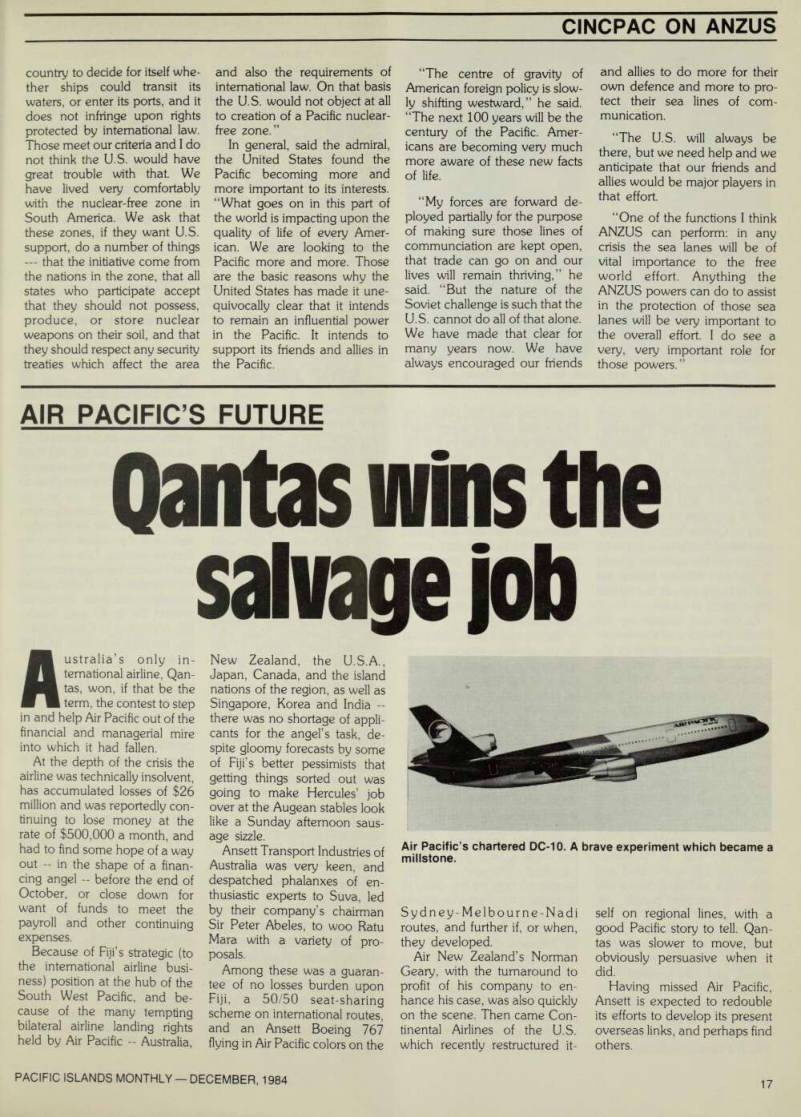
Air Pacific’s chartered DC-10. A brave experiment which became a millstone.
Qantas has three years’ work ahead on Air Pacific. The tenta tive agreement in principle, reached with the Fiji govern ment in October, gives the big Australian complete control for this period, and a formidable set of promises to fulfil. Accor ding to Qantas sources in Syd ney, some details have yet to be ironed out between the boards of the two airlines before the deal is finally signed, but no real impediment is seen.
Qantas was chosen by Air» Pacific’s board and the recom mendation was accepted by the prime minister, Ratu Sir Kamisese Mara, who took personal charge of Air Pacific affairs, after the board of directors resigned en masse while the then chairman, Mr John Hill, was overseas on leave. Mr Hill, a highly success ful Fiji businessman, took on the Air Pacific leadership about two years ago. Initially he had a good deal of support, and Air Pacific was notable for its optimism, but as problems worsened this evaporated and difficulties, including differences with management people, de veloped. Air Pacific’s main problem was that it was just too small to do what it sought to do in a sky full of highly-experi enced, and also business-hun gry, competitors.
For Qantas the irony is that it is now back in Fiji, involved in Air Pacific, a position from which it took considerable pains
to extricate itself five years ago.
The airline was for many years a major shareholder in the Fiji airline, and also operator of Nadi airport.
An Air Pacific statement said Qantas had been chosen be cause it “best satisfies the re quirements of the company, with regard to financing, man agement assistance, staff train ing, employment, regulatory and technical issues, the con tribution to tourism, and control of the company.”
Qantas said it was “delighted to be chosen against strong competition.” “Qantas’s objec tive is to establish Air Pacific in its own right as a profitable, well-managed, and highly-re garded airline in its own right. ”
Ansett, which made a major effort to win the race, is re portedly very disappointed by the decision. They had put a series of proposals to the Fiji government, and had guaran teed no further loss to them in their airline operations. Ansett has done a very good job in boosting Vanuatu tourism, hampered only by the delay in upgrading the Port-Vila airport to Boeing 727 standard. Their operation of Polynesian Airlines for Western Samoa has also won praise. They might have integrated the three services and provided the Pacific with the kind of viable regional air line about which the tourist and transport industries have been talking for years. At the same
time they would have achieved the level of growth they need, but which is impossible inside Australia. And they would have become Australia’s second in ternational airline, with a good network of routes linking Aus tralia and New Zealand with the Pacific Islands, the United States, and possibly also Can ada and Japan. All of this would have given them needed work for their still under-utilised Boeing 767 aircraft.
Suva reports say that under the deal with Qantas the Aus tralians will underwrite Air Paci fic’s accumulated losses and have guaranteed a ”no loss” operation to the government during the period of the con tract.
Services to Australia, New Zealand, and (if it is main tained) to Honolulu, are ex pected to be handled in future by Qantas 747 flights, probably with Air Pacific ’’piggy-backing” much as they already do into Sydney and Melbourne. This would cause no problems into Australia, but might present some difficulties on the Nadi- Auckland route. In that event a
previous discussion about Air Pacific buying seats from Air New Zealand could be reacti vated.
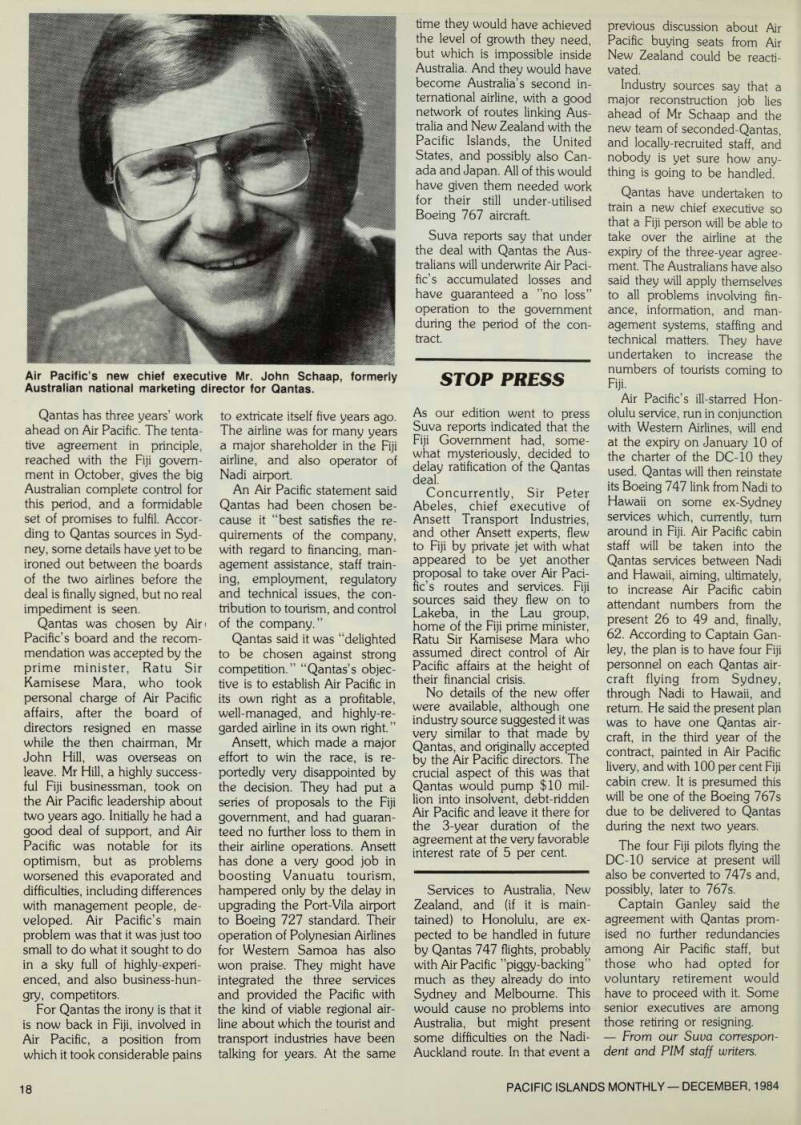
Industry sources say that a major reconstruction job lies ahead of Mr Schaap and the new team of seconded-Qantas, and locally-recruited staff, and nobody is yet sure how any thing is going to be handled.
Qantas have undertaken to train a new chief executive so that a Fiji person will be able to take over the airline at the expiry of the three-year agree ment. The Australians have also said they will apply themselves to all problems involving fin ance, information, and man agement systems, staffing and technical matters. They have undertaken to increase the numbers of tourists coming to Fiji.
Air Pacific’s ill-starred Hon olulu service, run in conjunction with Western Airlines, will end at the expiry on January 10 of the charter of the DC-10 they used. Qantas will then reinstate its Boeing 747 link from Nadi to Hawaii on some ex-Sydney services which, currently, turn around in Fiji. Air Pacific cabin staff will be taken into the Qantas services between Nadi and Hawaii, aiming, ultimately, to increase Air Pacific cabin attendant numbers from the present 26 to 49 and, finally, 62. According to Captain Gan ley, the plan is to have four Fiji personnel on each Qantas air craft flying from Sydney, through Nadi to Hawaii, and return. He said the present plan was to have one Qantas air craft, in the third year of the contract, painted in Air Pacific livery, and with 100 per cent Fiji cabin crew. It is presumed this will be one of the Boeing 767 s due to be delivered to Qantas during the next two years.
The four Fiji pilots flying the DC-10 service at present will also be converted to 747 s and, possibly, later to 7675.
Captain Ganley said the agreement with Qantas prom ised no further redundancies among Air Pacific staff, but those who had opted for voluntary retirement would have to proceed with it. Some senior executives are among those retiring or resigning.
From our Suva correspon dent and PIM staff writers.
Air Pacific’s new chief executive Mr. John Schaap, formerly Australian national marketing director for Qantas.