"Softly, softly"Will ease ANZUS crisis
pp. 12-17 · Read in the full issue

U.S. Admiral Talks On Cris
ANZUS may be less at risk than has been popularly supposed, and New Zealand and the United States may not be quite so diametrically opposed on the question of nuclear ship visits as has appeared since N.Z. prime minister David Lange took office last July.
For one thing, not totally to the point, but relevant, New Zealand stoutly maintains support for the alliance in conventional forces and this month will have her ships and air force busy in Tasmanex, cooperating with units from the U.S., Australia, and Canada, and giving them access to her waters and ports.
But the question remains very delicate; a case of political dynamite in New Zealand, and a reason for deep disappointment in Washington with a Pacific country supposed to be a solid gold ally.
In Honolulu last month the U.S.Commander in Chief for the Pacific (CINCPAC) Admiral William J.Crowe, was carefully optimistic about the out come when he was questioned by the media. But, he was also very clear about the problems the New Zealand policy posed, and the risks it invoked.
Admiral Crowe assumed his present post in 1980, but has had wide experience of Pacific defence and political affairs throughout his many years in the U.S.Navy. He regards the Pacific as “the unsung success story of U.S.foreign policy.”
When the U.S. withdrew from Vietnam, he said, he estimated it would take 25 years for the United States to rebuild its relationships with the area and to restore confidence in the U.S. “Fortunately, I was wrong. As I visit the countries of the region I am led to believe that our bonds today are tighter than they have been for very many years. The area has progressed a great deal politically in the last 30 years. We see maturity, stability and responsible participation in international councils,” the admiral said.
New Zealand’s adamant stand against giving ac cess to her ports for nuclear armed or po wered naval ships, even to the point of risking the future of ANZUS, could change the milit ary balance in the Pacific and certainly has embarrassed Aus tralia and the United States. It has given comfort to political groups which use widespread public concern about nuclear weapons as an anti-U.S. cam paign, ignoring the fact that the Russians also maintain nuclear ships and submarines in the Pacific. But, Mr Lange has continued to talk with the Un ited States, expressing firm gen eral support for the western alliance and it does appear that both sides are both patient and trying hard to find a solution.
The expectation now is that
there will be gradual movement of positions in both Washington and Wellington, and that a solution will be found. Admiral Crowe, who holds the hot seat for American defence commit ments in the Pacific, made no secret of the difficulties New Zealand had given him, but seemed calmly optimistic about the final outcome.
How deeply was he con cerned about New Zealand’s attitude on access of nuclear ships to its ports? What options lay open? Bearing in mind the way France and Pakistan just quietly slipped out of the Manila Pact many years ago, could not ANZUS operate with just Aus tralia and the United States until New Zealand eventually had a change of heart and resumed a full role in the treaty relation ship?
“I am well aware of the dispute within ANZUS; I am very concerned about it,” he said. “The policy which the current government of New Zealand is promulgating is one that would make it difficult for
me as a commander with my responsibilities in the Pacific under ANZUS to carry out those responsibilities.
“It is hard for me to see how the United States can support a security alliance whole-hearted
ly when its ability to inter-act with the forces of the other members of that alliance is limited, or constrained.
“But, it is a little bit prema ture to talk in terms of strictly a bilateral Australian-United
States alliance.
“Both New Zealand and the United States appreciate the seriousness of the dialogue which we have going. We are working very hard to sort it out, and I think it is just too early to
talk about alternatives.
“The dialogue now going on between Washington and Wel lington is to make sure both sides understand the import ance of the ANZUS alliance.
“Certainly the United States puts great stock in it. We feel it is an important pillar of the entire free world’s network of alliances which contribute so heavily to deterrence and stabil ity.
“I wish to make it clear,” he said firmly, “that we feel ANZUS is extremely important, not only to the members of ANZUS but also to the other countries of the South-West Pacific the island nations.
“I visit those countries, and I talk with many of their leaders. I have just returned from Papua New Guinea, for example. All of those countries feel they benefit from the shield of ANZUS. While only three coun tries are direct participants in the agreement, they feel that in a very real sense the entire region is under ANZUS, and benefits from ANZUS.
“Likewise it is important to explore with the government of New Zealand our military-to military relationships, and how we depend and rely on exer cises and joint operations, and then to look for ways in which we can continue to maintain our effectiveness and coopera tion.
“This is a very difficult prob lem. The issues are very sensi tive. I am not necessarily pes simistic on this. It is just serious and will take some time, and it will take a forthcoming attitude on the part of both govern ments. I think we have that. But it is a very serious matter,”
Admiral Crowe said. “I do not see how I, as the U.S. comman der in the Pacific, can carry out my responsibilities as they are charged to me under ANZUS, if my ships and my personnel do not have access to the country, the ports and the waters of an ally. ” Did the admiral see a role for Australia in the defence of the Pacific, and in the event of a
crisis, something greater than a sort of minor rural part in collaboration with U.S. forces?
“Given the inter-dependence of trade in that part of the Pacific, obviously the sea lines of communication are impor tant to every nation in the region, and I include in this the nations of ASEAN, Taiwan, Hong Kong, ANZUS nations -they all depend upon each other for trade.
“The economic success of the western Pacific has amazed the entire world. The U.S. and Japan do $6O billion worth of business each year; we do $137 billion worth annually with the entire Far East region. These figures are unmatched by any other theatre of the world,”
Admiral Crowe said. “It is an encouraging picture, drawn pri marily by the energy and the imagination of the people who live there. But, all of us, Amer icans included, should recog nise that U.S. security, dip lomatic, economic and military policies have also been heavy contributors to this success story.
“Our military shield has pre vented Soviet intimidation and aggression, and it has allowed our friends and allies to pursue their own fortunes and to deve lop their own potential.
“Since 1969 the Soviet Un ion has made very vigorous efforts to dramatically improve their own capability. They are making what I would call a very, very serious run on chan ging the military balance. In return the United States had also been improving the capability of its forces,” he said.
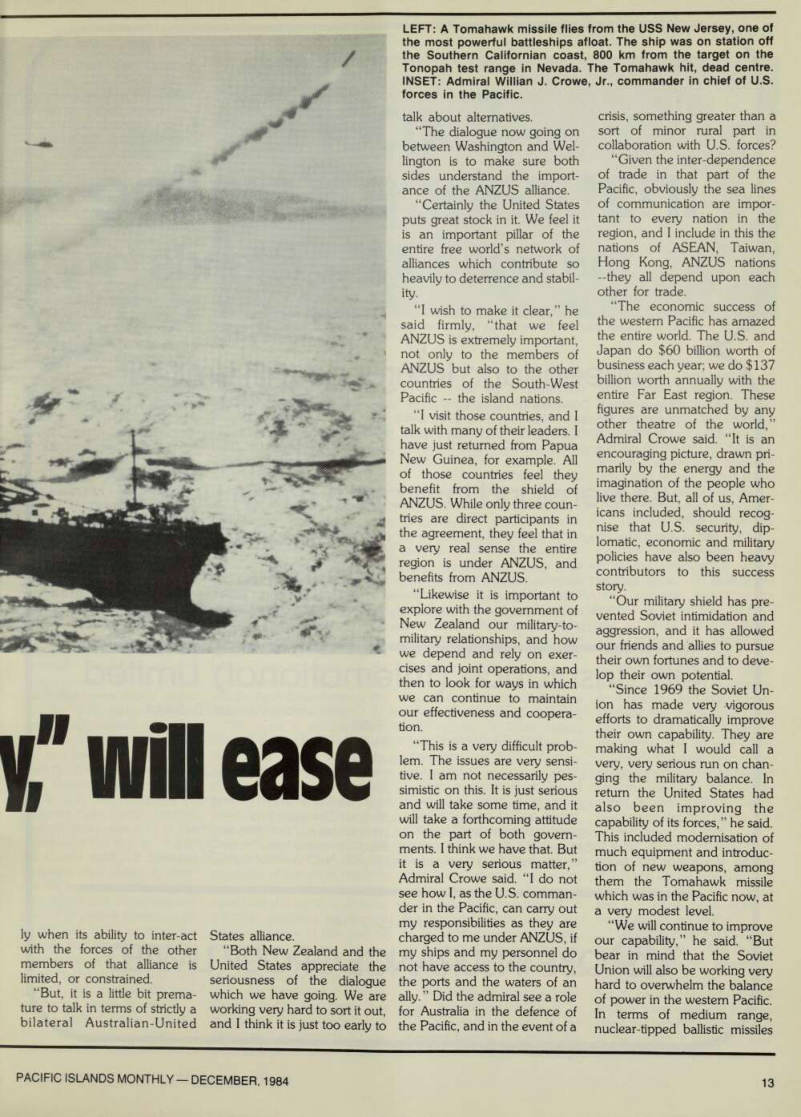
This included modernisation of much equipment and introduc tion of new weapons, among them the Tomahawk missile which was in the Pacific now, at a very modest level.
“We will continue to improve our capability,” he said. “But bear in mind that the Soviet Union will also be working very hard to overwhelm the balance of power in the western Pacific.
In terms of medium range, nuclear-tipped ballistic missiles
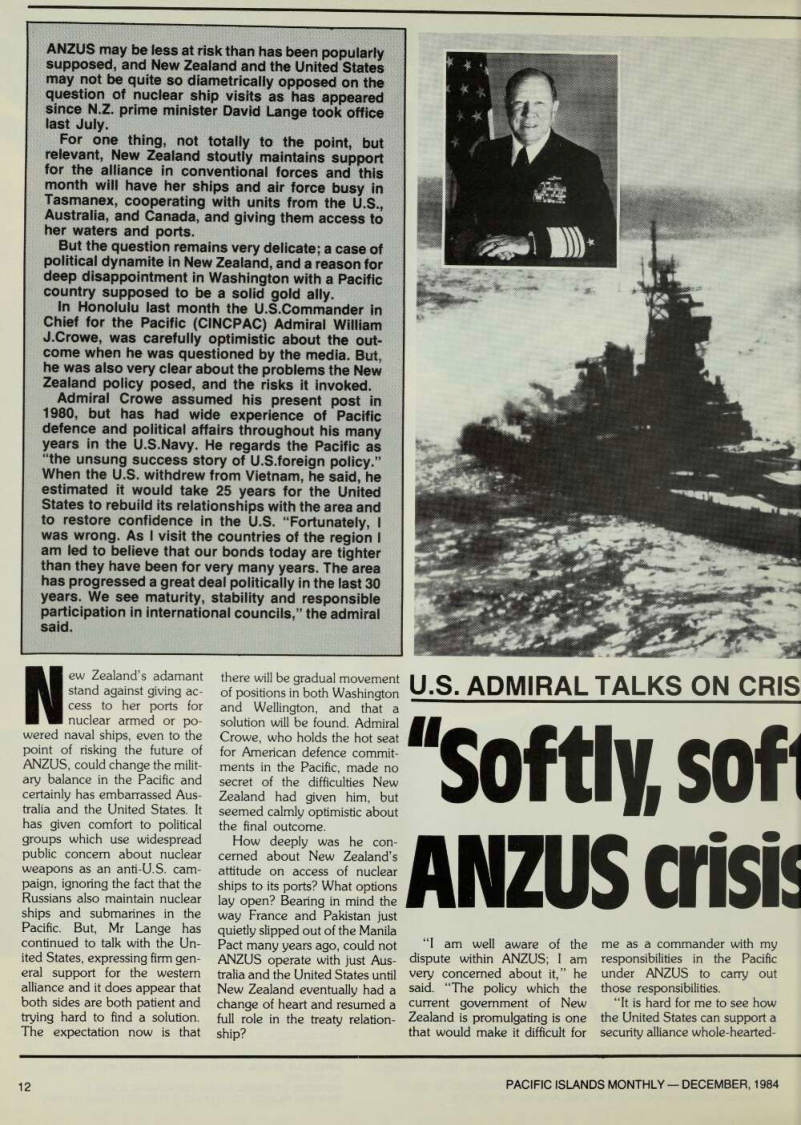
LEFT: A Tomahawk missile flies from the USS New Jersey, one of the most powerful battleships afloat. The ship was on station off the Southern Californian coast, 800 km from the target on the Tonopah test range in Nevada. The Tomahawk hit, dead centre.
INSET: Admiral Willian J. Crowe, Jr., commander in chief of U.S. forces in the Pacific.
the Soviets are currently carrying 135 SS-20 missile launchers in their Far Eastern provinces, which represents a tremendous increase and it threatens the entire balance in the region,” Admiral Crowe said.
At the same time, the admiral said, the Soviet Union has not had great return on their other efforts to influence the region.
They were not a player in the economic marketplace. “They have depended entirely upon their military strength, and we have seen an extremely steep rise since 1969 in Soviet milit ary strength in the Far East.”
Asked about the Russians’ presence in Vietnam, the admi ral said: “Clearly they have made a major investment in Cam Ranh Bay, and we have seen a steady build-up over several years now in that facil ity, obviously with Vietnamese permission.
“On any given day they operate out of Cam Ranh Bay six to 10 surface combat ships, five or six submarines, and 10 to 12 naval support ships. At the present time they have nine strike aircraft based there and about eight long-range ASW (anti-submarine warfare) and surveillance aircraft. This re flects a modest build-up in just the last few months. We antici pate that these increases will continue. They have a great deal of support capacity at Cam Ranh Bay, more than is neces sary . for their current deploy ment, which suggests to me that we will see further increases in the next few years. In my mind Cam Ranh Bay is now a perma nent Soviet facility.
“As they do increase their presence there, I think it should become more alarming to the countries in the region,” Admi ral Crowe said. “It certainly increases their ability to over see the sea-lanes of the Pacific, and extend their reconnaisance and ASW aircraft operations far to the east. It has changed the military and strategic calculus a very great deal. It is a very alarming development and one we will have to deal with for a protracted length of time.”
The United States had for some time had a policy of
unequivocal commitment to the Pacific, he said. It had been a comprehensive, four-pronged military policy. Not only were U.S. forces constantly being modernised, but a great deal of effort went into security assist ance to friendly countries. The task of ensuring the security of the Pacific was joint and collec tive, he said.
Admiral Crowe said his forces took part in more than 100 joint exercises with friendly and allied countries’ forces each year to improve performance and interoperability of defence units.
This forward deployment policy, and the five defence treaties with countries of the region, including ANZUS, stres sed the inter-dependence of the defence effort, he said.
“We want to see the coun tries of the region developing their own defence capability, and do the maximum that their own political imperatives will permit. If they have better self defence, if they address their own problems in a serious way, then in collaboration with the United States, the defence capability of the entire region is improved. It certainly promotes stability and it certainly gives us a further guarantee that we will maintain peace in that part of the world.
As part of the overall strategy of maintaining peace and stabil ity in the Pacific, said Admiral Crowe, the United States was glad to see the development in Japan of a respectable air de
fence system, and moves to wards capability of defending their sea lines of communica tion up to 1000 miles from the shores of Japan. “We applaud those objectives,” the admiral said.
The United States would cooperate in the defence of Japan in the event of hostilities, he said, “but I see the commit ment of the Japanese armed services, particularly their mari time self-defence force, as a separate and distinct commit ment on the part of the govern ment of Japan. I would antici pate that their forces would be interoperable with those of the United States, but in line with obligations set by the Japanese government, I would anticipate that their maritime self-defence forces would take the primary responsibility in those waters close into Japan for keeping open the sea lines of com munication. ”
Such a development would have “a great buttressing effect” for the United States, Admiral Crowe said, and would enhance the U.S. ability to assist in the defence of its friends and allies in the region.
He spoke also of changes in U.S. defence arrangements in the northern Pacific, in particu lar in the Mariana Islands, partly as a result of the constitutional changes in that part of the world.
“We already have a large and sophisticated base in Guam, which is part of the Mariana Islands. We are in the
process of negotiating an arrangement to sever the Trust Territory of the Pacific Islands.
As part of that, the Northern Marianas would come into the United States as a Common wealth and we have taken up an option as part of that agree ment for the use of the island of Tinian for defence purposes.
“The only other part of Mic ronesia which would have any defence arrangements, aside from the responsibility of the United States to defend the area generally, would be the islands of Palau, and we have not yet arrived at a mutually satisfactory or agreeable arrangement with Palau.
“The foreseeable use for Ti nian is primarily for marine and land training, and as an expan sion for the naval facilities in Guam, if that ever became necessary,” the admiral said.
Despite the political problems now experienced by the Marcos regime, the U.S. did not see either Tinian or Palau as re placements for any of the Phi lippine bases, he said.
What did the admiral think about the proposal to declare the South Pacific a nuclear-free zone? How did he see it affec ting U.S. relationships with the South Pacific countries?
“We hope it will not have any deleterious effect. We do not oppose nuclear-free zones. The Australian proposal in the South Pacific Forum to declare such a zone does not infringe upon the security arrangements in the region. It leaves to each
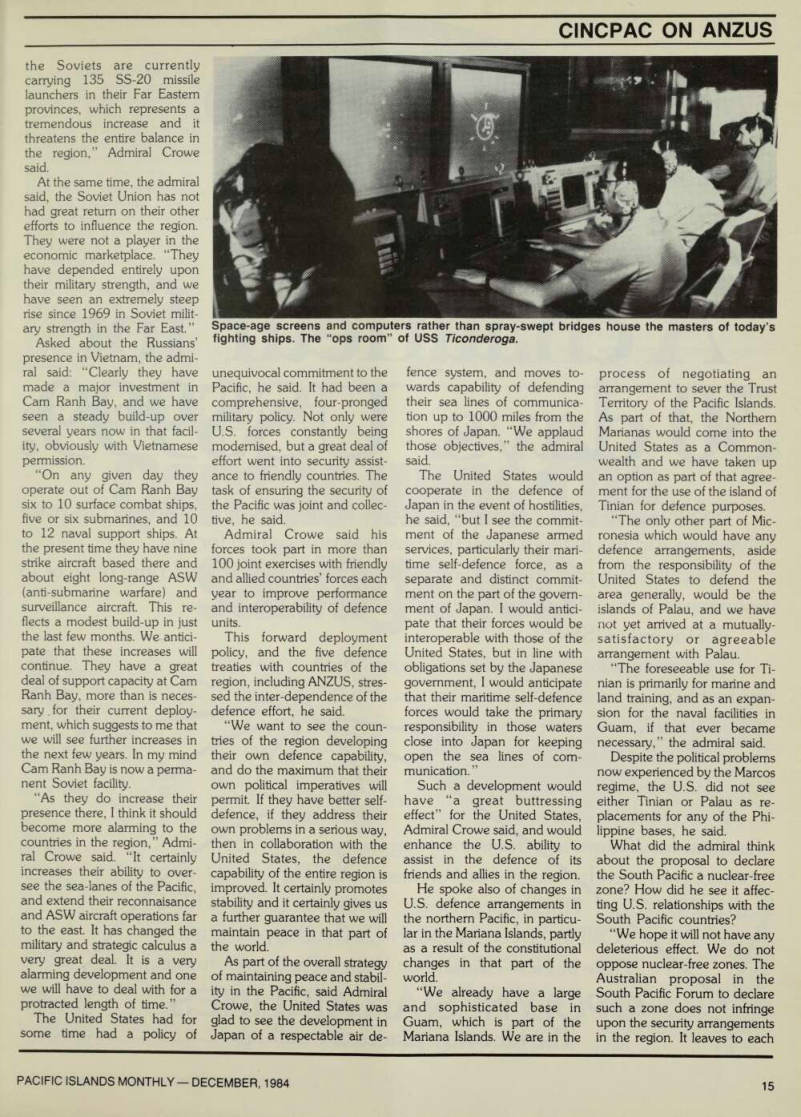
Space-age screens and computers rather than spray-swept bridges house the masters of today’s fighting ships. The “ops room” of USS Ticonderoga.
country to decide for itself whe ther ships could transit its waters, or enter its ports, and it does not infringe upon rights protected by international law.
Those meet our criteria and I do not think the U.S. would have great trouble with that. We have lived very comfortably with the nuclear-free zone in South America. We ask that these zones, if they want U.S. support, do a number of things that the initiative come from the nations in the zone, that all states who participate accept that they should not possess, produce, or store nuclear weapons on their soil, and that they should respect any security treaties which affect the area
and also the requirements of international law. On that basis the U.S. would not object at all to creation of a Pacific nuclear free zone.”
In general, said the admiral, the United States found the Pacific becoming more and more important to its interests.
“What goes on in this part of the world is impacting upon the quality of life of every Amer ican. We are looking to the Pacific more and more. Those are the basic reasons why the United States has made it une quivocally clear that it intends to remain an influential power in the Pacific. It intends to support its friends and allies in the Pacific.
“The centre of gravity of American foreign policy is slowly shifting westward,” he said, “The next 100 years will be the century of the Pacific. Amer- .cans are becoming very much more aware of these new facts ° 1 e ’
“My forces are forward deployed partially for the purpose of making sure those lines of communciation are kept open, that trade can go on and our lives will remain thriving,” he said. “But the nature of the Soviet challenge is such that the U.S. cannot do all of that alone, We have made that clear for many years now. We have always encouraged our friends
and allies to do more for their own defence and more to pro tect their sea lines of com munication. . The u s wi „ al be but we need M and we anticipate that our and allies would be major players in
at e^ort
“One of the functions I think ANZUS can perform: in any crisis the sea lanes will be of vital importance to the free world effort. Anything the ANZUS powers can do to assist in the protection of those sea lanes will be very important to the overall effort. I do see a very, very important role for those powers.”