yachts
pp. 61-67 · Read in the full issue
KAY BASON reports from Port Moresby, Papua New Guinea:
• Mabel E. Holland. David
Cowper hails from Newcastle upon-Tyne, England, and is a well known yachtsman. He is the first person ever to have circumnavi gated the world singlehanded both ways via Cape Horn. He also holds the record for being the first to circumnavigate via the five south ernmost capes. He is the fastest circumnavigator in a monohull sail ing vessel in both directions. (This was onboard Ocean Bound , a 12.5 m alloy yacht.) On this trip he’s motoring around the world in an ex-Royal National Lifeboat Institute (RNLI) 13 m lifeboat. Mabel E. Holland was built in 1957 and was stationed at Dungeness from 1957 to 1978.
During this time she was launched on service 198 times and saved 67 lives. Until 1982 she was part of the RNLI relief fleet.
David chose the lifeboat for this journey for several reasons. Mod ern lifeboats are immensely strong and excellent seaboats, he says they are built for saving lives. The equipment and machinery aboard is top quality, a most important factor on a single-handed voyage.
There is easy access to the pro pellers, rudder and engines. She’s powered by two 4LW Gardner engines and carries a maximum of 4540 litres (1000 gallons) of fuel.
The boat had a few modifications for this trip. Smith’s Shiprepairers installed living accommodation, totally enclosed the wheelhouse, and overhauled and serviced equipment, installing much larger fuel tanks along the way. They also helped sponsor the trip.
David considers planning and preparation vital for a successful journey. He spent 18 months mak ing arrangements and anticipating his needs. Nearly three quarters of a ton of food had to be stowed, all in plastic containers in his neat galley.
He carries only about 100 litres (25 gallons) of water as he has to take account of the weight of the fuel.
He recommends having three chronometers onboard to ensure accurate time-keeping. He uses a sextant for navigation.
He is finding motoring far more demanding than sailing. The mo tion is so different, far more wearying, especially in heavier weather. The constant noise from
the engines, and the heat 45 deg. C (120 deg. F) at times in the engine room are a far cry from yachting.
David left Plymouth, England, on April 16, and hopes to be home again around Christmas time. He will be the first person to have completed three single-handed cir cumnavigations.
• Leschenault. This 12 M
Bowden steel yacht was built on Leschenault Inlet on Australia’s west coast. Bill and Gwenda Wales decided they needed a new experi ence for their retirement and fitted out the hull over an 18-month period. In 1978 they sailed to Bali on a shakedown cruise, preparing themselves and the boat for the 1979 Parmelia Race.
This special race was held to commemorate Western Australia’s 150th anniversary. Twenty-three entrants (11 yachts travelled from Western Australia) sailed from Ply mouth, England, to Fremantle, with a stop-over in Cape Town. This was their one and only race!
In 1982 they cruised to New Zealand. They have covered quite a few miles with their six months ashore, six months cruising, plan.
They highly recommended Galle in Sri Lanka. The yacht haven run there by Don Windsor is definitely worth a visit as this man goes out of his way to help yachties, and makes them really welcome.
Bill and Gwenda now plan to explore the coasts of Papua New Guinea and Solomon Islands. • ADELANTE. Kenny Bernard has now owned three Pierson yachts. He’s graduated from 26’ to 28’, and now to the big 30’ (9.15 m). Built in 1966, this fibreglass sloop lives up to her name, which is Spanish for “go faster”. Kenny has owned her for four years and is really pleased with her perform ance. When he set sail from San Diego in 1981 he intended just to sail to Hawaii and then head home.
The cruising bug got to him and he sailed onwards through the Mar quesas, Fiji, Tonga and finally ar rived in Coffs Harbour, Australia.
Slight detour! He left the boat in Coffs Harbour for eight months and returned to the States to work and replenish cruising funds.
Jill Keogh joined Kenny in Aus tralia and they set sail for Japan.
After much windward work from Cairns and a freak accident causing a fire onboard (Kenny blames it all on leaving port on a Friday), they arrived in Samarai, PNG. Entering
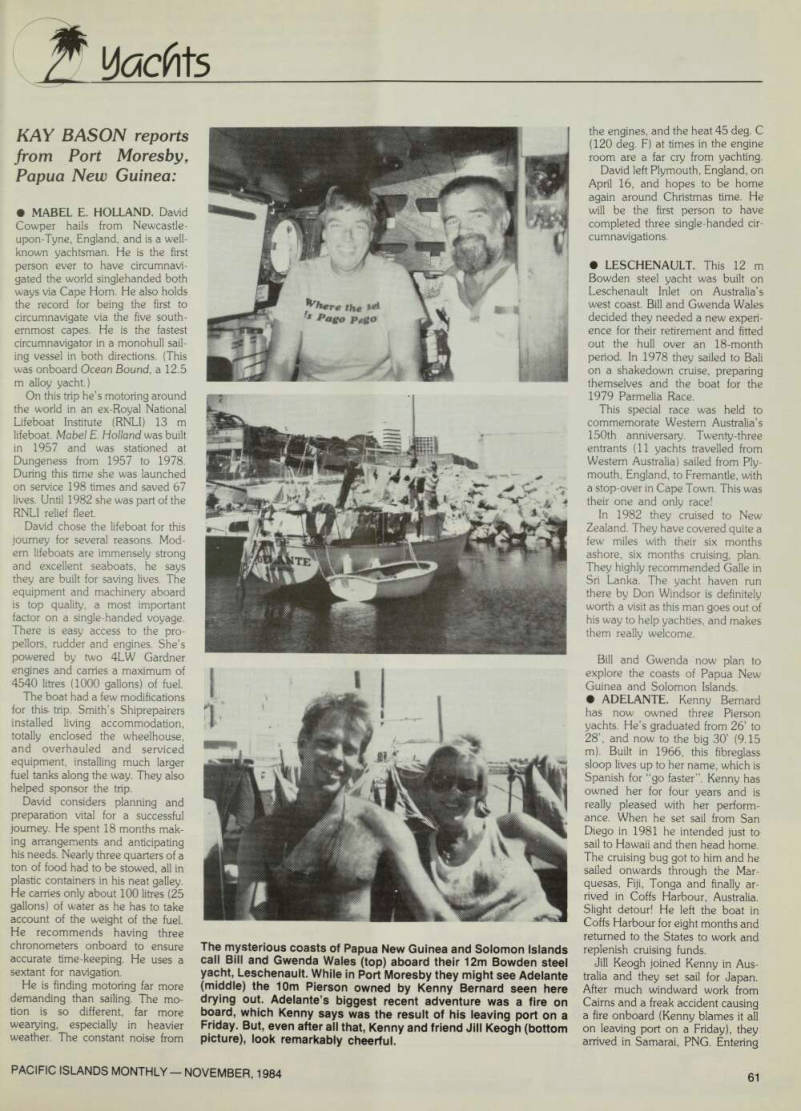
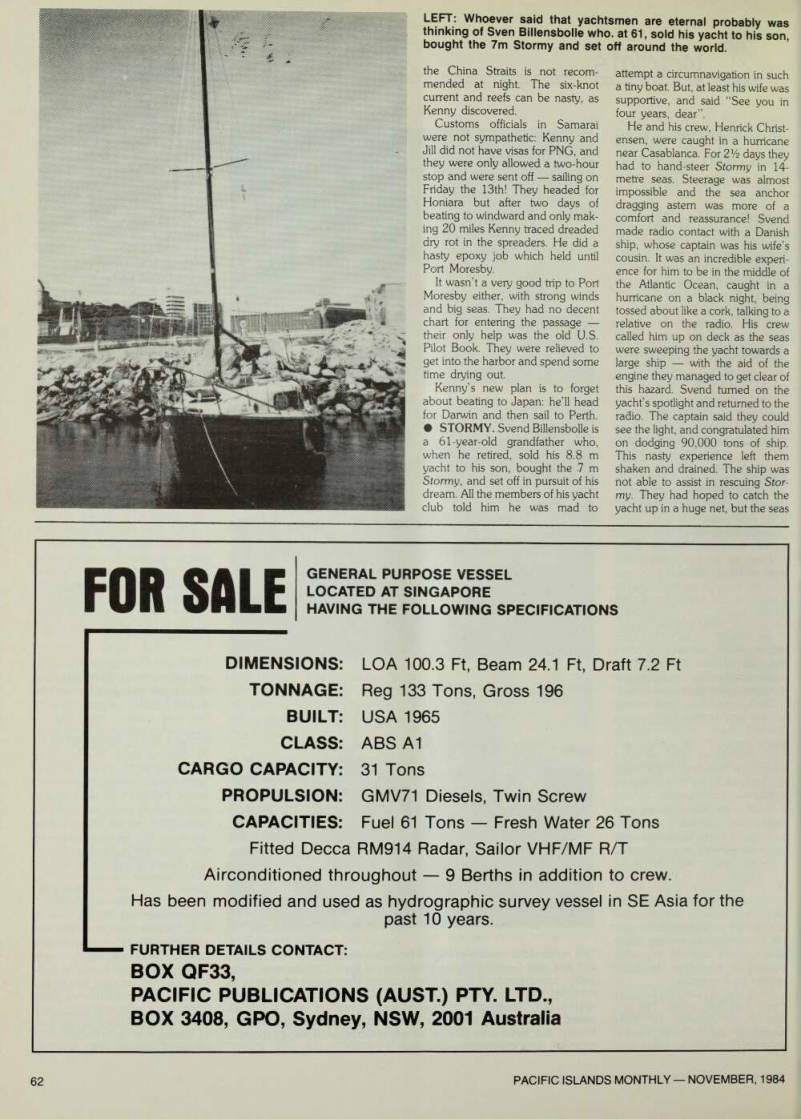
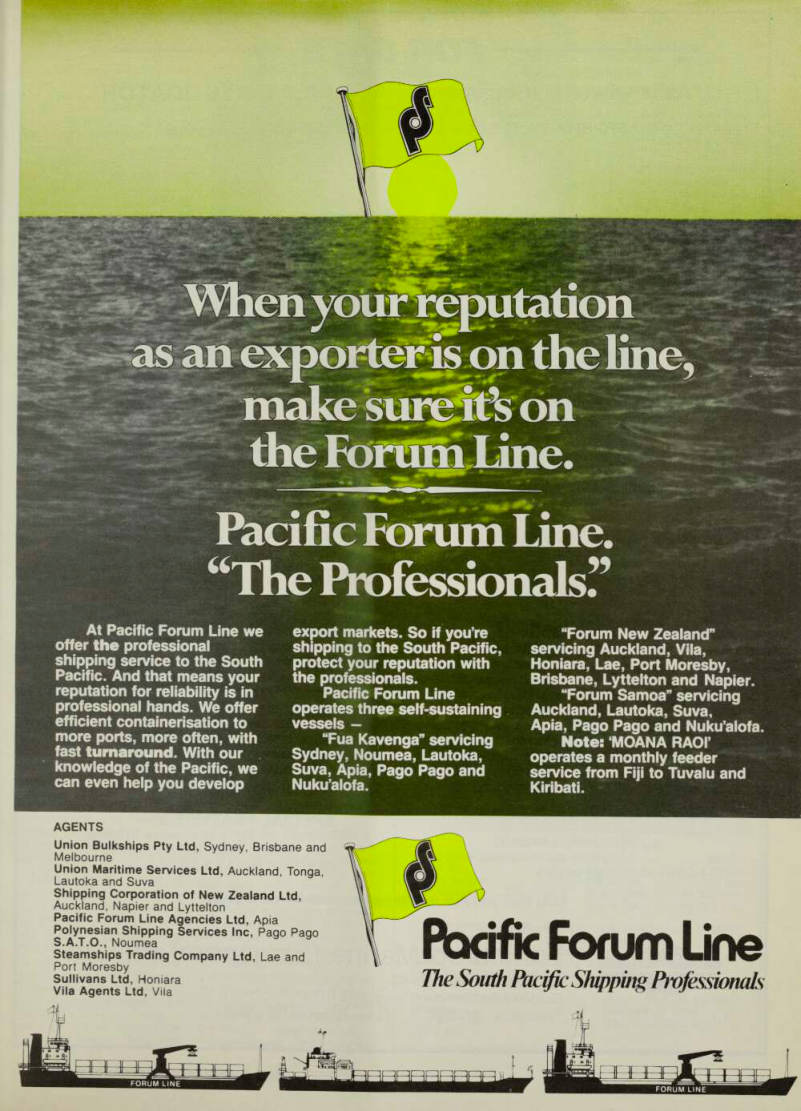
The mysterious coasts of Papua New Guinea and Solomon Islands call Bill and Gwenda Wales (top) aboard their 12m Bowden steel yacht, Leschenault. While in Port Moresby they might see Adelante (middle) the 10m Pierson owned by Kenny Bernard seen here drying out. Adelante’s biggest recent adventure was a fire on board, which Kenny says was the result of his leaving port on a Friday. But, even after all that, Kenny and friend Jill Keogh (bottom picture), look remarkably cheerful.
the China Straits is not recom mended at night. The six-knot current and reefs can be nasty, as Kenny discovered.
Customs officials in Samarai were not sympathetic: Kenny and Jill did not have visas for PNG, and they were only allowed a two-hour stop and were sent off sailing on Friday the 13th! They headed for Honiara but after two days of beating to windward and only mak ing 20 miles Kenny traced dreaded dry rot in the spreaders. He did a hasty epoxy job which held until
Port Moresby.
It wasn’t a very good trip to Port Moresby either, with strong winds and big seas. They had no decent chart for entering the passage their only help was the old U.S.
Pilot Book. They were relieved to get into the harbor and spend some time drying out.
Kenny’s new plan is to forget about beating to Japan: he’ll head for Darwin and then sail to Perth. • STORMY. Svend Billensbolle is a 61-year-old grandfather who, when he retired, sold his 8.8 m yacht to his son, bought the 7 m Stormy, and set off in pursuit of his dream. All the members of his yacht club told him he was mad to
attempt a circumnavigation in such a tiny boat. But, at least his wife was supportive, and said “See you in four years, dear”.
He and his crew, Henrick Christ ensen, were caught in a hurricane near Casablanca. For 2V£> days they had to hand-steer Stormy in 14metre seas. Steerage was almost impossible and the sea anchor dragging astern was more of a comfort and reassurance! Svend made radio contact with a Danish ship, whose captain was his wife’s cousin. It was an incredible experi ence for him to be in the middle of the Atlantic Ocean, caught in a hurricane on a black night, being tossed about like a cork, talking to a relative on the radio. His crew called him up on deck as the seas were sweeping the yacht towards a large ship with the aid of the engine they managed to get clear of this hazard. Svend turned on the yacht’s spotlight and returned to the radio. The captain said they could see the light, and congratulated him on dodging 90,000 tons of ship.
This nasty experience left them shaken and drained. The ship was not able to assist in rescuing Stor my. They had hoped to catch the yacht up in a huge net, but the seas
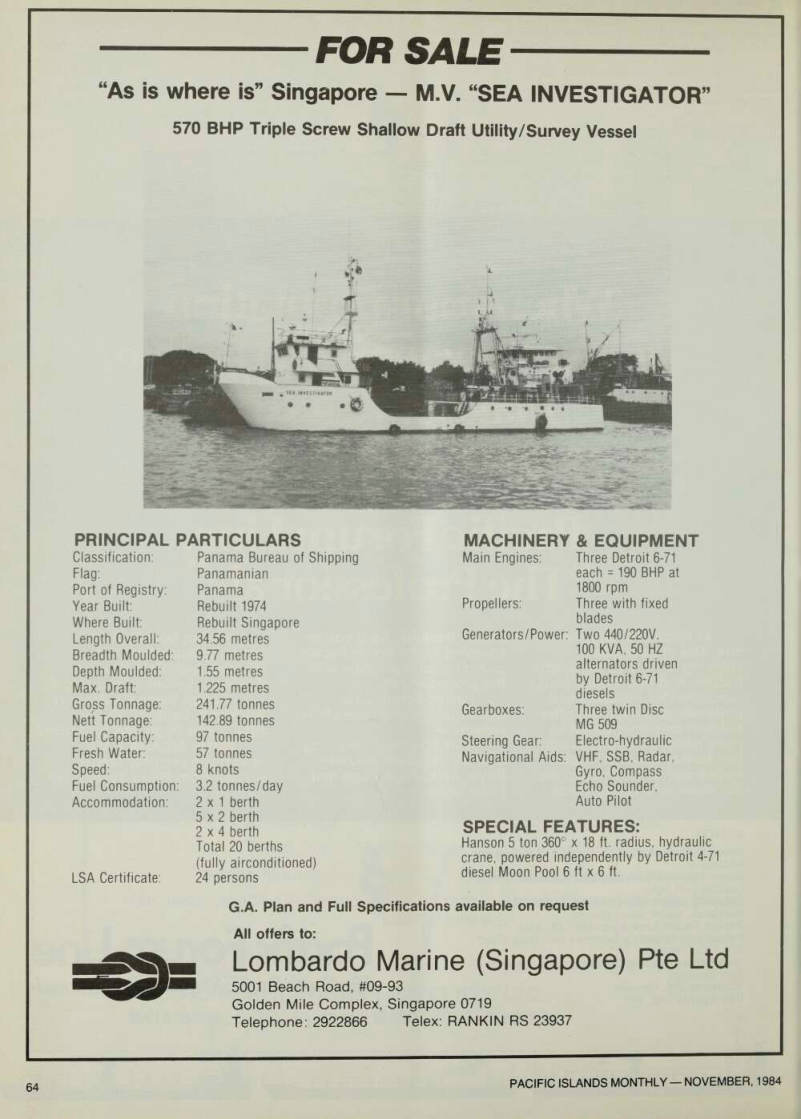
LEFT: Whoever said that yachtsmen are eternal probably was thinking of Sven Billensbolle who. at 61, sold his yacht to his son, bought the 7m Stormy and set off around the world.
were too big to attempt such a delicate manoeuvre.
Svend’s wife related in a letter that an hour later the same ship managed to rescue six Moroccan fisherman in a liferaft whose boat had gone down. In this dreadful weather Svend suffered a severe injury to his arm which took more than a year to heal. He and his crew arrived back in Casablanca in very poor health and suffering from shock. The crew gave up sailing from that day.
Svend considers he owes his life to his safety harness. He was apprehensive about setting sail again but friends assured him that he couldn’t possibly encounter such a terrible thing again. Two days out from Casablanca he was hit by another huge storm, which luckily pushed him southwards. He cruised in the West Indies and entered the spirit of racing in Antigua.
Little Stormy, the smallest yacht in her class, came home fourth out of 21 yachts. He’s rather proud of that.
In Grenada, Svend met his pre sent crew Winston, a student who couldn’t find work. Although Win ston had never done any sailing and still gets seasick, he’s strong and helpful, and is enjoying seeing the world.
From Grenada they sailed to Panama, but the next leg of the trip was frustrating. It took 65 days to reach the Marquesas, and they missed out on the Galapagos Is lands because there was no wind.
Svend can provision his small yacht with stores and water for 70 days, and he was relieved to arrive in Tahiti before he ran out of food.
Stormy sailed directly from West ern Samoa to Port Moresby, com pleting this passage in one month.
The winds were good, but his mainsail blew out and he had to improvise with a job up the mast.
Svend is looking forward to visit ing Australia and cruising the coast.
He has two more years travelling before returning home to his wife, five children, and two grandchil dren who have arrived since he’s been away.
He has much confidence in and love for his little yacht, hopes that he’s seen the worst of the weather and that the rest of his trip will be just “plain sailing”. • PUSTEBLUME. Built in Taiwan, this Uwe Bartels 12 m ketch is one of the finest yachts I’ve been onboard. Gunther and Heide Voigt designed the interior layout which uses the 3.8 m beam to full advantage. Gunther flew from Ger many to Taiwan several times dur ing the building to supervise and deliver European equipment. He considers this was a good move, as spare parts are easily obtained from Europe. The boat was finally fitted
out with her beautiful teak interior and shipped to Germany in a container.
After the yacht was launched in 1978, the Voigts spent six weeks working on technical repairs. The steering and gears had let them down badly on “splashdown” day.
In front of a large crowd of well wishers, the yacht steered the op posite to Gunther’s wishes.
Although he laughs about it now, it wasn’t funny at the time as there was a strong current running across a choppy sea.
A year later Gunther and Heide sailed to Bergen in Norway. This was a cold, hard trip and sea trials proved they had to do still more work on the boat. One thing they hadn’t expected was the leaks, not on a new boat!
In July 1979 they began the cruise they had planned when they had sailed a small 8.5 m yacht. A few months in the Mediterranean, a visit to the Canary Islands, West Indies and the Caribbean. From Grenada they sailed to Venezuela.
They were worried about pirates on the Colombian coast so kept well out to sea. They had heard stories that pirates seize yachts to use for drug running the pirates board at night, and yacht crews are never seen again.
Heading for the Galapagos Is lands, Pusteblume met up with another yacht returning from an Antarctic cruise. With help from their ham radios and sat. nav. systems the yachts rubbed fenders, on a calm night, while the crews had a feast to celebrate. Heide had caught a large fish that day and the visitors brought wine. They said it was quite an experience.
The sailing was great through to the Marquesas where they stayed for 10 days. It was too short a visit in their opinion. They still remem ber the huge, sweet grapefruit.
Pusteblume sat out the hurricane
season in Tahiti. They narrowly missed a hurricane which struck three days after their departure to the Tuamotu Islands. These islands enchanted them on their sail to Tahiti, and they returned for two glorious months. In the Cook Is lands they enjoyed trading for local pearls. Heide had an abundance of perfume samples, which she said were a terrific trading item.
They got a warm welcome in Western Samoa. The Voigts ap
plied for a permit in Suva to cruise the Lau group of islands. They said the 200-mile beat is worth the effort, as the islands are totally unspoilt.
Onwards they cruised through Vanuatu, Solomon Islands, Bris bane, to Coffs Harbour. This sea son they explored the Barrier Reef to Cairns and then headed for Samarai.
The Kula Ring is an old PNG traditional trading-sailing route through the Louisiade Archipelago.
This includes Budi Budi in the Laughlan Islands. Gunther re marked on the beauty of the islands and people in PNG. They were very impressed with the scenery, high mountains and low atolls, jungle, and hot springs such a variety of beauty. Not another yacht hove in sight in the seven week cruise. They thought it was wonderful.
From Port Moresby, Gunther and Heide plan to cross the Indian Ocean to Durban. They will sail north for the eastern edge of South America and return to Germany via the Caribbean, Azores, and Eng land.
Sadly, four years just wasn’t enough time, and they need more money. They believe that you need endless years to explore the South Pacific, and they certainly hope to return.
Gunther and Heide Voight have one of the finest yachts in the Pacific at the monent. A 12m Uwe Bartels design, it was built in Taiwan under Gunther’s close personal supervision.
• NINA. Zantmire built this 11.2 m aluminium yacht in Germany.
Built with a wider bow and stem, allowing more stowage, she’s a handicapped one ton cup candi date. Her gross weight is eight tonnes. A fast, safe yacht to cruise in.
Erik and Christina Jom, with the help of their four children, fitted out the hull themselves. After a shakedown cruise in Europe they felt confident to circumnavigate in Nina.
Eleven years ago Erik and Christ ina began a circumnavigation in Casiopeia, their 8.3 m yacht. Katar ina, their eldest daughter, was then only three. Unfortunately, they ran out of time. They sold Casiopeia in Noumea and had to return to work.
Christina is an architect and Erik a design engineer who was involved in the Airbus project.
Now, with their four children, Katarina, 13, Paul, 10, Joana, seven, and young Jacob, four, they are completing their dream. Christ ina regrets that there are no correspondence schools in Ger many. She buys the textbooks and conducts her own teaching pro gram which she admits makes a lot more work for her.
Erik and Christina agreed that travelling with four children can be difficult at times. When the weather
is bad and everybody is below the boat feels very crowded. If it’s fine, everybody is a lot happier. They hope it will be a good experience for their children.
Nina sailed from Vanuatu directly to Port Moresby. They had hoped to spend more time in PNG but time is running out if they are to be ahead of the cyclones. The Joms had planned to sail through the Red Sea, but the worry of the political situation in the area, and stray mines, are not appealing. They will now sail to Durban.
Don Travers Re
ports from Tubuai ,
Austral Islands ,
French Polynesia:
• INSATIABLE. A Duncason 11 m centre-cockpit ketch, registered in Sydney, arrived at Tubuai from Auckland after a 23-day voyage.
Insatiable is a fibreglass construc tion, built from a bare hull by her owner, Glenn Ferris. Cruising with Glenn were crew Lorraine Firth and Guy Holloway. All three are from- Sydney where the cruise began in December last year. The crew tho roughly enjoyed the Bastille Day celebrations which last through 10
days here in Tubuai during July.
Insatiable left for Raivavae and then Moorea, Tahiti, and other Society Islands.
Return to Australia is projected for the end of 1985. • PINOCCHIO. This is prototype of a 12.5 m sloop constructed in France in 1980 in wood, using the West system. The model is now in general production.
Pinocchio arrived at Tubuai from
Tahiti with Frederic Camilleri and Patricia Gambier, both of France.
They sailed from Raivavae where they will spend two years. Frederic is a male nurse who will be in charge of the infirmary on that island.
Their cruising began from Anti bes, France, and took them to the West Indies (via North Africa), Panama, Galapagos, Marquesas, Tuamotus and Tahiti.
The Jorn family of the yacht Nina, an 11.2 m alloy yacht from Germany, visiting PNG.
LEFT: Insatiable at anchor at Tubuai after her voyage from Auckland. ABOVE: Prototype of what is now a popular French design, Pinocchio, rests after her long voyage from Antibes.