people
p. 60 · Read in the full issue
Carl Edward Dillery, a career member of the US Foreign Service, has been appointed American Ambassador to Fiji (where he will reside), Tonga, Tuvalu and Kiribati. He suc ceeds Fred J. Eckert, who resigned to contest the con gressional seat in Rochester, New York. Mr Dillery has served in Japan, Belgium, Viet nam, Britain and Cyprus. His last position was as head of the US Office of United Nations Political Affairs.
Dr Dennis Osbourne, director of the British Grassland Re search Institute in England, has been named as a pro-vice chancellor of the University of the South Pacific to take over the management of the Alafua Campus in Western Samoa, which serves as the university’s school of agriculture. He will also serve as professor of agri culture. He will take up his new post in January.
What began as a six-week Tongan holiday has turned into 10 creative years in Tonga for Australian artist June Egan, known professionally as Sune.
Famous for her landscapes, portraits, and scenes of everyday Tongan life using ton go (traditional brown dye) on feta’aki (plain white tapa), Ms Egan began using these almost by accident.
After completing her Tongan holiday back in 1974, Ms Egan returned to her Sydney home, deeply impressed with what she had seen in the kingdom. A few months later she was back, well armed with canvas, brushes, and oil paints. All too soon the canvas was used up, and she turned to feta’aki as a substi tute.
“But the colors seemed too garish for tapa, so I decided to use only brown shades . . . traditional local coloring,” Ms Egan said. When her single tube of brown paint ran out, it seemed natural to substitute tongo.
“At first it was too watery,” she said, “but I kept on experi menting and found that by
letting the tongo dry out a little, it was perfect for the effects I wanted. ”
Soon Ms Egan’s tapa pain tings were being sold in Hawaii and exhibited in Tahiti. Along with the paintings came a series of note and holiday cards, printed on tapa, which are still widely sold both in the kingdom and abroad.
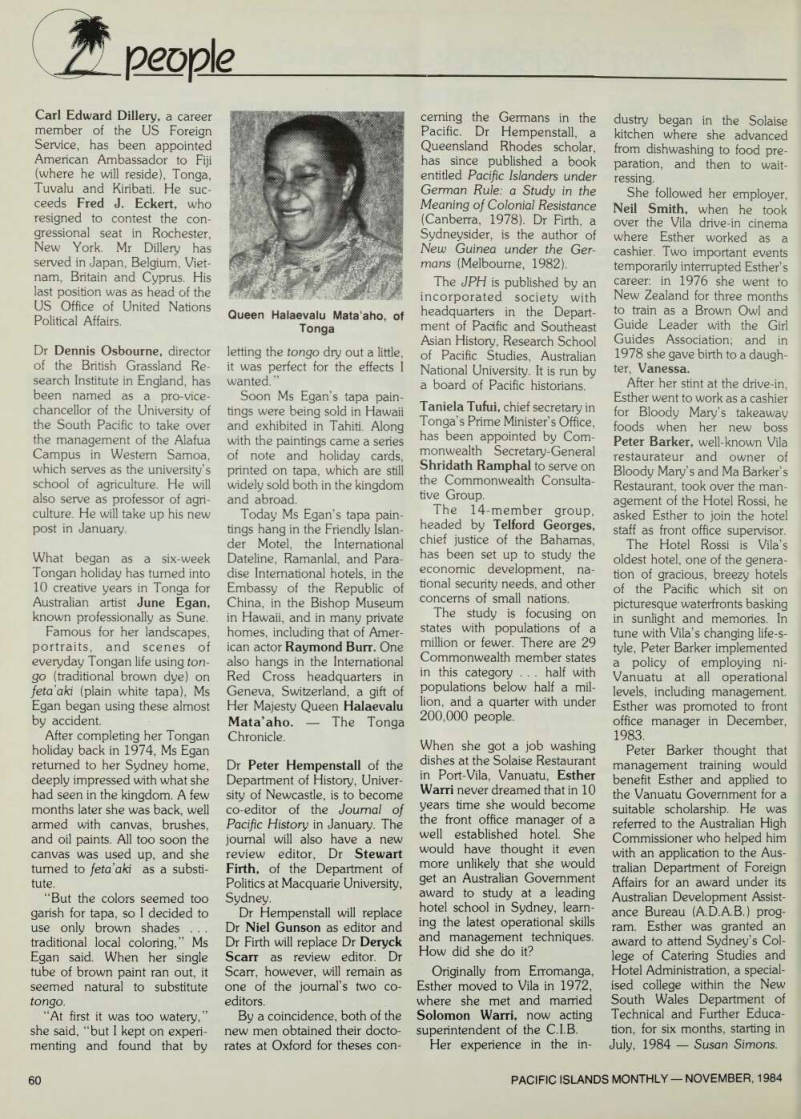
Today Ms Egan’s tapa pain tings hang in the Friendly Islan der Motel, the International Dateline, Ramanlal, and Para dise International hotels, in the Embassy of the Republic of China, in the Bishop Museum in Hawaii, and in many private homes, including that of Amer ican actor Raymond Burr. One also hangs in the International Red Cross headquarters in Geneva, Switzerland, a gift of Her Majesty Queen Halaevalu Mata’aho. The Tonga Chronicle.
Dr Peter Hempenstall of the Department of History, Univer sity of Newcastle, is to become co-editor of the Journal of Pacific History in January. The journal will also have a new review editor, Dr Stewart Firth, of the Department of Politics at Macquarie University, Sydney.
Dr Hempenstall will replace Dr Niel Gunson as editor and Dr Firth will replace Dr Deryck Scarr as review editor. Dr Scarr, however, will remain as one of the journal’s two co editors.
By a coincidence, both of the new men obtained their docto rates at Oxford for theses con
cerning the Germans in the Pacific. Dr Hempenstall, a Queensland Rhodes scholar, has since published a book entitled Pacific Islanders under German Rule: a Studi; in the Meaning of Colonial Resistance (Canberra, 1978). Dr Firth, a Sydneysider, is the author of New Guinea under the Ger mans (Melbourne, 1982).
The JPH is published by an incorporated society with headquarters in the Depart ment of Pacific and Southeast Asian History, Research School of Pacific Studies, Australian National University. It is run by a board of Pacific historians.
Taniela Tufui, chief secretary in Tonga’s Prime Minister’s Office, has been appointed by Com
monwealth Secretary-General
Shridath Ramphal to serve on the Commonwealth Consulta tive Group.
The 14-member group, headed by Telford Georges, chief justice of the Bahamas, has been set up to study the economic development, na tional security needs, and other concerns of small nations.
The study is focusing on states with populations of a million or fewer. There are 29 Commonwealth member states in this category . . . half with populations below half a mil lion, and a quarter with under 200,000 people.
When she got a job washing dishes at the Solaise Restaurant in Port-Vila, Vanuatu, Esther Warri never dreamed that in 10 years time she would become the front office manager of a well established hotel. She would have thought it even more unlikely that she would get an Australian Government award to study at a leading hotel school in Sydney, learn ing the latest operational skills and management techniques.
How did she do it?
Originally from Erromanga, Esther moved to Vila in 1972, where she met and married Solomon Warri, now acting superintendent of the C. 1.8.
Her experience in the in
dustry began in the Solaise kitchen where she advanced from dishwashing to food pre paration, and then to wait ressing.
She followed her employer, Neil Smith, when he took over the Vila drive-in cinema where Esther worked as a cashier. Two important events temporarily interrupted Esther’s career: in 1976 she went to New Zealand for three months to train as a Brown Owl and Guide Leader with the Girl Guides Association; and in 1978 she gave birth to a daugh ter, Vanessa.
After her stint at the drive-in, Esther went to work as a cashier for Bloody Mary’s takeaway foods when her new boss Peter Barker, well-known Vila restaurateur and owner of Bloody Mary’s and Ma Barker’s Restaurant, took over the man agement of the Hotel Rossi, he asked Esther to join the hotel staff as front office supervisor.
The Hotel Rossi is Vila’s oldest hotel, one of the genera tion of gracious, breezy hotels of the Pacific which sit on picturesque waterfronts basking in sunlight and memories. In tune with Vila’s changing life-s -tyle, Peter Barker implemented a policy of employing ni- Vanuatu at all operational levels, including management.
Esther was promoted to front office manager in December, 1983.
Peter Barker thought that management training would benefit Esther and applied to the Vanuatu Government for a suitable scholarship. He was referred to the Australian High Commissioner who helped him with an application to the Aus tralian Department of Foreign Affairs for an award under its Australian Development Assist ance Bureau (A.DAB.) prog ram. Esther was granted an award to attend Sydney’s Col lege of Catering Studies and Hotel Administration, a special ised college within the New South Wales Department of Technical and Further Educa tion, for six months, starting in July, 1984 Susan Simons.
Queen Halaevalu Mata’aho, of Tonga