A specialist book,
pp. 45-46 · Read in the full issue
Inter-Island Ships: Hawaii
A specialist book, and a delight for all
Schooner from Windward Two Centuries of Hawaiian Interisland Shipping. By Mifflin Thomas. Published by Uniuersity of Hawaii Press, 1983. 239 pp. ISBN O 8248 0799 5.
I was as surprised as Mifflin Thomas to discover that while five books have been written about Hawaiian railroads, few have considered Hawaiian shipping. One thinks only, perhaps, of Kinau Wilder’s Wilders of Waikiki (1978) and Thomas’s earlier Hawaiian Interisland Vessels and Hawaiian Registered Vessels (1982).
Schooner from Windward will fill a great gap in the record of Hawaiiana.
That the Hawaiian language did not contain words for “trade” or “trader” reveals that pre-European inter-island shipping had a character wholly different from that which followed the building of the Beretone in 1791, the first haoletype keel ever laid in Hawaiian waters.
Each island had been selfsufficient, and inter-island sailing had been for pleasure or war. Thomas mentions only two exceptions which may have formed the basis for an inter-
island trade”: basalt for adzes could be found only on Hawaii and Maui, and the islands of Kahoolawe and Niihau re quired timber beyond their own resources. HawaKans continued to voyage between the islands in outrigger canoes of a pre haole type right up to 1856.
Throughout the first four dec ades of the 19th century inter island shipping remained firmly in the hands of the ali’i, or chiefs. It was a trade based largely on sandalwood and the provisioning of haole ships.
Hawaiian inter-island ship ping did not fully come under the influence of haole mariners until 1900-01, when an out break of bubonic plague caused the death of many “native” sailors The story of inter-island ship ping conveniently falls into three overlapping eras. An age of schooner and sail runs from Kamehameha I, who began to take an interest in inter-island shipping around 1817, through to the loss of the Moi Wahine off Palaau, Molokai on February 24, 1911, when she was struck by the U.S. lighthouse tender Kukui and sank.
The first steamer to ply Hawaiian waters appears to
have been the 530-ton Con stitution which arrived off Hon olulu on January 24, 1852.
One hundred years later, in May 1952, a major engineroom breakdown on the Humuula brought the days of the steam ers to an end.
The years since 1950 have seen a succession of tugs, barges, container ships and jet foils, which goes on; but at least for passengers, the race has really passed to inter-island air services.
Behind an impressive stream of nautical facts and statistics, Mifflin Thomas has kept an eye out for those stories of hazard and courage, humor and skul duggery, which must finally captivate even the most casual reader.
In the 1860 s, Isabella Bird described her cabin on one of the schooners, the Jenny; “A mere den, with a table and a berth on each side, in one of which I lay down, and the other was alternately occupied by the captain and his son. The heat and suffo cation were nearly intolerable, the black flies swarming, the mos quitoes countless and vicious, and the fleas agile beyond anything, and the cockroaches gigantic.
Some of the finer cargo was in the cabin, and large rats, only too visible by the light of the swinging lamp, were assailing it, and more than once, producing a stampede among the cockroaches ...”
John Cameron was mate on the hualani about 20 years later and wrote of the hazards of discharging and loading cargo: “On some voyages we found it impossible to land at our designated
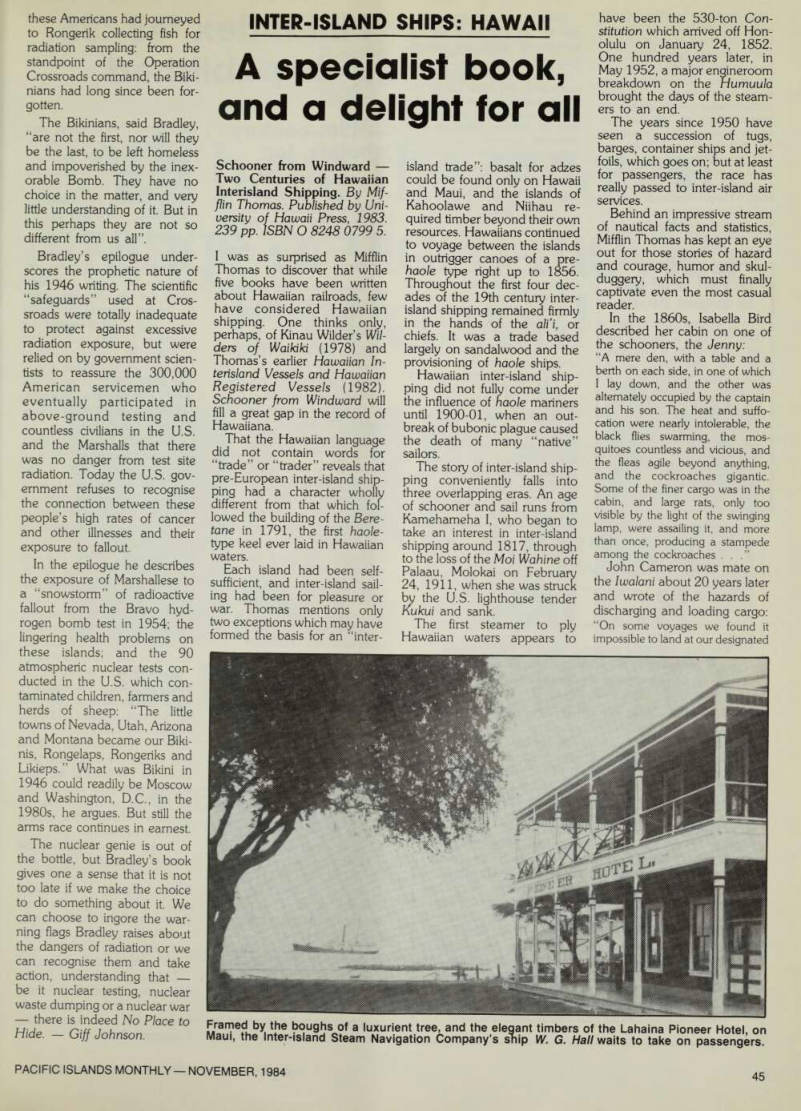
Framed by the boughs of a luxurient tree, and the elegant timbers of the Lahaina Pioneer Hotel, on Maui, the Inter-island Steam Navigation Company’s ship W. G. Hall waits to take on passengers.
ports, especially on Niihau during winter months, when I have seen heavy seas roll in from the far North, perhaps from Alaska, and break in eight fathoms or forty-eight feet of water. This may not mean much to landsmen, or to those seamen who speak glibly and irresponsibly of hundred-foot waves; however, I assure the reader that those breakers of Niihau were truly gigantic. At such times all we could do was send a boat as close as possible to land and then dis patch a Hawaiian sailor through the surf with a message in a bottle tied around his neck, to arrange a call at a leeward port.”
Volney Howard went steer age on the Humuula and re membered taking on passen gers at Lahaina: “The launch came back with new passengers. The crew formed line down the ladder to hand the passengers up as they were shuttled from the bobbing launch at each opportune moment. Nine laughing elderly women came up the ladder, so jolly and full of good spirit that I began to think they might have been tippling a bit. But they were well mannered and lady-like in their laughter and I concluded that they were enjoying themselves without the need of accelerators. They came in billowing holokus, gay bandanas and lauhala hats, with ukuleles, guitars, leather gourds and mats. They spread their mats in a row and seated themselves facing the shore ... As the ship got under way and slid along the shoreline, the women took up their ukuleles and guitars and began to sing. That music was the most beautiful I had ever heard.”
Within 20 years she had been cut down to a barge in Miami.
Schooner from Windward is that happiest of books; a volume for the specialist, which will delight all those who stray
into it.
D. S. Long.