us) there’s “no place to hide”
pp. 43-45 · Read in the full issue
books
For Bikinians (and the rest of us) there’s “no place to hide”
No Place to Hide 1946-1984.
By Dauid Bradley. Published by and available from Univer sity Press of New England, Hanover, N.H., U.S.A., 03755.
No ISBN, price, provided.
First published in 1948, No Place to Hide is an extraordi narily perceptive account by David Bradley of the early days of nuclear testing at Bikini Atoll, of the young American men who experienced the crystal clear lagoons, the reef fish, and the radiation first-hand, of the political forces behind the tes ting, and of the Marshallese and the Marshall Islands in 1946.
The book was reprinted in
1983 with an epilogue by the author, a medical doctor who worked as a radiation safety officer during “Operation Cross roads”. Then, as now, his book was a sobering early warning of the dangers of nuc lear weapons.
It is remarkable that the book was even written in view of the shroud of secrecy surrounding the first post-war nuclear testing series. At an early briefing on security, Bradley recounts: “The naval equivalent of a Trial Judge Advocate read us the riot act on security, backing it up with selections from the Federal Espionage Act. Before he got
through it began to look as though Bikini would be but a brief stop on the way to Leavenworth (prison).”
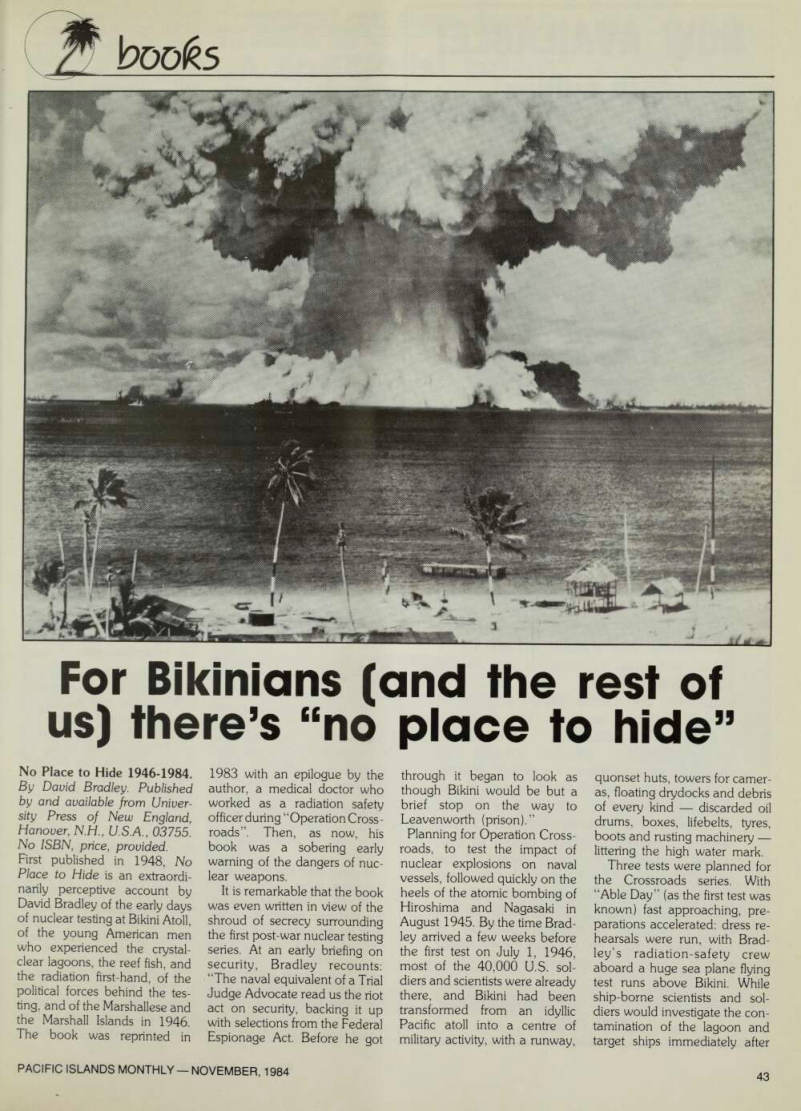
Planning for Operation Crossroads, to test the impact of nuclear explosions on naval vessels, followed quickly on the heels of the atomic bombing of Hiroshima and Nagasaki in August 1945. By the time Bradley arrived a few weeks before the first test on July 1, 1946, most of the 40,000 U.S. soldiers and scientists were already there, and Bikini had been transformed from an idyllic Pacific atoll into a centre of military activity, with a runway,
quonset huts, towers for camer as, floating drydocks and debris of every kind discarded oil drums, boxes, lifebelts, tyres, boots and rusting machinery littering the high water mark, Three tests were planned for the Crossroads series. With “Able Day” (as the first test was known) fast approaching, pre parations accelerated; dress re hearsals were run, with Brad ley’s radiation-safety crew aboard a huge sea plane flying test runs above Bikini. While ship-borne scientists and sol diers would investigate the con tamination of the lagoon and target ships immediately after
the shot, Bradley’s crew was to fly through the nuclear cloud over Bikini and measure radi tion levels.
Standing at “ground zero” minutes after a nuclear explo sion is an unappealing task, particularly in light of what is known today about the dangers of radiation. Nevertheless, that was their job at Crossroads, and while Bradley and his rad-safe team appear to have taken numerous precautions, the au thor makes it only too clear that nobody really knew how much radiation they were getting.
The first bomb was dropped from an aircraft which had been practising bombing runs over Bikini for weeks. About the size of the Hiroshima bomb, Able was detonated in the air over the target fleet of old American, German and Japanese ships and submarines. Within mi nutes of the blast, as the mushroom cloud rose tens of thousands of feet high and was sheared apart by winds, Brad ley’s plane began its first run over Bikini. After three traverses at varying altitudes with no register of radiation, they decided against using their gas masks. Then, as they approached the centre of the target area again, the Geiger counter started to hop on the scale, beeping frantically.
Suddenly radiation levels were a hundred times stronger.
Should we pull out, asked the pilot nervously? “No,” came the reply. “It’s not too bad yet.
You could stick around here for several days if you had to.”
For 12 hours Bradley’s crew continued their patrol over Biki ni. The same procedure was followed after the second shot, an underwater test. The “Bak er” cloud, however, did not rise nearly as high, and the millions of tons of ocean water, coral, sand and radiation began to settle back over the ships and the atoll.
A week after the Baker test, the target ships in the lagoon were still so intensely radioac tive that men could remain on deck for a maximum of just 20 minutes to an hour. Yet Navy men in continuously alternating shifts spent hours hosing and scrubbing down the decks of the ships in an unsuccessful attempt to rid them of radiation.
These men were repeatedly
exposed as they worked, only to find that “fission products, having fallen like a coat of paint over these ships, cannot be washed off by salt water and suds . . . The magic formula of a ‘clean sweep down fore and aft’ is out of date in the atomic age,” noted Bradley.
What’s more, in the haste to make scientific observations im mediately following the Baker test, many safety precuations were thrown out the window, despite the fact that Bikini was so heavily contaminated that the Navy was forced to cancel the third test. Paradoxically, he notes that more safety precau tions were taken a month and a half after the Baker test than within the first 10 days when radiation was at its peak. Such precautions against radiation exposure only allowing men on board ship for a few minutes at a time, with heavy protective gear and gas masks would have delayed or prevented the hurried activity needed to carry out the experiments. It is little wonder that today many of these servicemen have con tracted rare forms of cancer and other diseases.
Bradley constantly describes the difficulties in obtaining reli able information about radia tion exposures and their pos sible effects thoroughly undermining the U.S. govern ment’s current contention that servicemen received “no radia tion of significance”.
The struggle of the Bikinians to survive in exile is well known in the Pacific. But Bradley re cords an intensely personal en counter with the Bikini people on Rongerik Atoll about six months after their first displace ment. By this time, the Biki nians were subsisting on fish alone, as the meagre supply of coconuts and breadfruit on Rongerik had been exhausted.
After meeting the Bikinians, the captain of Bradley’s ship pro vided them with some flour, sugar, cigarettes and fish hooks, which were greeted with much enthusiasm and numerous gifts of handicrafts for the Amer icans.
But the incident illustrates in a brief, dramatic way, how close to starvation the Bikinians had come in so short a time.
And it was quite by chance that
these Americans had journeyed to Rongerik collecting fish for radiation sampling: from the standpoint of the Operation Crossroads command, the Biki nians had long since been for gotten.
The Bikinians, said Bradley, “are not the first, nor will they be the last, to be left homeless and impoverished by the inex orable Bomb. They have no choice in the matter, and very little understanding of it. But in this perhaps they are not so different from us all”.
Bradley’s epilogue under scores the prophetic nature of his 1946 writing. The scientific “safeguards” used at Cros sroads were totally inadequate to protect against excessive radiation exposure, but were relied on by government scien tists to reassure the 300,000 American servicemen who eventually participated in above-ground testing and countless civilians in the U.S. and the Marshalls that there was no danger from test site radiation. Today the U.S. gov ernment refuses to recognise the connection between these people’s high rates of cancer and other illnesses and their exposure to fallout.
In the epilogue he describes the exposure of Marshallese to a “snowstorm” of radioactive fallout from the Bravo hyd rogen bomb test in 1954; the lingering health problems on these islands; and the 90 atmospheric nuclear tests con ducted in the U.S. which con taminated children, farmers and herds of sheep: “The little towns of Nevada, Utah, Arizona and Montana became our Biki nis, Rongelaps, Rongeriks and Likieps.” What was Bikini in 1946 could readily be Moscow and Washington, D.C., in the 1980s, he argues. But still the arms race continues in earnest.
The nuclear genie is out of the bottle, but Bradley’s book gives one a sense that it is not too late if we make the choice to do something about it. We can choose to ingore the war ning flags Bradley raises about the dangers of radiation or we can recognise them and take action, understanding that — be it nuclear testing, nuclear waste dumping or a nuclear war — there is indeed No Place to
Hide.
Giff Johnson.