if cool reason can word
pp. 12-17 · Read in the full issue

Race Relations In N.Z.
In a world over-populated with pressure groups, multitudes of militants, and power-hungry politi cians, New Zealand’s race relations conciliator, Hiwi Tauroa, is a breath of fresh air and sanity. He has what many people consider to be a no-win job. He deals with issues which are often of great sensitivity, even in a country as small, and as generally reasonable, as New Zealand. His powers are considerable, but his belief is that more can be achieved by informal talking than by the wielding of a big stick.
Hiwi does not go about calling shovels fancy names and consequently gets himself into the headlines more often than he would like. His recent suggestion that the sports boycott against South Africa might be doing more damage than good upset militant anti-racist groups, most of whom had far less experience than he of the grassroots problems of race relations.
“A lot of these pressure groups are really after publicity for themselves,” Hiwi said. “They like to make a lot of noise so they feel big and important.
But very often all they do is polarise the opposition and drive them into a corner from where they would rather fight than be reasonable.”
New Zealand’s racial problems are older than some, and smal ler than some, but they are at the core of the country’s development away from being an outpost of Eng land and towards becoming a truly Pacific sort of nation.
Auckland is already the largest Polynesian city on earth. The arrival of the islanders, together with migrants from Europe and Asia, has complicated the older matter of Maori versus pakeha.
The Maori has been more dis advantaged than supported by the arrival of migrants of similar ethnic background. He might have gone up a rung on the social ladder, but he has been squeezed out sideways into deeper unemployment. Much the same sort of thing hap pened in New York where the indigenous negro found his jobs taken by the immigrant Puerto Rican. In New York the prob lem led to the riots now down in history as the “Long Hot Sum mers.” Violepce between the races is not unknown in New Zealand, but it is far from widespread. People talk out their problems, and they do so, in very large measure, because of the patience, and the influ ence, of big, avuncular, reason able and stalwartly determined Hiwi Tauroa.
He is a Maori who believes very much in Maori methods; in the values of the marae, the traditional meeting ground, where people come together to discuss their problems and en joy the company of family and friends.
“One day we might get pake ha maraes ... wouldn’t be a bad thing. It would mean they would talk together instead of trying to score off one another. I would like to see the whole of
parliament go on to the marae ... forget their politics for two days and learn about one an other,” said Hiwi. “I think it would produce a better coun try. If everyone did it, we might get a better world.”
PIM: In the time you have been Race Relations Con ciliator and Human Rights Commissioner, have things really improved?
HIWI: Attitudes have im proved a tremendous amount.
But they still have to go on improving, and if we congratu late ourselves too much, things will just sit still again. We have a long way to go yet. Big changes have occurred in a lot of institu tions and organisations in the country, but it has taken a long
time to achieve them, and we have a lot yet to do.
The change in attitudes is an overall change. The pakeha people are starting to realise that we are a little country down here and that we have different sorts of people now, and all of us must get along together.
There is, recognisably, greater sensitivity among people, and more understanding. But it’s only just starting.
PIM: The Maoris have to protect their culture and yet get along in a country which is essentially Western and fairly well developed. How do they manage? Do they have to make concessions? Are they losing out?
HIWI: Originally we had the
good old colonial idea of assimilating people. They felt that if they could make the Maoris into nice brown Eng lishmen it could only do them good. The result of that was a determination to destroy everything Maori, or, if not destroy it, ignore it. That is really what set the Maori people back so much. Now there has been a reversal, and a revival of our cultural identity. Maori peo ple are trying to persuade others that there are many aspects of Maoridom which could be very useful and very helpful to all people. So we now have pakeha people going on to the maraes learning about Maoridom and a tremendous number of pakehas learning the Maori language.
PIM: So you are getting somewhere?
HIWI: I am quite sure we are.
There is not only the grassroots interest, but there is an aware ness among the top people in government and in the com munity.
We have to persuade people that we are all New Zealanders, that when you talk about the Maori language you are not talking about a foreign tongue, but about a New Zealand lan guage. Maori people are New Zealanders and Maori words are New Zealand words. That’s the thing we have difficulty persuading our majority culture to accept, although many of them are really going for it now.
Understanding the language adds to the understanding gen erally.
PIM; What do you think of Maori parliamentary seats? Are they necessary or should they be abolished in favor of a general roll?
HIWI: I think they are very necessary right now. Everyone
says they were the product of the philosophical love by the pakeha people for Maoridom. It wasn’t. The seats came about because of the evangelical movement in England where they had just taken part in an effort to abolish slavery in America. So the people in England required of the people here proof that they were doing the right thing for the Maoris and making sure there was no slavery. That’s really why they established the Maori seats.
I am now busily involved in arguing against having the seats, saying that Maoridom should be on general seats but, over a period of time, say about 10 years.
But, in those 10 years there are things that the pakeha peo ple must accept, and one of them is that we are mono cultural; that Maoridom is part of New Zealand, and they must get to know about other New Zealanders.
Ultimately we should have a parliament with just general seats, and in those seats, all sorts of people - Maoris, Sa moans, Tongans, Europeans.
My argument is that with the four Maori seats we have a parliament in which only four people are concerned with Maoridom, and there are 91 who couldn’t care less. Now, if they all required the Maori vote for their survival everyone would jolly soon learn about Maoridom.
But, historically, the Maoris needed the special seats. If they had not had them, then Maori dom would have disappeared far more rapidly. Now it is resurgent. But for Maoridom to come all the way back you have to get attitudes changed, among Maoris as well as pakehas.
“If everyone in Parliament needed the Maori vote to survive, they’d jolly soon learn about ■ dom ..
With general seats represen ting all New Zealanders you will find people with political aspira tions going on to a marae to ask for the Maori vote. And the first
thing they will have to do is learn a bit of Maori, which will help with the understanding all round.
But you can’t do it all straight away. We are talking about changing the attitudes of both Maori and pakeha and then go to a general roll, so that everyone who is standing for the House has to learn a bit about everyone in the country.
As things are we have four people who know about Maori dom, and perhaps four people who know a bit, and all the rest who don’t need to know any thing to achieve their political survival.
PIM: In that process would you not also change Maoridom?
HIWI: Maoridom is changing now. Some are social changes.
We now have to be more businesslike on the maraes be cause the people don’t have enough money to feed everyone who wants to come, as they could in the old days.
They cannot afford to spend a week at a hui just enjoying it.
Other changes are deeper.
Take the unemployment situation among Maoris. The criterion for work is basically an examination pass. A lot of our Maori leaders have been telling us for years, and they arc still telling us, that Maoris cannot pass exams. If you keep telling people they are going to fail, then they will, regardless of their intelligence. But our peo ple still tell themselves they cannot pass exams and they now use it as a kind of excuse.
But, given the proper en vironment, and the right en couragement it does not take long for a former failure to start succeeding.
PIM: How much of that atti tude comes from the old lead ers trying to hang on to their culture and their position within that culture?
HIWI; That’s part of it. They fear they will lose influence over the young. They don’t realise that young people need to flap their wings a bit, but that doesn’t break the bond they have with their Maoridom, pro vided they have been given the proper foundation. If they have a foundation in their culture they will always come back to it.
But the main problem is the examination. If you don’t pass the exam, you don’t get a job.
Many of our young people cannot see the relationship be
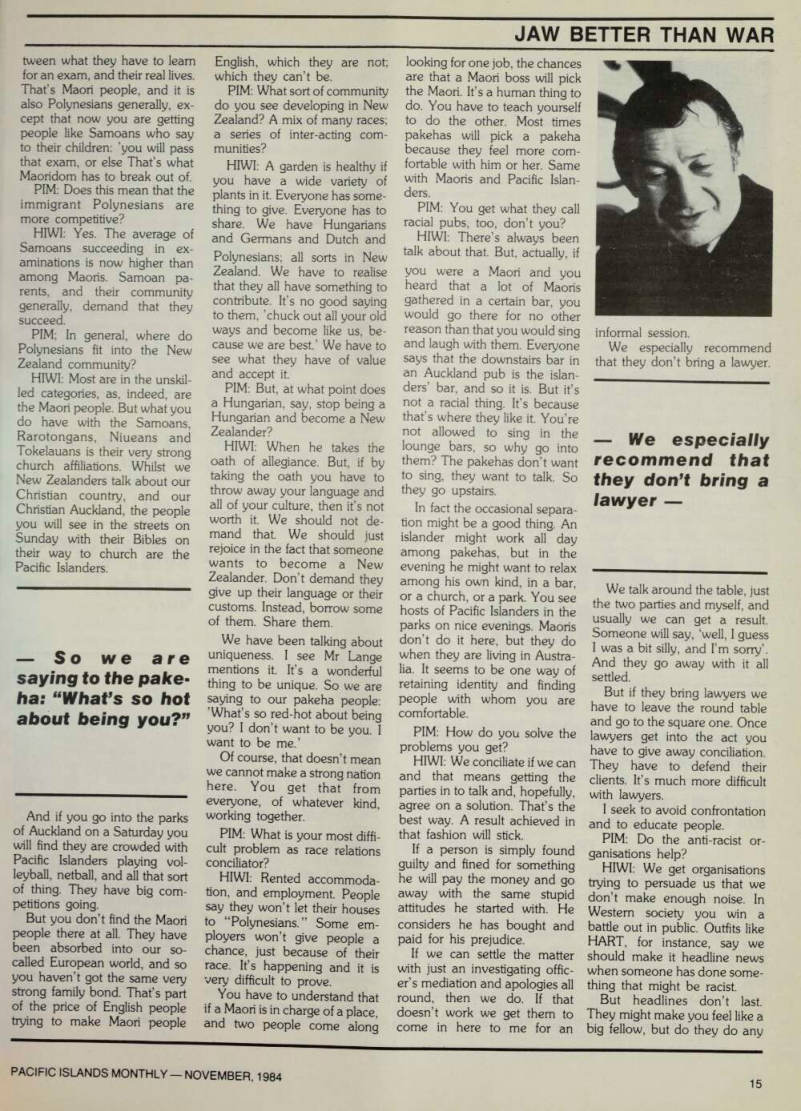
Edward Te Rangihiwinui Tauroa, known throughout the land as Hiwi, seen here in a cartoon from the Auckland Star has the patience of Job, and a determined, calm reasonableness in an area of human affairs known for its difficulty and sensitivity.
tween what they have to leam for an exam, and their real lives.
That’s Maori people, and it is also Polynesians generally, ex cept that now you are getting people like Samoans who say to their children: ’you will pass that exam, or else That’s what Maoridom has to break out of.
PIM: Does this mean that the immigrant Polynesians are more competitive?
HIWI: Yes. The average of Samoans succeeding in ex aminations is now higher than among Maoris. Samoan pa rents, and their community generally, demand that they succeed.
PIM; In general, where do Polynesians fit into the New Zealand community?
HIWI: Most are in the unskil led categories, as, indeed, are the Maori people. But what you do have with the Samoans, Rarotongans, Niueans and Tokelauans is their very strong church affiliations. Whilst we New Zealanders talk about our Christian country, and our Christian Auckland, the people you will see in the streets on Sunday with their Bibles on their way to church are the Pacific Islanders.
So we are saying to the pake ha; “ What’s so hot about being you?”
And if you go into the parks of Auckland on a Saturday you will find they are crowded with Pacific Islanders playing vol leyball, netball, and all that sort of thing. They have big com petitions going.
But you don’t find the Maori people there at all. They have been absorbed into our so called European world, and so you haven’t got the same very strong family bond. That’s part of the price of English people trying to make Maori people
English, which they are not; which they can’t be.
PIM; What sort of community do you see developing in New Zealand? A mix of many races; a series of inter-acting com munities?
HIWI; A garden is healthy if you have a wide variety of plants in it. Everyone has some thing to give. Everyone has to share. We have Hungarians and Germans and Dutch and Polynesians; all sorts in New Zealand. We have to realise that they all have something to contribute. It’s no good saying to them, ’chuck out all your old ways and become like us, be cause we are best.’ We have to see what they have of value and accept it.
PIM; But, at what point does a Hungarian, say, stop being a Hungarian and become a New Zealander?
HIWI: When he takes the oath of allegiance. But, if by taking the oath you have to throw away your language and all of your culture, then it’s not worth it. We should not de mand that. We should just rejoice in the fact that someone wants to become a New Zealander. Don’t demand they give up their language or their customs. Instead, borrow some of them. Share them.
We have been talking about uniqueness. I see Mr Lange mentions it. It’s a wonderful thing to be unique. So we are saying to our pakeha people: ’What’s so red-hot about being you? I don’t want to be you. I want to be me.’
Of course, that doesn’t mean we cannot make a strong nation here. You get that from everyone, of whatever kind, working together.
PIM: What is your most diffi cult problem as race relations conciliator?
HIWI: Rented accommoda tion, and employment. People say they won’t let their houses to “Polynesians.” Some em ployers won’t give people a chance, just because of their race. It’s happening and it is very difficult to prove.
You have to understand that if a Maori is in charge of a place, and two people come along
looking for one job, the chances are that a Maori boss will pick the Maori. It’s a human thing to do. You have to teach yourself to do the other. Most times pakehas will pick a pakeha because they feel more com fortable with him or her. Same with Maoris and Pacific Islan ders.
PIM: You get what they call racial pubs, too, don’t you?
HIWI: There’s always been talk about that. But, actually, if you were a Maori and you heard that a lot of Maoris gathered in a certain bar, you would go there for no other reason than that you would sing and laugh with them. Everyone says that the downstairs bar in an Auckland pub is the islan ders’ bar, and so it is. But it’s not a racial thing. It’s because that’s where they like it. You’re not allowed to sing in the lounge bars, so why go into them? The pakehas don’t want to sing, they want to talk. So they go upstairs.
In fact the occasional separa tion might be a good thing. An islander might work all day among pakehas, but in the evening he might want to relax among his own kind, in a bar, or a church, or a park. You see hosts of Pacific Islanders in the parks on nice evenings. Maoris don’t do it here, but they do when they are living in Austra lia. It seems to be one way of retaining identity and finding people with whom you are comfortable.
PIM; How do you solve the problems you get?
HIWI: We conciliate if we can and that means getting the parties in to talk and, hopefully, agree on a solution. That’s the best way. A result achieved in that fashion will stick.
If a person is simply found guilty and fined for something he will pay the money and go away with the same stupid attitudes he started with. He considers he has bought and paid for his prejudice.
If we can settle the matter with just an investigating offic er’s mediation and apologies all round, then we do. If that doesn’t work we get them to come in here to me for an
informal session.
We especially recommend that they don’t bring a lawyer.
IVe especially recommend that they don’t bring a lawyer
We talk around the table, just the two parties and myself, and usually we can get a result.
Someone will say, ‘well, I guess I was a bit silly, and I’m sorry’.
And they go away with it all settled.
But if they bring lawyers we have to leave the round table and go to the square one. Once lawyers get into the act you have to give away conciliation.
They have to defend their clients. It’s much more difficult
with lawyers.
I seek to avoid confrontation and to educate people.
PIM: Do the anti-racist or ganisations help?
HIWI: We get organisations trying to persuade us that we don’t make enough noise. In Western society you win a battle out in public. Outfits like HART, for instance, say we should make it headline news when someone has done some thing that might be racist.
But headlines don’t last.
They might make you feel like a big fellow, but do they do any
lasting good?
PIM: How healthy are the grassroots race relations in New Zealand?
HIWI: We have one of the healthiest atmospheres in the world, without doubt. You know, I heard about the wonderful things done for the American Indian, and then I went there. Goodness me, if we have some educated, intelligent Maoris coming back praising what is happening to the In dians in America, something has gone wrong with what they saw. And when we talk about Australia you couldn’t even begin to compare Maoridom with the aboriginals. I don’t think you can relate the two.
But some people are trying.
PIM: You get yourself into hot water from time to time.
The All Blacks’ proposed 1985 South African rugby tour for instance?
IVe are trying to teach the whole of our society that each is responsi ble to his neighbor
HIWI; Oh yes. They’re all seeking publicity. They want me to run down all sorts of rugby leaders and tell them where they get off. But I find that if you run people down they get their backs up and won’t change. What we really seek is change. You want bad things not to be repeated be
cause the person who commit ted them realises they were bad.
It’s like coaching rugby.
There’s not much point in blas ting a player who makes a mistake. If there is one person on the field who knows who made the mistake, it’s the bloke who made it. He feels responsi ble.
We are trying to teach the whole of our society that each is responsible to his neighbor.
That’s the ethic the pakeha came over here preaching out of the Good Book love thy neighbor as thyself but, by Jove, I think some of it has fallen flat.
But there are changes. Many pakeha people now support Maoridom.
PIM; Does the Maori have the same ethic?
HIWI: Yes. But it is more practised in Maoridom. In fact it gets the Maori into trouble. In a European society you are not supposed to love a criminal.
But these so-called criminals in the Maori community the blokes who have been involved in punch-ups or some petty theft -are promptly invited on to the maraes and into the homes. So society tends to dismiss them all as a bunch of criminals. But it happens be cause they are showing concern for one of their friends in trouble.
The same happens among the Pacific Islanders. It is an expression of familyness, which is a very valuable thing when you have little work, and very little money. It’s familyness that holds you together.
PIM; Returning to the South African question: Do you think your view is prevailing?
HIWI: I am not sure what my view is. When 1 came back from South Africa I think we had a wonderful opportunity to do something for the blacks there.
New Zealand should have sim ply said to the South African government: ’You prove that you are going to change the laws and then, a year from now, we will play you.’
But we lost that opportunity.
I can understand how we gave it away because by then we had
various groups saying to New Zealanders: Tf you do not do so-and-so, we will do some thing else.’ And what New Zealanders respond to best is a threat. It doesn’t matter from whom. You threaten us, and watch out.
So, by the time we got back from that visit our anti-South African organisations had de livered some ultimatums to the community, and a lot of backs were up. We lost a wonderful opportunity simply because of the confrontation and the vio lence over the Springbok tour of New Zealand , but none of it actually affected any black in South Africa. They may not even have heard of it.
But what it did do was show the average New Zealander that the people could get worked up and that we weren’t necessarily the staid, stable lot we all thought we were. We had fami lies fighting one another. But it was a lesson and I think it helped race relations in the country. It showed us the dan ger. But I don’t think it changed one single thing in South Africa.
If the purpose of all this protest is to effect change in South Africa, then let us do something really towards that end.
That’s really why I don’t wholly agree with the closing of the consulate in Wellington. I don’t see how that is going to affect black people in Johan nesburg, or anywhere else.
It might ease our conscience to be able to say to other nations: ’look what we have done.’ But what we ought to be doing is things that are going to effect change for the 23 million blacks in South Africa, not drive the South African government further into the corner from where all they can do is fight.
So, when it comes to the proposed 1985 All Black tour of South Africa, perhaps we should think about that angle.
I was at a conference of psychiatrists the other day; very eminent people. Among them was a colored doctor of psychiatry from South Africa who spoke of the changes which have been occurring in the South Africa. His main
point was that he considered the sporting boycott probably would not work. He said that as a psychiatrist he knew that the way to change a person’s view was to communicate with him; give him knowledge, but do not reject him. Emotionally, he said, he felt that if the boycott were kept up long enough, one day it had to work. But intellec tually he did not think it would.
That’s saying to us, push the boycott for all you’re worth, but it’s probably not going to work.
Now, to me,that’s poor reason ing.
I know that in our office we are achieving change because we are going out, and getting people together, not separating them or threatening them.
If I thought that by us not going to South Africa it would create change for the blacks, I would agree with the ban. But I am not sure ...
PIM; Do you agree that racial tensions arise because of fear?
H1WI: Yes. The South Afri can attitude towards blacks is based on fear. Equally, the pakeha attitude towards the marae is based on fear, and the Maori attitude to the pakeha board meeting is based on fear ... fear of the unknown. So the only way to get anywhere is to remove the unknown and clear away the fear.
So I am still not sure about the South African tour. If I thought that by us not going it would create change for the blacks I would agree with the ban. But I am not sure.
And, after listening to this doctor of psychiatry, and know ing that Scotland is going, and England is going, and Wales have been, and France is going
... that isn’t a boycott. That is a whole lot of national teams going, except New Zealand.
And where does that fit into a boycott?
The other objection I have is that the boycott seems to affect only sport. We are told to have a sports boycott, but to keep up the trade because that affects money. We’re a bunch of hypocrites in some of the things we do and say.
I am very undecided about this tour and I have not come out for or against it. So far as rugby is concerned we seem to be a boycott of one. New Zealand is a small country and can be greatly affected by small groups. But the big countries are linking up again, the beg gars, which means that the boycott is finished.
If we are going to have change, let’s be very sure it is for the benefit of the black people, and not just aimed at satisfying our own little consci ences. That’s pointless.
PIM: Will you stay on as conciliator?
HIWI: No. I will finish this term; I have another two years to go. Then someone else can have a go.
PIM: And then what?
HIWI: I don’t know. Being a high school principal was good.
This has been good. Challen ging. But I don’t think I will go back to teaching and I don’t like the idea of board rooms.
There have been tremendous changes in New Zealand in the last few years.
Things here can be good, if we don’t muck them up.
We have now got pressure groups - much-publicised like the National Workers’
Association who have lately come out with some very strong pamphlets demanding that the Pacific Islanders be sent home because they are taking jobs here.
That group just had to do that. Three years ago they were doing it in Wellington. There
were complaints. I called in the complainants, one of whom was a member of parliament, and told them that it was a small group trying to grow big through publicity. I asked them to keep quiet and let us keep an eye on the group, but we won’t give them any publicity by making speeches about them.
The noise died down. That was three years ago. They ran a candidate in the election, and I think he got a total of 23 votes.
We held them.
Now they’re distributing pamphlets again and the media is giving them the publicity they seek. So, because they have the eye of the media we will have to answer them, and the islanders will become in creasingly nervous and a situa tion will have been created where, in fact, nothing much of real consequence was happen ing.
One of the realities of the Polynesian situation, which in cludes Maoridom, is that they
feel they cannot match the English verbally. So they take them on physically with their fists, because the islanders get frustrated and angry. That makes a police situation, which is what this group would like, because it supports their claims.
If we could get everyone on to the maraes. If we could get everyone talking instead of fir ing at each other then we would get somewhere.