Refundable deposits:
p. 10 · Read in the full issue
Recycling Drink Cans
Refundable deposits: Adelaide’s experience
David North’s proposal for the recycling of drink cans (PIM Aug) is most welcome. Most Pacific Island communities have readily adopted the practice of buying drink and food sealed in
“convenience packaging”, but few have taken steps to solve the resulting litter problem.
The amount of litter to be seen in some island towns is now at a disgusting level.
David North’s article pro vides one solution — to encour age people to make profitable businesses out of collecting and returning drink cans.
I suggest that both the manu facturers and purchasers have major parts to play too. In South Australia (as in Oregon and some other U.S. states) the system of adding a refundable deposit to the retail price of each beer and soft drink can and bottle has had a remark able success in reducing litter.
For a large city, Adelaide is now amazingly clean, and drink container litter is rarely to be seen. Over 85 per cent of beer bottles are returned for washing and refilling, and the proportion of drink cans returned for re processing has risen from less than 10 per cent in 1975 to over 60 per cent in 1982.
Non-refillable throw-away bot tles are now illegal, and the return rate of soft drink bottles is in excess of 90 per cent.
Depots for receiving empty cans have been established throughout the state. Soft drinks are usually returned to the place of purchase for the refund, and beer bottles are usually returned via the gar bage collection system.
This arrangement works well, despite the earlier fears and protests of manufacturers who said that sales would fall and that employees would be laid off.
Transportation costs im mediately spring to mind as an obstacle to introducing such a system to Pacific islands. But of course it is a consideration in a big state like South Australia too. Flattened drink cans are light and compact and can be carried on return journeys at low cost. But such a system will only work if both consumers and manufacturers play their part.
(Dr) Christopher Nance
Senior Project Officer Department of Environment and Planning Adelaide, S.A.
Australia
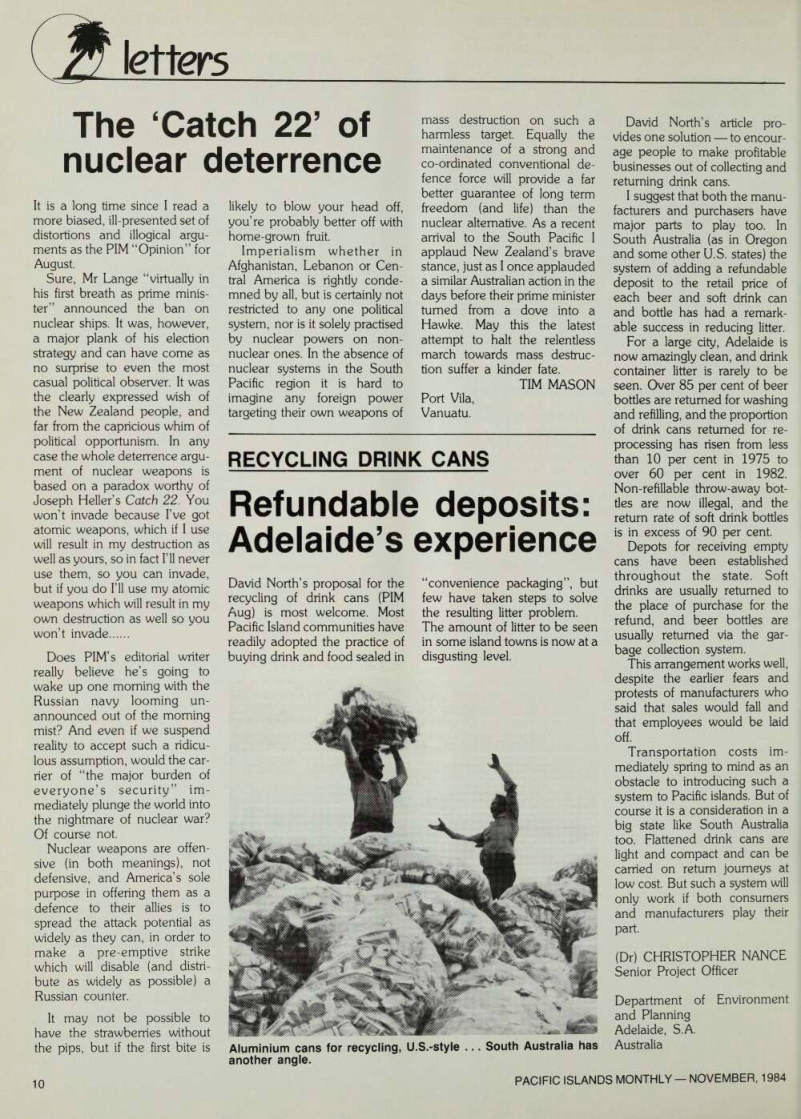
Aluminium cans for recycling, U.S.-style . . . South Australia has another angle.