arts of Oceania
pp. 45-46 · Read in the full issue
Looking in on the arts of Oceania
Art and Artists of Oceania: A Review. Edited by Sidney M. Mead and Bernie Kernot Published 1983 by The Dunmore Press Ltd.. P.O.
Box 5115. Palmerston North.
New Zealand. ISBN 0 908564 85 6, Ethno graphic Arts Publications. 1040 Erica Road. Mill Valley. Calijor ni a. 949 4 1 ISBM 0 9611006 0 5. Price (be fore devaluation) $NZ29.95. 1 have before me a photograph of a room in a house. The room is that of the French poet Guillaume Apollinaire in Paris, and the photograph was taken in the early years of this cen tury. In many ways it is the sort of room expected of a poet. It shows both austerity and plen ty. A hard wooden chair and plain table are surrounded by trappings of luxury heavy
drapes at the window, pictures on the walls and statuettes carefully placed. It reflects French civilisation at its peak.
Yet something does not fit. It is necessary to look again at the photograph. Gradually one be comes aware of artifacts from Africa or the South Pacific.
Though distributed among the general clutter they seem to have a life of their own. Their very difference makes them stand out. To the Western world this marked an important point in the development of modern art. It is necessary to go no further than Les Demoiselles dAvignon, a canvas completed (rather than finished) by Picas so in 1907: European art was about to be re-invigorated from outside.
In a sense this book repre sents a movement in the oppo site direction. It represents the
outcome of the Second In ternational Symposium on the Arts of Oceania convened at Victoria University of Welling ton. New Zealand, in 1978. The task, as perceived by the chair person Sidney Mead, was to consider the component parts, in their inter-relationships, of the “total art situation.” This is no light task and the density of perceptions in the book reflects this. There are 18 articles, or papers, presented here.
Though collected together in three sections, the divisions are really for convenience. The richness of material almost de fies categorisation. For the re viewer it is perhaps best to follow the pattern laid down.
The first, or general, section of the book considers stand points from which the art and artists of Oceania can be both approached and appreciated.
The first two writers, Sidney Mead and Philip Dark, consider “art as doing.” To achieve this the making of objects by indi viduals is cited, examples being drawn from Santa Ana in the Solomons and Kilenge in West New Britain. It makes fascinat ing reading. A slight quibble is to ask how far the carvers observed represent the full artist in their individual societies.
In examining the role of women in art. Jehanne Teilhet leads us towards the complexity of Oceanic society. A theme which recurs throughout the book is first presented by this writer. Woman is to be seen as creator and destroyer, as life and death, even as good and evil. It obviously affects the type of art work which they under take. A new and. I think, vital dimension is added by Jean Guiart’s study of the changing Western attitudes to Oceanic art. It might be argued that this takes us away from the theme.
It does, but increases awareness as one returns to the issue of the symposium. In a search for theoretical models to link life and art in the Pacific, Nelson Graburn continues, to some extent, to explore the wider dimension. As he says, the
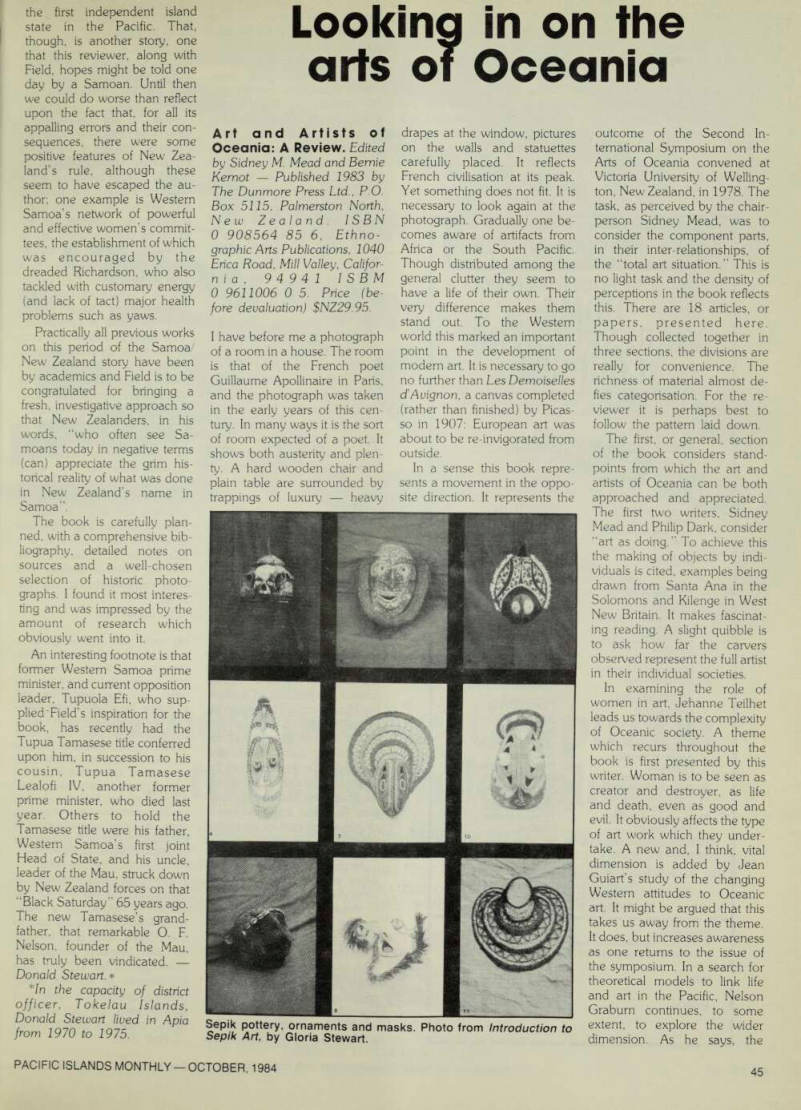
Sepik pottery, ornaments and masks. Photo from Introduction to Sepik Art, by Gloria Stewart.
LUUIISL LU WCeCU HCI LU 1111 U the “simple truth” and the “moral other” as exemplified by the peoples living there. The need of the Westerner is to help himself, not to help others. The section ends on an open note with Katarina Mataira attemp ting to see the art from within and without, in terms of negative and positive influ ences.
Melanesia and Micronesia
cue ueau wun logeiner in one section. The emphasis now be comes one of deepening under standing by presenting the fin dings of detailed field study, somewhat after the style of Codrington. Deborah Waite examines the making and use of war shields ornamented with shell inlay in the Solomon Is lands. Shields feature again in the article by Dirk Smidt, which examines Middle Ramu art in
rapua iNew Uuinea. Ihe com munity houses (bai) in the Palauan Islands of Microniesia are described by David Robin son in considerable detail.
Throughout one gains more than a description. Referring to the making of Kominimung shields Smidt observes that the carvers accepted their chil dren's immediacy even when a child went so far as to sit on the shield his father was working on. The other two articles in the section are special unto them selves. De’Ath concerns himself with a pottery clay dispute in the Trans-Gogol of Papua New Guinea. At first sight the inci dent may seem to have little direct relationship to art. In fact it contributes much towards the total art situation. The last (though first in the book) ex plores. through a person, Bagou, in West New Britain, the development and variety of clan designs. An unusual level of insight results. Where faces are painted they are often refer red to in natural terms what they resemble. An example, presented by Ann Chowning, is that of “the testicles of the butterfly”.
The final section of the book, slightly longer than the other two. is more diverse. It serves to remind us of the span of the region as well as of its variety.
The title given to it is Polynesia.
Three of the articles are con cerned in some way with Maori carving in New Zealand. Bernie Kernot and Roger Neich both indicate the conflict between the old and the new. Kernot follows the building of a Meet ing House in the Horowhenua- Rangitikei district. The builders split into two groups. The tra ditionalists want food and women to be prohibited in the unfinished house. The others felt that it would delay comple tion. At a later stage the needs of genealogy had to be recon ciled with Christianity.
Neich studies the effect of white patronage on Maori art around the turn of the century.
It would seem here, as with tourism, that roles are changed about. Maori craftsmen seek innovation, while their patrons wish to imitate museum pieces.
Allan Hanson’s article, though specifically relating to Maori art, is similar to that of Graburn in the first section of the book. He is interested in the relationship
between art form and society.
Symmetry, though not always exact, is seen to replicate social organisation male and female, union and separation, and so on. My only doubt is to how far this is particular to the Maori.
Many of the voices so far have been of those looking into Oceania. To mix a metaphor somewhat. Albert Wendt is doubly a writer looking out. He seeks to correct the passivity and lack of self-respect intro duced by the papalagi. His is a study of contemporary art in Oceania. Judith Huntsman examines the social aspects of food preparation in the Tokelau Islands. Finally a lost cult, using post images, is brought to light by Roger Rose in Hawaii.
As suggested earlier the form of the book dictates, to some extent, the way in which a reviewer might approach it. The offerings are so rich and varied that each demands mention.
The presentation and use of photographs is excellent. As in the Tokelaus. one has the right to ask what are the social implications of the feast. Feeling replete is not enough. The intention laid down by Sidney Mead at the very beginning was to look at art in Oceania in a total sense. To achieve this he saw the roles of analyser and artist complementing one an other.
To quote him: My main plea was to gather a maximum of evidence before plun ging into the domain of interpreta tion. I asked also that we take the artists into our confidence and exchange information more freely with them, that we develop a sense of problem so as to bring more excitement into studies of Oceanic art. that we raise our standards of observation, interpretation and re porting. that we entice more Pacific Islanders into our field of study, that we find alternative ways of training them, and that we co-operate in defining new problems and seeking solutions to them. (P. 24.) How far this intention is realised in the book is for the reader to decide. In a wider sense I wonder what the gain to the Oceanic artist is. Is he able to take Western artifacts to re-invigorate his culture from the outside, or are we simply putting Apollinaire’s masks and figures back into an ethnog raphic museum, albeit living?
Bob Wild.