Bumblers, yes - but were they
pp. 43-45 · Read in the full issue
books
New Zealand In Samoa
Bumblers, yes - but were they fools or knaves?
Mau: Samoa’s Struggle Against New Zealand Oppres sion. By Michael J. Field. Pub lished by A. H. & A. W. Reed Ltd., Wellington. 1984. XVIII, 262. 15BN 0 589 014927. $A19.95.
On Saturday, December 28, 1929, a small contingent of New Zealand police, jittery and feeling threatened, armed with revolvers, rifles and a single Lewis machine gun, opened fire without warning on a much larger, yet unarmed and peace ful, group of Samoan demon strators on Beach Road, Apia.
The gunfire killed 11 Samoans and wounded 30. One New Zealand policeman died from injuries received at the hands of the Samoan survivors.
Among those killed was the leader of the demonstrators, Tupua Tamasese Lealofi 111, a Samoan chief who had only recently returned to Samoa after serving a prison sentence in New Zealand for the crime of leading a seditious organisation.
The story of that organisation is the subject of a new and meticulously researched book titled Mau and subtitled, some what emotively, “Samoa’s struggle against New Zealand oppression” by New Zealand journalist, and former govern ment press officer in Western Samoa, Michael J. Field.
The events of “Black Satur day” as it came to be known were the lowest in a series of lows which marked the first 25 years of New Zealand adminis tration of its mandate. The stage for the Samoans’ disillu sionment with their New Zea land rulers was set as early as 1918 when the appalling con sequences of official negligence resulted in an influenza
epidemic in which one in every five Samoans died. This dis aster could have been pre vented by simple ship quaran tine measures, such as were adopted in neighboring Amer ican Samoa, where not a single case of influenza was recorded.
The point was not lost on the Samoans who, in Field’s words, from then on regarded New Zealanders as “bumblers and people not fit to run somebody else’s nation”.
The ensuing 20 years, as described elsewhere by another writer on Samoa, Mary Boyd, were “a tragedy of good inten tions”. This is a view obviously not shared by Field, who re gards New Zealand’s actions in Western Samoa at the time as evil in themselves, springing from the “deeply racist attitude
of a colonial power”. In seeing history from this viewpoint Field claims to have been influenced by former Western Samoan prime minister Tupuola Efi, for whom Field worked as press officer, and who, in a speech to the United Nations General Assembly, said: “When Samoa talks about colonialism and rep ression, whether they be in Africa, in the South Pacific, in Asia or elsewhere, it is not just rhetoric. Rather, Samoa’s opposition to colonialism is fun damental because of its own experience.” That Tupuola should have made such a com ment to the world is a natural legacy of New Zealand’s far from inspirational administra tion of his country: the Tupua Tamasese Lealofi 111, jailed and then gunned down by New
Zealanders in 1929, was his uncle; the legendary Olaf Frederick Nelson, founder of the Mau, deported twice from Samoa and jailed in New Zea land for his activities, was his grandfather.
Whatever motives are attri buted to New Zealand’s ac tions, there is no dispute that its administration, at best, was totally inept. To the jailing of Tamasese and the subsequent slaying of him and his suppor ters, the influenza epidemic and the deporting twice of the enigmatic Nelson, can be added the formal banning of the Mau, the hunting down, arrest and imprisonment of its adherents (including the use of a machine-gun equipped sea plane), the banishment of Sa moan matais from their villages
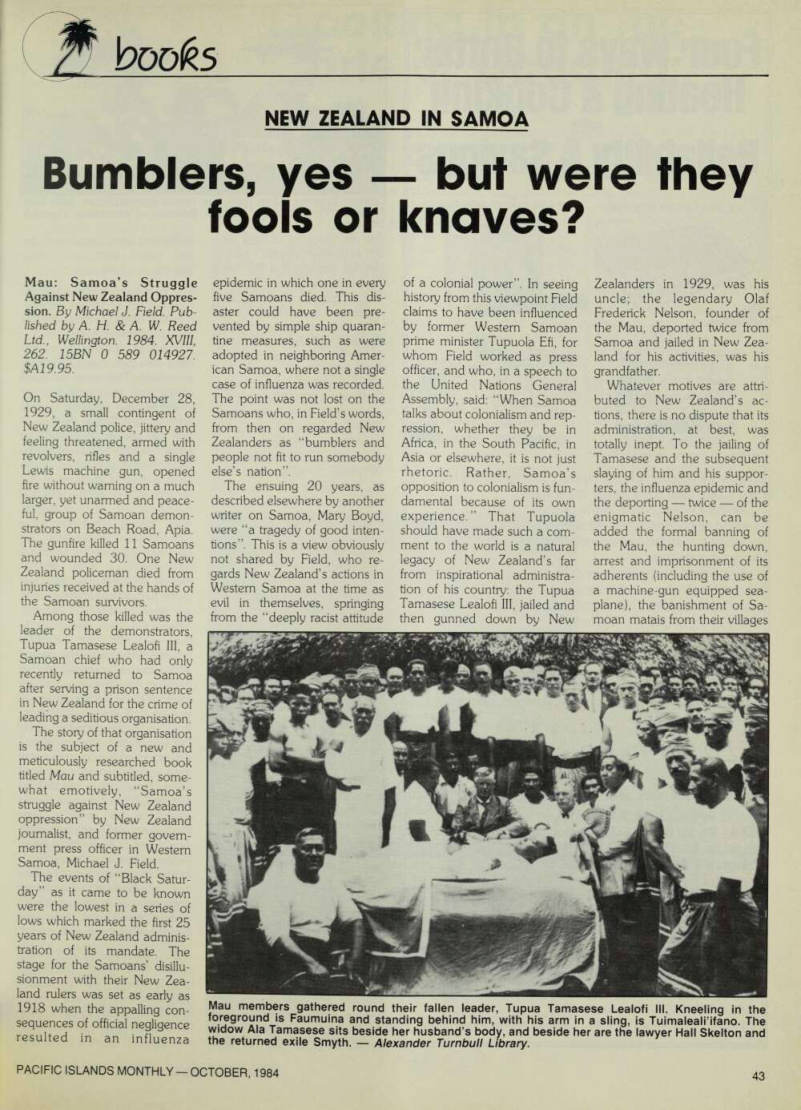
Mau members gathered round their fallen leader, Tupua Tamasese Lealofi III. Kneeling in the foreground is Faumuina and standing behind him, with his arm in a sling, is Tuimaleali'ifano. The widow Ala Tamasese sits beside her husband’s body, and beside her are the lawyer Hall Skelton and the returned exile Smyth. - Alexander Turnbull Library.
and the stripping of their titles by executive decree, heavy handed intimidation by naval gunboats, the clumsy handling of the Chinese indentured labor question, and blind-eye-tur ning. and whitewashing by New Zealand officials and even Royal Commissions, to men tion some.
Fundamental to all these problems was an inability on the part of New Zealand official dom. particularly its men on the spot, to understand the nature of Samoan society and thought.
Of particular significance was the insistence of successive administrators on dealing with Samoans only through an offi cially appointed Fono a Faipule (council of chiefs) and to regard all representations from other sources, especially if the influ ence of afakasis (half-castes), such as Nelson, was detected, as not only unrepresentative of Samoan thought, but criminal and seditious. This was New Zealand’s big mistake, leading directly to the tragedy of “Black Saturday".
Whether New Zealand was prompted by out and out rac ism and the regarding of Sa moans as an inferior people, as claimed by Field, is at least debatable. Other writers, not ably Boyd and the late Profes sor J. W. Davidson, saw it differently. Having largely fore gone its 19th-century aspira tions towards a Pacific colonial empire, but having found itself in control of Western Samoa first by military expedition mounted for reasons of genuine security concern, and later by League of Nations mandate.
New Zealand came to the realisation that Western Samoa was of little direct economic or strategic significance. Western Samoa was largely unknown or forgotten by the New Zealand public, and so far as Kiwi
politicians were concerned, the less heard from and about Samoa the better.
This allowed ample scope for a succession of upright, narrow minded military administrators to run Samoa with virtually unchecked powers in accord ance with their own ideas, right or wrong. That most of these ideas were disastrous in their effect on the Samoan people and on New Zealand’s reputa tion is not in dispute. The book’s failure however, in the opinion of this reviewer, lies in its imputing of motives of the utmost evil to all the principal NZ characters. All New Zealan ders, saving those few who sympathised with the Mau, are regarded by Field as the “de vil’s disciples”, while all Sa moans, save the misguided few in the pay of the administration, are seen as Gabriel’s legions.
That some New Zealand offi cials. including even the hard headed Richardson, the second administrator (who spoke fluent Samoan, incidentally, a fact not mentioned by Field) might have had at least some good inten tions, is not conceded at all by the author; nor is the possibility that some of the Samoans and their supporters might not at all times have been guided by altruism. It has been suggested elsewhere, for example, that the brilliant and wealthy Nelson would have been more than happy to see himself official ly and by choice a representa tive of Samoa’s European population —• as prime minister of Samoa and was manoeuv ring the Mau towards that end.
But. the path to hell being paved with good intentions, that is where New Zealand's misguided rule led. Just prior to World War 11. and its aftermath, the situation changed markedly with Western Samoa becoming
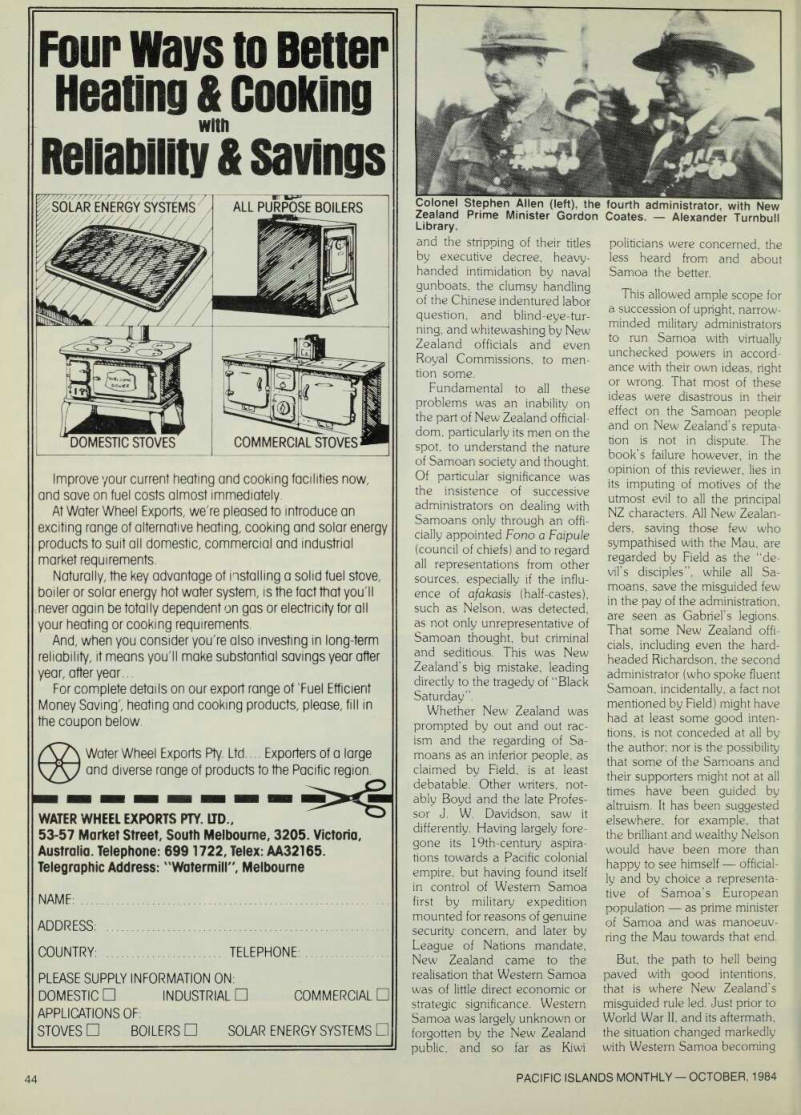
Colonel Stephen Allen (left), the fourth administrator, with New Zealand Prime Minister Gordon Coates. - Alexander Turnbull Library.
the first independent island state in the Pacific. That, though, is another story, one that this reviewer, along with Field, hopes might be told one day by a Samoan. Until then we could do worse than reflect upon the fact that, for all its appalling errors and their con sequences, there were some positive features of New Zea land's rule, although these seem to have escaped the au thor: one example is Western Samoa’s network of powerful and effective women’s commit tees, the establishment of which was encouraged by the dreaded Richardson, who also tackled with customary energy (and lack of tact) major health problems such as yaws.
Practically all previous works on this period of the Samoa/ New Zealand story have been by academics and Field is to be congratulated for bringing a fresh, investigative approach so that New Zealanders, in his words, “who often see Sa moans today in negative terms (can) appreciate the grim his torical reality of what was done in New Zealand's name in Samoa”.
The book is carefully plan ned, with a comprehensive bib liography, detailed notes on sources and a well-chosen selection of historic photo graphs. I found it most interes ting and was impressed by the amount of research which obviously went into it.
An interesting footnote is that former Western Samoa prime minister, and current opposition leader, Tupuola Efi, who sup plied Field’s inspiration for the book, has recently had the Tupua Tamasese title conferred upon him, in succession to his cousin, Tupua Tamasese Lealofi IV, another former prime minister, who died last year. Others to hold the Tamasese title were his father, Western Samoa’s first joint Head of State, and his uncle, leader of the Mau, struck down by New Zealand forces on that “Black Saturday” 65 years ago.
The new Tamasese’s grand father, that remarkable O. F.
Nelson, founder of the Mau, has truly been vindicated.
Donald Stewart.
*/n the capacity of district officer, Tokelau Islands, Donald Stewart lived in Apia from 1970 to 1975.