Micronesia after November
pp. 28-29 · Read in the full issue
November
In just a month the American electorate will go to the polls to choose a president. At this point, it would be an upset of the greatest magnitude if Ronald Reagan and George Bush were not re-elected.
Still, even with the odds so heavily in the Republicans’ favor, it is worth considering what impact this election will have on Micronesia. For even if the islands of the Trust Territory are of negligible concern to American decision-makers, what happens in Washington, D.C., has tremendous impact in the Pacific.
First, what can Micronesia expect in a second Reagan administration?
American national politics aside, a second term would be a considerable boon to the islands. As in all administra tions, a small but active cadre of self-styled “Micronesia hands” has formed. Their knowledge of
and exposure to island con cerns may not qualify them as experts, but they are the closest thing the Micronesians have.
Indeed, the case can be made that the changing of the guard in Washington has
Notes from the North
Floyd K.
Takeuchi on Micronesia
slowed the decolonisation pro cess in Micronesia, perhaps by at least five years. For instance, had President Gerald Ford been elected in 1976, or had Carter been re-elected in 1980, the status negotiations would almost certainly have been en ded and the trusteeship along with it by now.
Another Reagan administra tion would give the Republicans the leverage to move ahead with getting the free association compacts through Congress. It would also give the Americans more influence in Palau.
Perhaps more significant, at least in the short-term, it would mean a continuation of the major trends of this administra tion. They are an emphasis on “privatisation” of island econo mies, and greater fiscal accountability by local govern ments.
There is a factor that is not directly related to either a Reagan or Mondale victory, although it would be influenced by it. And that is the composi tion of the U.S. Congress. The Republicans now control the Senate, the upper house, and the Democrats the House of Representatives.
A Democratic sweep in both houses would likely stall the compacts, at least for the good part of a year. There would be a whole new set of lawmakers to educate.
But there also is a tendency among the Democrats, not all, but some, to assuage America’s collective guilt for the less than stellar U.S. administration of Micronesia by making available all sorts of federal programs.
The paternal approach is at odds with present trends and, if reinstituted, could lead to con fusion in Micronesian capitals.
Still, a Democratic victory in Congress as well as the White House would make for interes ting possibilities in the Pacific.
This is not so much in terms of formal policy, because if one
looks closely, much of what the Reagan team has done was outlined by the Democrats in 1980 at the Kuilima Confer ence on the American flag territories.
Rather, it would be a time of flux as a new American squad took over. One cannot over
emphasise the importance of personal contacts in keeping territorial policy running with some sense of smoothness.
Trans-Pacific mutual trust would have to be developed again and the inevitable political appointees would have to be educated.
The point no one is sure about is whether the general policy direction developed over the past four years is insti tutionalised enough to survive a change in administrations.
Richard Montoya, the active assistant secretary of the In terior for territorial and in ternational affairs, has said they are. He makes the good point that there are really only a few people who follow Micronesian matters closely, and many of them (such as congressional staffers) will remain in positions of influence regardless of which party wins in November.
Now, the countdown begins.
Floyd K. Takeuchi.
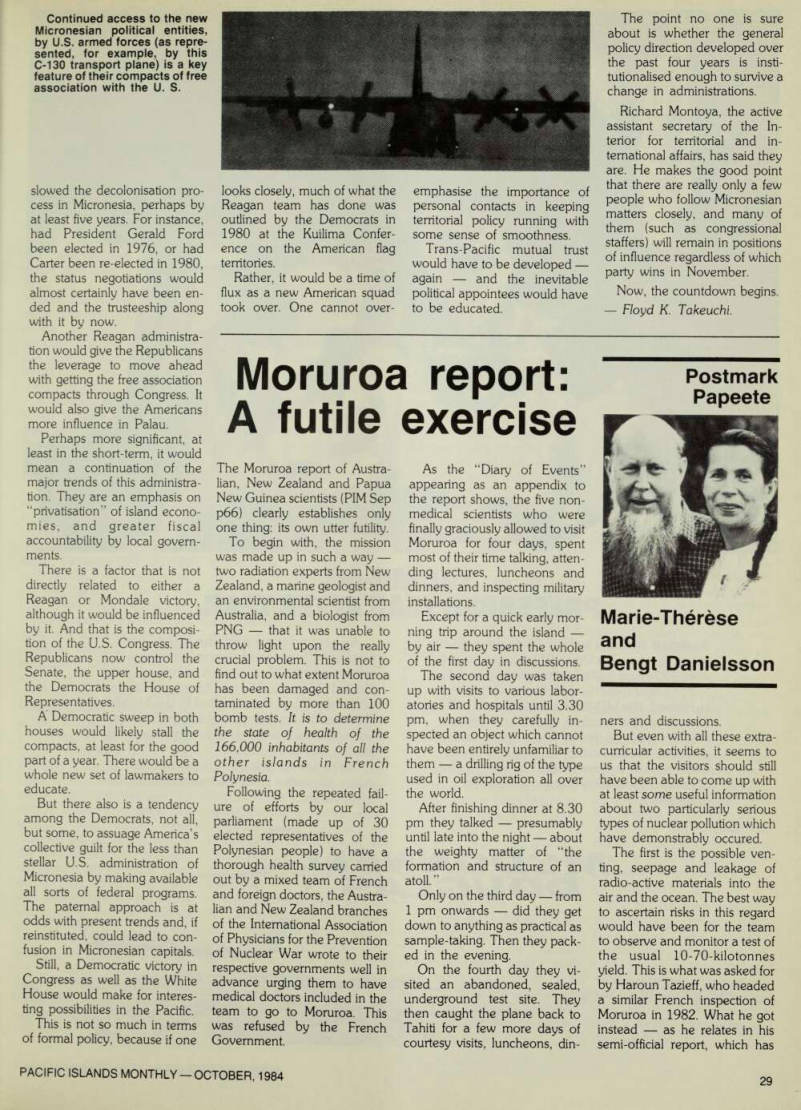
Continued access to the new Micronesian political entities, by U.S. armed forces (as repre sented, for example, by this C-130 transport plane) is a key feature of their compacts of free association with the U. S.