the month
pp. 26-28 · Read in the full issue
Waiting for the ‘unblocking’ . . .
New Caledonia’s political situa tion remains stagnant. While the Independence Front is con tinuing with its plans to boycott and disrupt the Territorial Assembly election, the election date has yet to be fixed. Origin ally scheduled for July, the elections, which are to usher in a five-year autonomy period, have been delayed by French parliamentary procedures.
However, the autonomy bill was expected to be prom ulgated by mid-September, and the elections must take place within the 90 days following the promulgation.
Despite all the uncertainty about the date, some parties had already started their electoral campaigns in the first days of September. Following a general assembly of the party in late August, the LKS (Libera tion Kanake Socialiste) party announced their participation in the elections, stressing that they would not be forming alliances with other parties.
The LKS press statement alleged that some sections of the IF parties Union Caledo nienne and Fulk were unhappy with the IF decision to boycott the elections. It was this deci sion which led to the LKS breaking away from the five year-old IF.
The LKS statement said that by threatening to disrupt the elections, the IF was implying that there would be no right to free expression in a post-inde pendence New Caledonia for those with differing opinions.
LKS also calimed the boycott/ disruption threat demonstrated IF fears that the Kanak people would not follow the boycott order.
The LKS said that after the elections they would call for new negotiations with the French Government, with a program of government as the basis for discussions.
At the same time the LKS presented its program of gov
ernment to the press. The 210page document contains poli cies on economic, social, judi cial, defence, development, fisheries, forestry, land, health, agricultural, and land matters, set out within the framework of a decentralised, democratic New Caledonia.
LKS leader Nidoish Naisse line said the policy document would serve as a basis for discussions with other races, as well as with the French govern ment.
The withdrawal from the IF of the LKS was denounced by the UPM Party as a capitulation to the aims of the French Government. Party secretary Guy Tamai said the govern ment had succeeded in dividing the Rightwing (by persuading the centrist FNSC to go into coalition with the IF in 1982), and had now succeeded in dividing the independence forces. Although describing the LKS as “traitors” to the Kanak cause, Mr Tamai said that dia logue was not broken with the LKS leadership. He urged the French Government to “un block” the political situation in New Caledonia, stressing that the vagueness of French poli cies “could lead to a violent
situation”. Mr Tamai said that for the UPM all possibilities for discussion with the French gov ernment were exhausted.
The French autonomy plan was described as “racist” by the anti-independence pressure group the Caledonian Front.
Caledonian Front leader Justin Guillemard said the autonomy statute favored Melanesians to the detriment of other races, and that it was a preparation for independence. Mr Guillemard urged Caledonians to unite and form resistance structures against the statute, which he described as “an administrative monster”. • • • Demonstrations were held throughout New Caledonia in early August to express de mands that a trial be held over the assassination three years ago of independence leader Mr Pierre Declercq. The demon strations, organised by the Pier re Declercq Memorial Commit tee, were held in Noumea, Voh, Poindimie, Puebo, and on Lifou Island. Mr Declercq, gen eral secretary of Union Caledo nienne, was shot at his sub urban Noumea home on September 19, 1981. Although two men have been charged in connection with the shooting, no trial has been held and the two men have been released on bail. Speaking to the 600 de monstrators in front of Noumea’s courthouse, De clercq’s widow, Mme Magitte
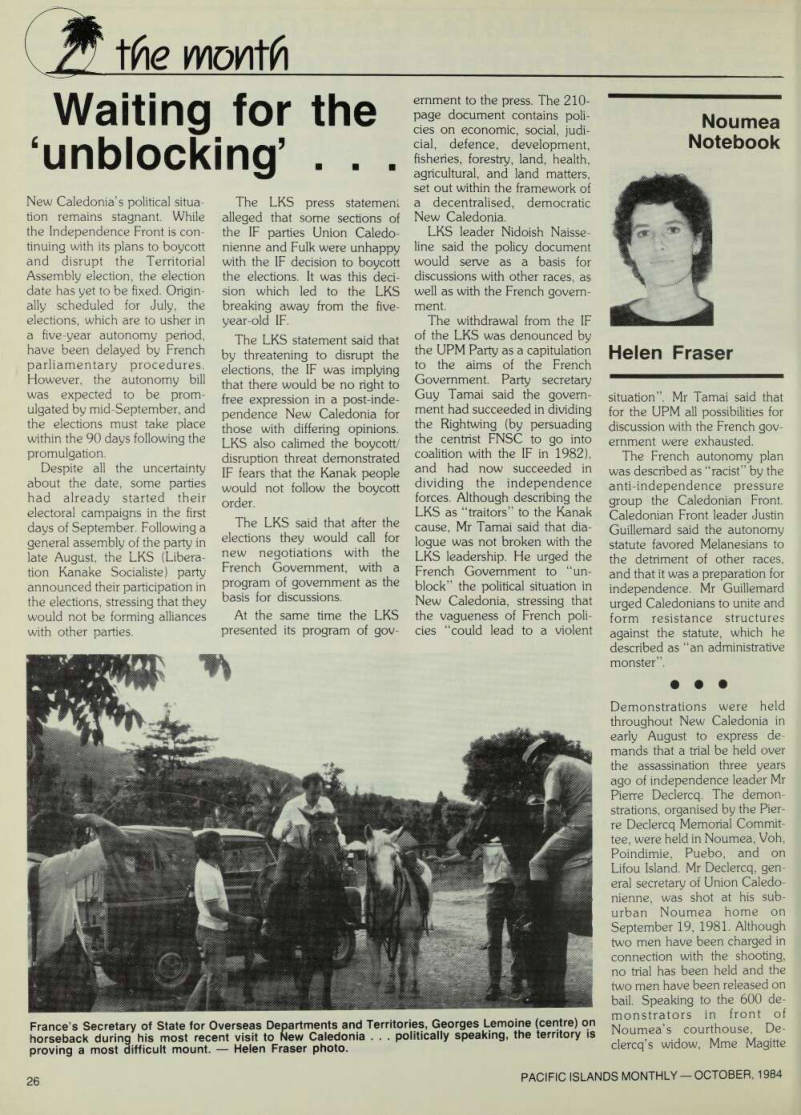
France’s Secretary of State for Overseas Departments and Territories, Georges Lemoine (centre) on horseback during his most recent visit to New Caledonia . . . politically speaking, the territory is proving a most difficult mount. - Helen Fraser photo.
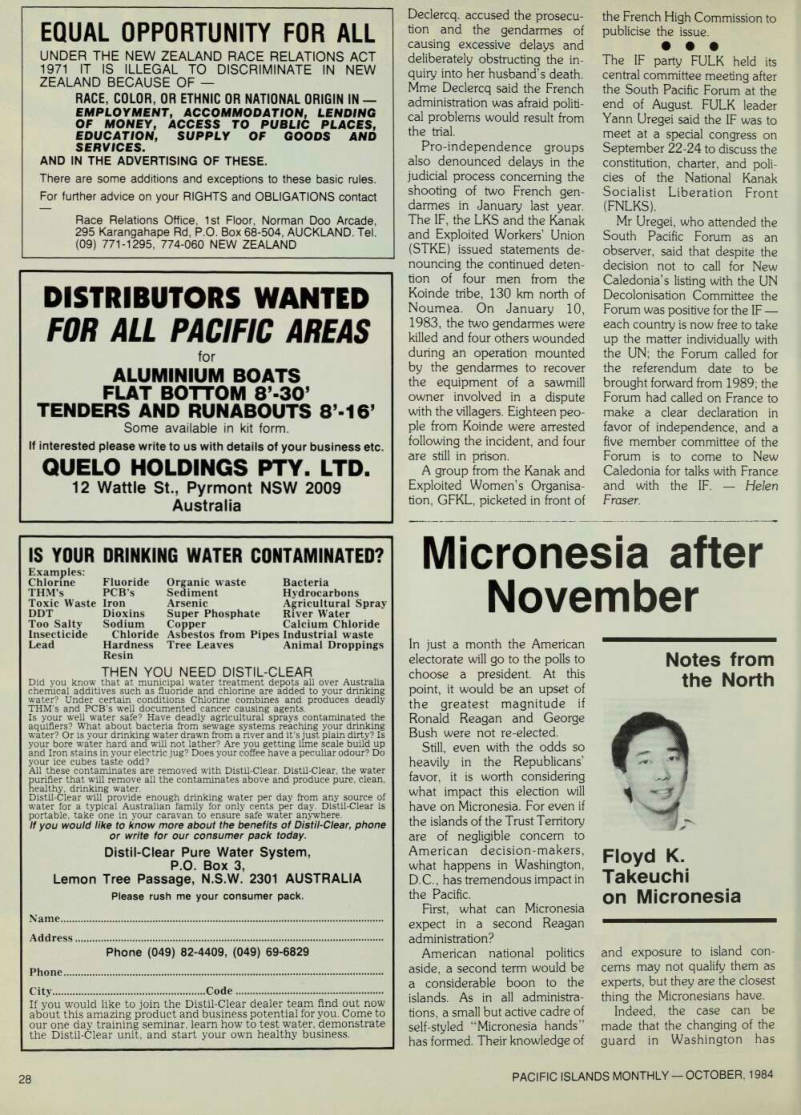
Noumea Notebook
Helen Fraser
Declercq. accused the prosecu tion and the gendarmes of causing excessive delays and deliberately obstructing the in quiry into her husband’s death.
Mme Declercq said the French administration was afraid politi cal problems would result from the trial.
Pro-independence groups also denounced delays in the judicial process concerning the shooting of two French gen darmes in January last year.
The IF, the LKS and the Kanak and Exploited Workers’ Union (STKE) issued statements de nouncing the continued deten tion of four men from the Koinde tribe, 130 km north of Noumea. On January 10, 1983, the two gendarmes were killed and four others wounded during an operation mounted by the gendarmes to recover the equipment of a sawmill owner involved in a dispute with the villagers. Eighteen peo ple from Koinde were arrested following the incident, and four are still in prison.
A group from the Kanak and Exploited Women’s Organisa tion, GFKL, picketed in front of
the French High Commission to publicise the issue. • • • The IF party FULK held its central committee meeting after the South Pacific Forum at the end of August. FULK leader Yann Uregei said the IF was to meet at a special congress on September 22-24 to discuss the constitution, charter, and poli cies of the National Kanak Socialist Liberation Front
(Fnlks).
Mr Uregei, who attended the South Pacific Forum as an observer, said that despite the decision not to call for New Caledonia’s listing with the UN Decolonisation Committee the Forum was positive for the IF each country/ is now free to take up the matter individually with the UN; the Forum called for the referendum date to be brought forward from 1989; the Forum had called on France to make a clear declaration in favor of independence, and a five member committee of the Forum is to come to New Caledonia for talks with France
and with the IF.
Helen
Fraser.