The Forum
pp. 21-23 · Read in the full issue
Heavy issues in a simpler setting
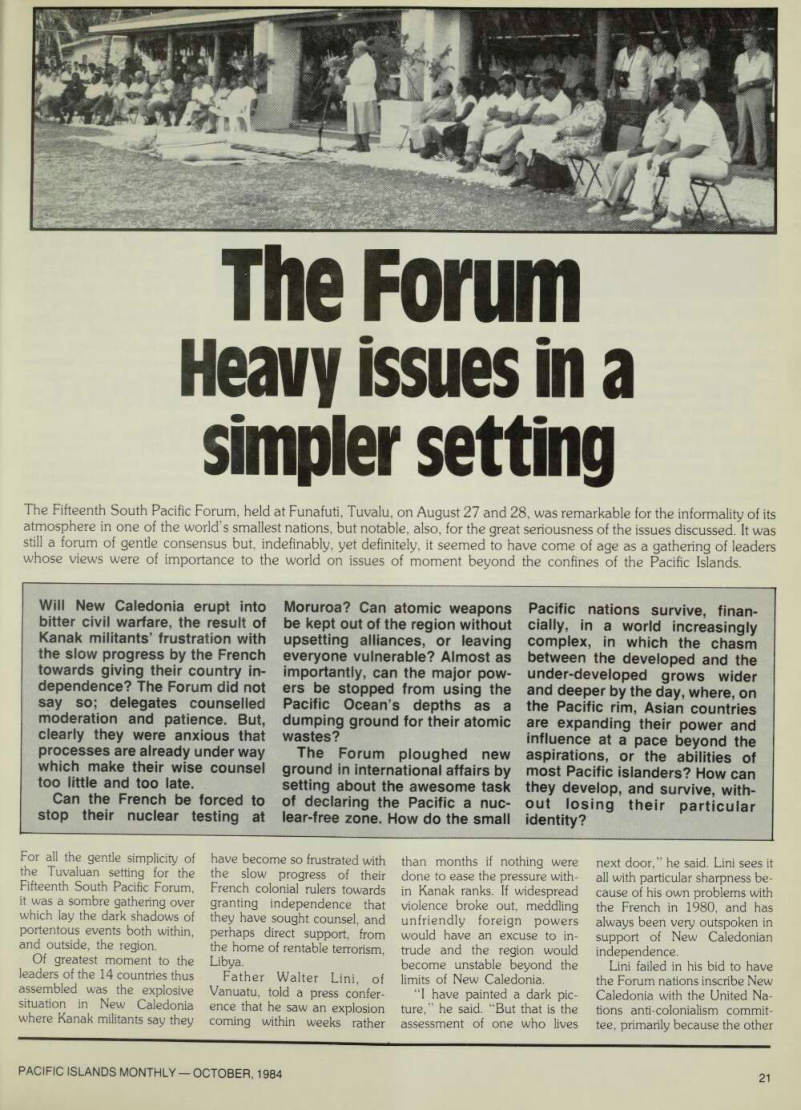
The Fifteenth South Pacific Forum, held at Funafuti, Tuvalu, on August 27 and 28, was remarkable for the informality of its atmosphere in one of the world’s smallest nations, but notable, also, for the great seriousness of the issues discussed. It was still a forum of gentle consensus but, indefinably, yet definitely, it seemed to have come of age as a gathering of leaders whose views were of importance to the world on issues of moment beyond the confines of the Pacific Islands.
Will New Caledonia erupt into bitter civil warfare, the result of Kanak militants’ frustration with the slow progress by the French towards giving their country independence? The Forum did not say so; delegates counselled moderation and patience. But, clearly they were anxious that processes are already underway which make their wise counsel too little and too late.
Can the French be forced to stop their nuclear testing at
Moruroa? Can atomic weapons be kept out of the region without upsetting alliances, or leaving everyone vulnerable? Almost as importantly, can the major pow ers be stopped from using the Pacific Ocean’s depths as a dumping ground for their atomic wastes?
The Forum ploughed new ground in international affairs by setting about the awesome task of declaring the Pacific a nuc lear-free zone. How do the small
Pacific nations survive, finan cially, in a world increasingly complex, in which the chasm between the developed and the under-developed grows wider and deeper by the day, where, on the Pacific rim, Asian countries are expanding their power and influence at a pace beyond the aspirations, or the abilities of most Pacific islanders? How can they develop, and survive, with out losing their particular
identity?
For all the gentle simplicity of the Tuvaluan setting for the Fifteenth South Pacific Forum, it was a sombre gathering over which lay the dark shadows of portentous events both within, and outside, the region.
Of greatest moment to the leaders of the 14 countries thus assembled was the explosive situation in New Caledonia where Kanak militants say they
have become so frustrated with the slow progress of their French colonial rulers towards granting independence that they have sought counsel, and perhaps direct support, from the home of rentable terrorism, Libya.
Father Walter Lini, of Vanuatu, told a press confer ence that he saw an explosion coming within weeks rather
than months if nothing were done to ease the pressure with in Kanak ranks. If widespread violence broke out, meddling unfriendly foreign powers would have an excuse to in trude and the region would become unstable beyond the limits of New Caledonia.
“I have painted a dark pic ture,” he said. “But that is the assessment of one who lives
next door,” he said. Lini sees it all with particular sharpness be cause of his own problems with the French in 1980, and has always been very outspoken in support of New Caledonian independence.
Lini failed in his bid to have the Forum nations inscribe New Caledonia with the United Na tions anti-colonialism commit tee, primarily because the other
Forum members believed any such initiative was doomed to failure and, in that failure, would only damage the situa tion. Vanuatu reserved its right to take unilateral action at the United Nations but, privately, recognised they had little chance of beating the French diplomatic machine in New York.
In the end the consensus, (which is the basis of Forum actions and the secret of its success), was that the French and the Kanaks should be kept talking at as many levels as possible so that polarisation, and therefore the feared explo sion into open civil war, could be staved off long enough for a solution to be found. But, Forum members agreed, fin ding an answer suitable to everyone would not be easy.
The rights of non-Kanak citi zens had to be protected, too.
So the Forum told France very clearly that it should get cracking, should bring the act of self-determination forward from 1989, the present Paris propo sal, and make a public state ment that independence for New Caledonia “is the desir able, logical and acknowledged outcome” of that act.
To further keep the ball roll ing the Forum set up a commit tee of five ministers from New Zealand, Papua New Guinea, Fiji, Western Samoa and Vanuatu, to meet with both the French and the various groups in New Caledonia.
Two observers from the Kanak Independence Front attended the forum meeting,
chief of them being the bearded Yann Uregei who was among those who went to Libya in August seeking money and support from Colonel Gaddafi.
Some, it is said, also sought guns, of which Libya seems to have plenty.
Uregei spent most of his time in Tuvalu swimming and loun ging around and left deeply disappointed with most of the delegations and in particular the Australians who had most influ ence in shaping the quite mod erate communique references to New Caledonia. With tem pers now fraying in Noumea, and Kanak leaders being asked to show some results Uregei will clearly continue his efforts to get support wherever he can.
By most counts the Forum could not responsibly have done more than it did, but it was far less than the angry Kanaks wanted and, to that extent, the situation is seen as continuing very fragile. • • • Bob Hawke’s triumph at the Forum was the launching of a program designed to establish a nuclear-free zone in the Pacific.
To this was added, as a product of an excellent paper from Nauru, a proposal to amend the London Dumping Convention on nuclear waste and prohibit totally dumping in the region.
Particular reference was made by Nauru to the intentions of Japan.
The objective of a nuclear free zone was complicated by alliances, notably ANZUS, which need to have nuclear
armed ships moving through the Pacific. New Zealand’s ban on nuclear ships has caused political discomfort to Australia and is seen as threatening the existence of ANZUS, but it was taken calmly by the Forum which, with the exception of Vanuatu, seemed to side with Australia in wishing an ANZUS type alliance to survive.
Mr Hawke was closely ques tioned by the press on precisely how he saw a nuclear-free zone in which, like the sultanas in a fruit cake, nuclear weapons were stuck at strategic places.
“Some of the states made it clear they wanted to ban all involvement with nuclear weapons or anything to do with the nuclear fuel cycle,” Mr Hawke said, referring, one felt, to New Zealand and Vanuatu.
“But the majority agreed that any zone concept could only be acceptable and operative if it left individual countries free to make their own decisions about visits of nuclear armed and nuclear powered ships. That right was intrinsic to the propo sal I put to the Forum in Canberra last year, and has been accepted,” he said.
How nuclear-free is a zone in which nuclear ships traverse freely? “Well over 100 U.S. nuclear ships have travelled very many millions of miles, have been into about 150 ports in 50 countries without accident or seepage of nuclear material, ”
Mr Hawke said. “That does not diminish the concept that we, as nations, will not acquire nuclear weapons, or manufacture them, or allow them to be
stored on our land, and we are opposed to the testing of weapons in the region, and to the dumping of nuclear waste. ”
The Forum’s aim is to have a draft treaty ready for considera tion at the Forum meeting in Rarotonga next year and a working group of officials, chaired by Australia, and in cluding all members of the Forum, was appointed to set about preparing such a docu ment.
Since everyone appears to have agreed already on the principle of individual choice so far as ship visits are concerned, and since the broad principles of the zone are more or less already agreed, the drafting committee is likely to be in volved more with legal niceties than with policy or principle.
Presumably the Forum will pro duce a treaty in 1985 and forward it to the United Na tions.
Mr Hawke said he saw a need for urgency in the project because “the international en vironment has deteriorated the stand-off which has deve loped between the super-pow ers and the traditional for mov ing towards reduction in arma ments, and particularly nuclear armaments, has somewhat broken down.”
The Forum discussed the re port of the scientific mission of Australian, New Zealand and Papua New Guinea scientists which went to Moruroa. “While the extent of environmental concern may not need to be as large as had been thought, nevertheless the report could not allow any complacency and in no way diminishes the opposition of all Forum mem bers to the continuation of nuclear testing by France,” Mr Hawke said.
The Forum also agreed to tell the Japanese as firmly as pos sible of Forum opposition to nuclear waste dumping in the Pacific.
The Federated States of Mic ronesia, which attends Forum meetings as an observer, said the proposal fitted completely with their Compact of Free Association with the United States, and they expected to join in adopting the treaty when it was drawn up.
While not even the optimistic
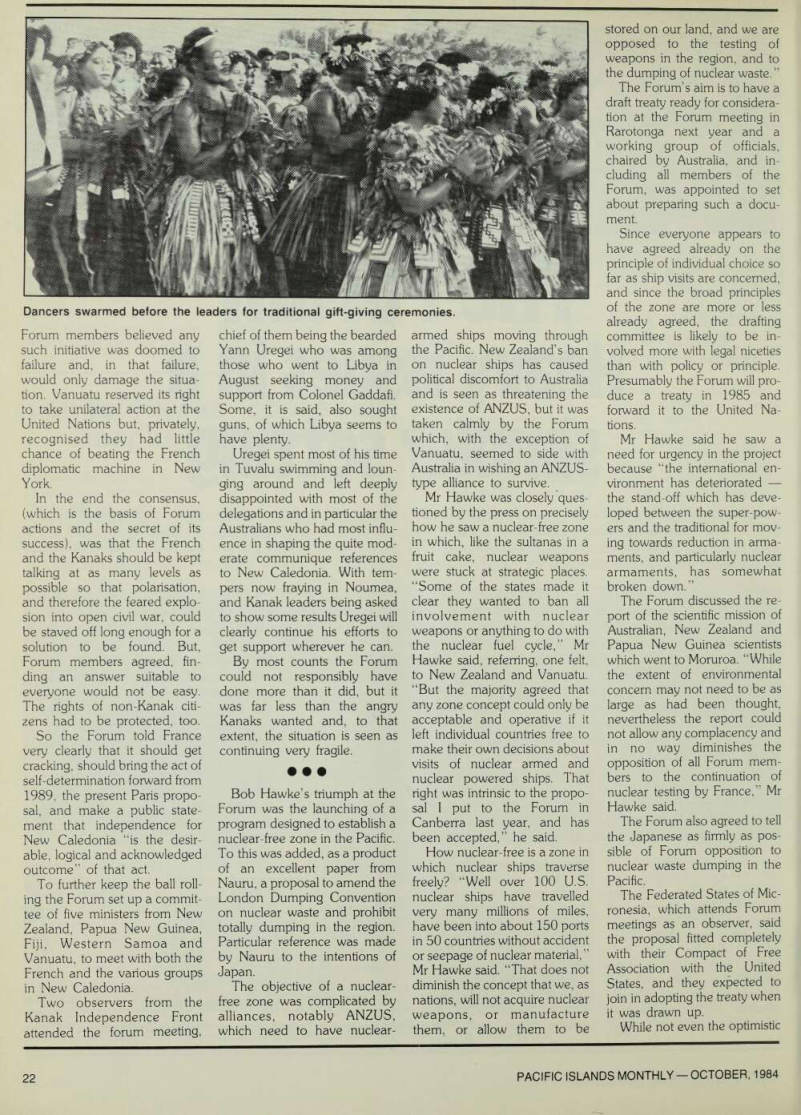
Dancers swarmed before the leaders for traditional gift-giving ceremonies.
Mr Lange felt that a Forum treaty setting up a nuclear-free zone would stop the French in their testing tracks, or persuade the Russians to stay in Vladivos tok, the delegates felt their action would add weight to the review in 1985 of the nuclear non-proliferation treaty. It might persuade the nuclear powers to limit their weapons stock. It might persuade Pacific rim nations to join in eschewing nuclear capacity.
It would not, however, Mr Hawke said, weaken ANZUS to which both Australia and New Zealand had stated their firm commitment.
Led by Kiribati, strongly sup ported by New Zealand, the Forum mulled over the con
tinuing, vexed, problem of hel ping the small Pacific countries find solutions to their in creasingly difficult economic problems. It might be, Mr Lange told reporters, that by the standards of developed countries some Pacific nations were not, and might never be, truly viable. But that did not mean effort should not be put towards alleviating their situa tion.
In some cases the problem was not to achieve economic viability, but to provide the very barest essentials of transport, trade, communications, food and water supply.
SPARTECA, the regional agreement under which island countries gain duty-free access
for a wide range of products to Australia and New Zealand, came under review and some criticism, particularly from the small countries which had been unable to take advantage of it.
While total trade under the agreement had increased in the last three years, the rises were almost totally from the bigger Pacific countries, like Fiji and PNG. Exports from the smaller countries had, in some cases, decreased.
A committee of officials from the Cook Islands, Fiji, Kiribati, Nauru, New Zealand, Niue, Tuvalu and Western Samoa was set up to study the prob lems and recommend solutions to the Sixteenth Forum.
Most Pacific countries suffer
from a shortage of raw materials, expensive energy, a lack of trained personnel, small domestic markets, and long and expensive distances between themselves and potential export customers. Yet some experts believe much more could be done to find island products which could sell profitably all over the world. For example, Western Samoa is reported to be looking at the Hawaiian vegetable market and has had some discussions with air freight companies about such trade.
Other suggestions include development of regional trade through relaxation of present tariff barriers. Handicrafts are a particular sore point Garry Barker.