Lange: Hawke ‘congenial’,
p. 20 · Read in the full issue
despite differences
The New Zealand N-ships policy is not new. Indeed it is rather old-established Labor Party dogma on both sides of the Tasman Sea. That, in fact, is part of the rub on the tender and sometimes prickly hide of Mr Bob Hawke, the Australian leader, who sees in Lange’s cheerful adamancy, aid and comfort for the Australian leftwing which continues to worry
him on the eve of a general election. More than that, how ever, has been the growing realisation that the Lange line is supported in New Zealand by a far larger segment of the popu lation than those who wear cheesecloth dresses and eat organic foods. A large part of the New Zealand middle-class is in an isolationist, neutralist mood. People do seriously
propose that New Zealand could be turned into a South Seas Switzerland. It is partly the effect of what has become fashionable thinking, and partly a realisation of their own very serious economic problems, and the awesome effort that will be required to overcome them.
There is reason to believe that Mr Lange himself does not personally support the party policy banning nuclear ship visits which he considers him self bound to advance. He has sought understanding from both the Australians and the Americans. The ANZUS prob lem has not gone away and they are not letting him off the hook, but he appears to have won time.
At the South Pacific Forum meeting in Tuvalu in August New Zealand took a major part in supporting the Australian in itiative towards creation of a nuclear-free zone. Lange announced himself “very happy” with the outcome of meetings in which he had found Mr Hawke very congenial and understanding, he said.
Mr Hawke, for his part, re fused to offer the slightest critic ism of his trans-Tasman col league, although he sharply reiterated his own firm belief in the importance of ANZUS and the need to play host to the horses if one wished the protec tion of the cavalry.
Australia would shortly make new and far-reaching, decisions on the manner in which it would accept overseas students into its schools and universities, said prime minister Bob Hawke during a speech made at the opening of the Australian aid built Technology Buildings at the University of the South Pacific in Suva, Fiji.
Mr Hawke said that a “small minority” in Australia had ques tioned the continued access of students from Asia and the Pacific to Australian educational institutions but “my govern ment is determined that Austra lia should continue to respond to this regional demand”.
“This commitment will be maintained no matter which system that recommended by Professor Goldring in his study, that of the Jackson Com mittee, or any other approach may be chosen by the government,” he said.
Australia would also remain willing to continue to assist the U.S.P. in meeting its priorities in the fields of curriculum deve lopment, staffing and all the other needs of the 11 subscrib ing nations. In the five years up to June, 1988, Australia would have given U.S.P. a total of $lB million and in 1983/84 pro vided $2.62 million for staffing, academic and program deve lopment, campus upgrading and capital works. The new technology buildings were an aspect of that commitment, he said.
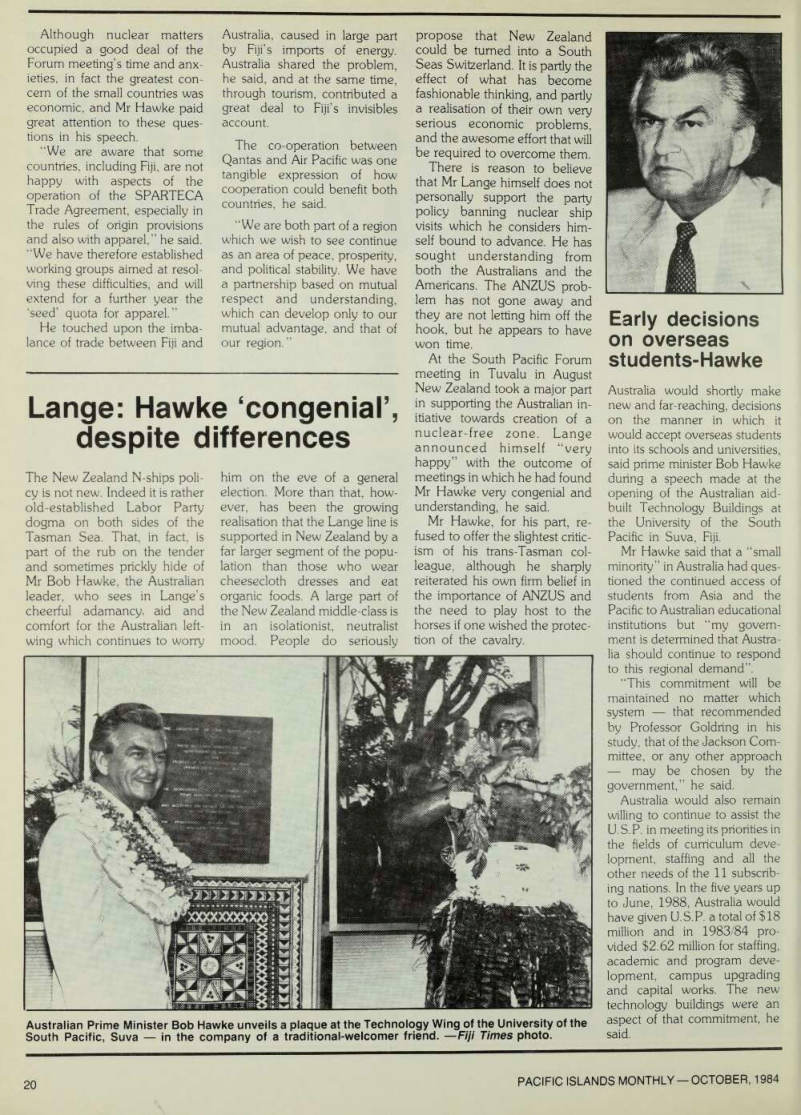
Australian Prime Minister Bob Hawke unveils a plaque at the Technology Wing of the University of the South Pacific, Suva —in the company of a traditional-welcomer friend. —Fiji Times photo.
Early decisions on overseas students-Hawke