people
pp. 61-62 · Read in the full issue

Fiji’s Ombudsman Justice Sir Moti Tikaram has been appointed a member of the International Commission of Jurists in Geneva. Membership of the ICJ is limited to not more than 40 distinguished lawyers who represent different regions and legal systems.
The task of the ICJ is to defend the rule of law through out the world, and to work towards the full observance of the provisions of the Universal Declaration of Human Rights.
Sir Moti was appointed Fiji’s first Ombudsman in 1968.
Maori film director Merata Mita was in London in July for the screening of her film Patu!, which depicts the 1981 anti apartheid protest movement against the Springbok Rugby Union tour of New Zealand.
The director of the London Film Festival, at which Patu! was screened described it as “a major documentary of our time”.
The Guardian Weekly of London reported: “Merata’s plane touched down at 7.30 a.m. on June 2, and three hours later she was marching through the streets of London with 25,000 other people pro testing against the visit of South Africa’s prime minister. It was the largest ever anti-apartheid gathering in Britain but Merata was unimpressed. An ‘artists against the tour’ march in Auck land in 1981 attracted a crowd of 50,000 and New Zealand’s total population is only three million ...”
The government of Japan has appointed Kikuo Yoshida as its new Ambassador in Fiji in suc cession to Ken Ikebe. Mr Yoshida, aged 62, has been Japanese Consul-General at Pusan in South Korea.
Nauru President Hammer De- Roburt has appointed Profes sor M. S. Rajan, of India, as his adviser. Professor Rajan, aged 63, has nearly 36 years experi ence in teaching various sub jects such as international rela tions and organisations, and
India’s foreign policy and rela tions.
The commander-in-chief of French military forces in New Caledonia, General Gastaldi, has reached the end of his assignment in the territory.
He will be replaced by Gen eral Franceschi.
Nancy Berryman reports in the July 29 edition of the Sydney based Sun-Herald: Ruby Boye-Jones, the only woman coastwatcher in the Pacific during World War 2, turns 93 today. Along with her late husband, George Boye, she stayed on in the British Solomon Islands while others left in the face of the Japanese advance.
After a cyclone destroyed a suspension bridge linking her home to the radio which she used to transmit coded meteorological data, she had to cross the crocodile-infested Lawrence River by punt, four
times a day, then often walk ankle-deep in mud. She also had to be ready to relay mes sages between the Solomons and Vila.
After receiving a warning from the Japanese to “get out” and after Guadalcanal coast watchers had found the bodies of nuns and priests bayoneted to death by the Japanese, it was decided Ruby should be in uniform for her own protection.
Her uniform was dropped by parachute and Ruby, at 51, became the first honorary member of the Women’s Royal Australian Naval Service.
Japanese aircraft often flew over her hideouts at low heights, dropping pamphlets telling natives to report the whereabouts of Europeans.
“This was very frightening at times,” she recalls.
Admiral William “Bull”
Halsey of the US Navy said when he landed on her island: “I’d like to meet that wonderful
lady who operates the radio here.”
Because she held only hon orary rank, Ruby received no payment for her work, nor a war pension. In 1979, aged 87, she was granted permission to apply for a service pension. It was refused but that didn’t bother Ruby. Her honors, in cluding the BEM for meritorious service, the 1939/45 Star, the Pacific Star, the War Medal and the Australian Service Medal, mean more to her than money.
At 90, she had her left leg amputated below the knee and had to learn how to use an artificial leg. Today she’s as sharp as a tack and looking forward to a quiet birthday outing with her two sons, Don and Ken. • • • In Commander Eric Feldt’s book, The Coast Watchers (Ox ford University Press, Mel bourne, 1946), “Hon 3rd Offic er Mrs Boye” is the sole name
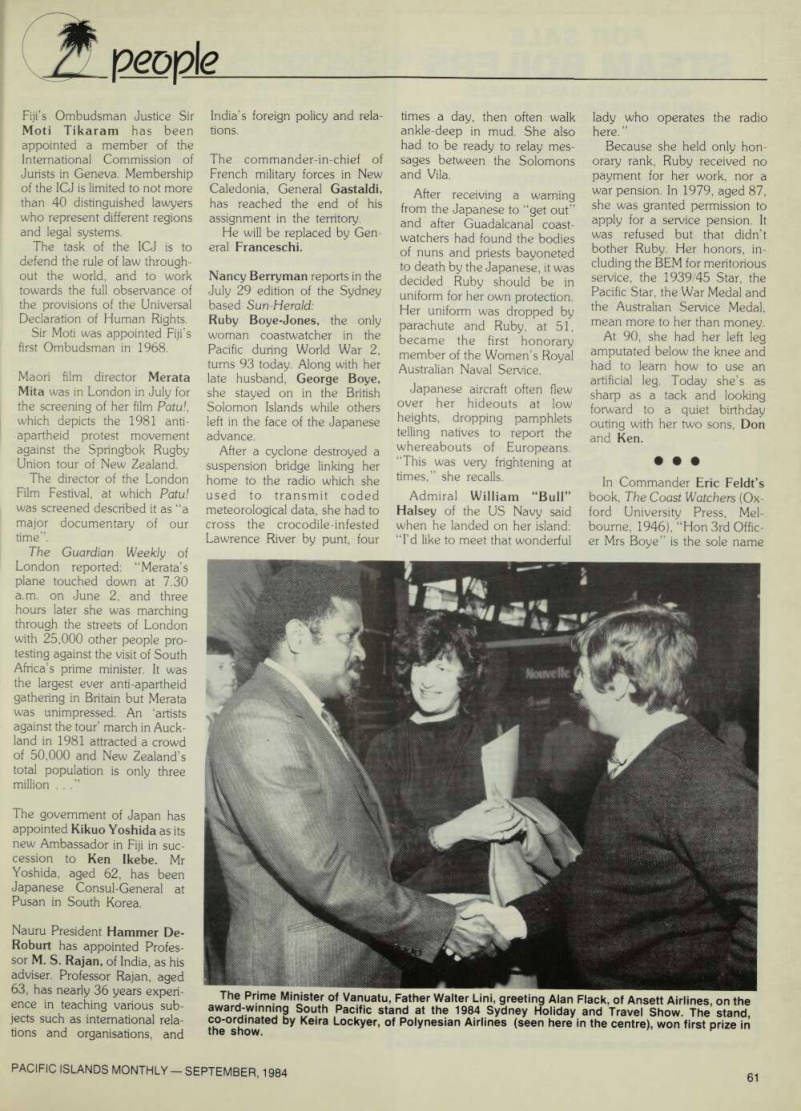
The Prime Minister of Vanuatu, Father Walter Lini, greeting Alan Flack, of Ansett Airlines, on the award-winning South Pacific stand at the 1984 Sydney Holiday and Travel Show. The stand co-ordinated by Keira Lockyer, of Polynesian Airlines (seen here in the centre), won first prize in the show.
appearing in a listing of coast watchers from the Women’s Royal Australian Naval Service.
The entry records that she served at Vanikoro, Solomon Islands, from February 1942 to October 1944, and that she was awarded the BEM.
On page 108 of the book, Commander Feldt notes: “Vanikoro, three hundred miles east by south from Malaita, was in easy range.
When transmission to Vila be came difficult, this island acted as a link, the radio there being operated by Mrs Boye, wife of the manager of a timber com pany which operated there. Mrs Boye was unperturbed by the events in the Solomons and remained on Vanikoro. She was later, deservedly, appointed an Honorary Third Officer, W.R.A.N.S., and was awarded the British Empire Me dal.” PIM.
V. L. Bykova, Russia’s new non-resident Ambassador to Tonga, has presented his credentials to King Taufa’ahau Tupou IV. Mr Bykova is resi dent in Wellington as Ambassa dor to New Zealand.
Yasaburo Yamashita, 85, who designed the old Japanese hospital in Garapan, Northern Marianas, was back in Saipan in June to advise on the restora tion of the hospital.
Mr Yamashita, who still prac tices as an architect in Mie Prefecture, western Japan, said he was head architect at the pre-war Japanese government headquarters in Koror, Palau, when he was asked to design the Saipan hospital back in 1925.
It took him six months to design it, and another seven months to complete construc tion. It was designed for out patients, although a few beds were providewd for serious cases.
Mr Yamashita said after finishing the hospital job he went to Ponape to oversee construction of an agriculture building, which is still standing today.
Following an interview with the Commonwealth News Service, Mr Yamashita walked outside the public information office and counted the number of air conditioners in the main government complex. Shaking his head he said it would have been better to build “larger windows” to take advantage of the island’s tropical breezes.
“That would have saved money,” he said.
Scott Russell, deputy his toric preservation officer, said about $200,000 more was needed to complete restoration of the hospital, which could later be turned into a museum.
Dr Joaquin J. Gochoco, who has been appointed chief executive of the Asian Development Bank’s new South Pacific regional office in Port Vila.