Not only a haven,
pp. 59-60 · Read in the full issue
but a centre
“Vanuatu meets all the very special criteria demanded of a finance centre as distinct from just a tax haven,” says Tom Bayer. “We also have an advantage in time in dealing with people in a sector running from Japan, through Asia, Indonesia, Australia and New Zealand, and back up along the
west coast of America. During the day we are open. We start at 7.30 am which is 3.30 pm in New York City, so we are there for the New York close. And we are still here at 7 pm, so we over-lap with London, During that great span we are seeing what is happening in international finance. Con
versely, people in Europe or America don’t use our facilities very often because they have them closer in their own time zones. ”
The benefits of the finance centre to Vanuatu are several fold. Of the 300 people em ployed by the finance centre in Port Vila, more than 200 are ni-Vanuatu. The centre is now the biggest single industry for training the future managers of business in the country. This has now been extended to Santo with the opening there of Briggs Moore’s new office.
“At PITCO,” says Tom Bayer, “we have had four em ployees run for parliament; two are currently sitting in parlia ment, and we are not unique.
“The finance centre is the train ing ground for this country’s future business leaders. We also train clerical staff to a high standard and, thirdly, we pro vide recognition for the coun try. Vanuatu’s name is well known and respected through out the financial world, to an extent which would not have occurred if the big banks had not come here. Through their world-wide networks Vanuatu gains recognition in internatio nal forums.
“Then, perhaps most impor tant, there is revenue. The finance centre provides at pre sent about Aust $1.5 million to direct government revenue, in annual registration fees of com panies and trusts etc. But, all up, some $lO million a year is put into the economy because finance centre is an invisible exporter,” Mr Bayer said. “We are selling our services internationally, receiv ing money from our clients, and spending it in this economy.
Further, our first-class in ternational communications system in Vanuatu was only installed because it could be justified by the finance centre.
But the whole country, includ ing the tourists, have the benefit of it,” he said.
“But it is the big banks which give the centre its energy. There are some 80 banks incorpo rated here. Only about half a dozen have direct operations here, but the rest all trade through here.”
Business in the Vanuatu fin ance centre is now growing quite satisfactorily after a dull period produced by the world recession. In particular the centre is benefitting from the uncertainty over Hongkong’s future. Nothing scares money faster, or more, than un certainty, thus Vanuatu is star ting to pick up this sort of business out of Asia. A degree of uncertainty over one of the other tax havens in the Pacific is also sending business Port Vila’s way.
“Asia has been historically uncertain for the overseas Chinese living in the other Asian countries. They are a political minority and they like to have their funds somewhere safe where they can move them quickly, and freely, and we supply that sort of facility.
“Countries like Australia are not that important ... the real wealth in the Pacific Basin is in Asia,” said Mr Bayer. “The laws of Australia make it not impossi ble, but more difficult, for us to help Australian residents. If we can do it legally, then we will.
But there is too much other business to be done so if it cannot be done legally, then we are not interested.”
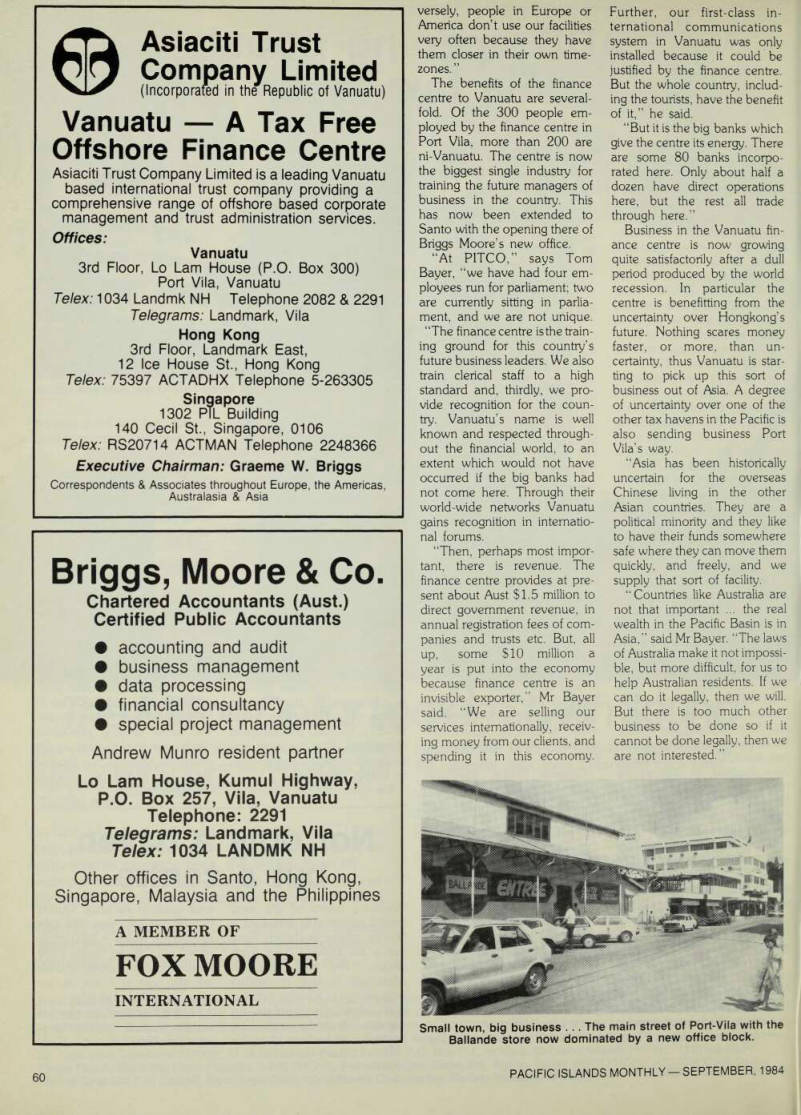
Small town, big business . . . The main street of Port-Vila with the Ballande store now dominated by a new office block.