"Pacific to have lion's
pp. 10-13 · Read in the full issue
The Jackson Report
"Pacific to have lion's share of Aust. aid"
The Pacific region should again become the main, almost exclusive, focus for Australian aid, says the Jackson Report. Aid administration should be made much more efficient. More and better staff should be employed so that full value was obtained from every dollar given.
Much more accountability should be involved. Untied, budgetary support should be gradually phased out in favor of integrated, planned, national and regional aid, on a project or program basis.
Total aid given by Australia should rise from the present 0.5 per cent to the international goal for industrialised countries of 0.7 per cent of national income, as the Australian eco nomy grew and domestic con ditions permitted. But there should be, the report says, a harder-headed approach to aid donation.
“The present program is spread over too many coun tries, with too many initiatives and activities implemented in too many different ways. The circle of recipients has been widened unrealistically and, as a result, the program has leant heavily on improvisation and post hoc rationalisation.
“Resources for program ming, implementation and evaluation are inadequate, and they are strained further by the range of aid attempted,” says the report. “Not enough has been done to identify and ex ploit Australia’s relative strengths so that aid delivery can take full advantage of com petitive Australian goods and services. The Australian aid program needs to be better
focused to achieve its objec tives.”
How this is done will ulti mately depend, of course, upon Cabinet and bureaucratic de cisions. Yet it seems clear that a new broom is in the halls of the aid administration and that while Australian aid, particularly to the Pacific countries, will not be reduced, and indeed may well be increased, changes of style and direction are now certain.
Five-year plans
The Jackson committee proposes development of aid strategies on a five-year basis, with much more attention given to the results achieved by each aid project. There should be better planning and more effec tive monitoring, they say. Pro jects and programs should be evaluated after completion to gauge their effectiveness, and to provide a growing fund of knowledge upon which to base decisions about future aid directions.
Aid is given primarily for humanitarian reasons to allevi ate poverty by fostering deve lopment, says the report. “It is the response of the wealthy industrial countries to the needs of hundreds of millions of peo ple who live harsh and materially meagre lives. Aid also complements strategic, economic and foreign policy interests...it provides economic opportunities for Australia by helping developing countries to grow. ”
Aid’s over-riding thrust was development, says the report, but if the majority of a popula tion did not benefit, then the
impetus for development was lost.
“To be effective, aid policy should be focused on helping countries achieve growth that alleviates poverty and improves income distribution...develop ment cannot be achieved sim ply by providing poor people with basic needs...it requires investment in people as well as in roads, dams and ports so that higher incomes may be achieved.
“At least 200 million people in the world still live under crushing poverty. Some coun tries have made dramatic prog ress, but it will be decades before most can achieve stan dards of living comparable to those of the industrial coun tries... even the relatively ad vanced countries still face se rious problems.
“Aid alone cannot achieve development,” says the report.
“Domestic policies of deve loping countries are the critical component of growth with equity. Natural resources and people’s abilities can be mobil ised only by growth-oriented policies...education, health and other social policies must also be marshalled to contribute to development.
“End untied aid”
“Population planning is essential if progress toward higher living standards is not to be eroded,” the report says.
“In the main,” it says, “Aus tralian aid funds and skills are most effective when applied to removing major constraints to development. This often in volves capital-intensive inputs. ”
Australia was one of the first countries to give aid after the Second World War and now spends about $B4O million annually on a wide variety of projects. This is 3 per cent of total world aid from industrial ised countries.
Papua New Guinea has al ways been the principal be neficiary of Australian aid. In the fifties PNG had more than 60 per cent of the total, but now gets 36 per cent, most of it in untied, non-accountable, budgetary support without which the national books would not balance..
The Jackson committee re commends that this kind of aid should in future be limited to PNG and, “in exceptional circumstances” the very small Pacific states. Even then it should be gradually phased out as, indeed, is already planned for PNG.
Because of their small size, the Pacific and Indian Ocean countries should be eligible for project aid “to any sectors within the framework of coun
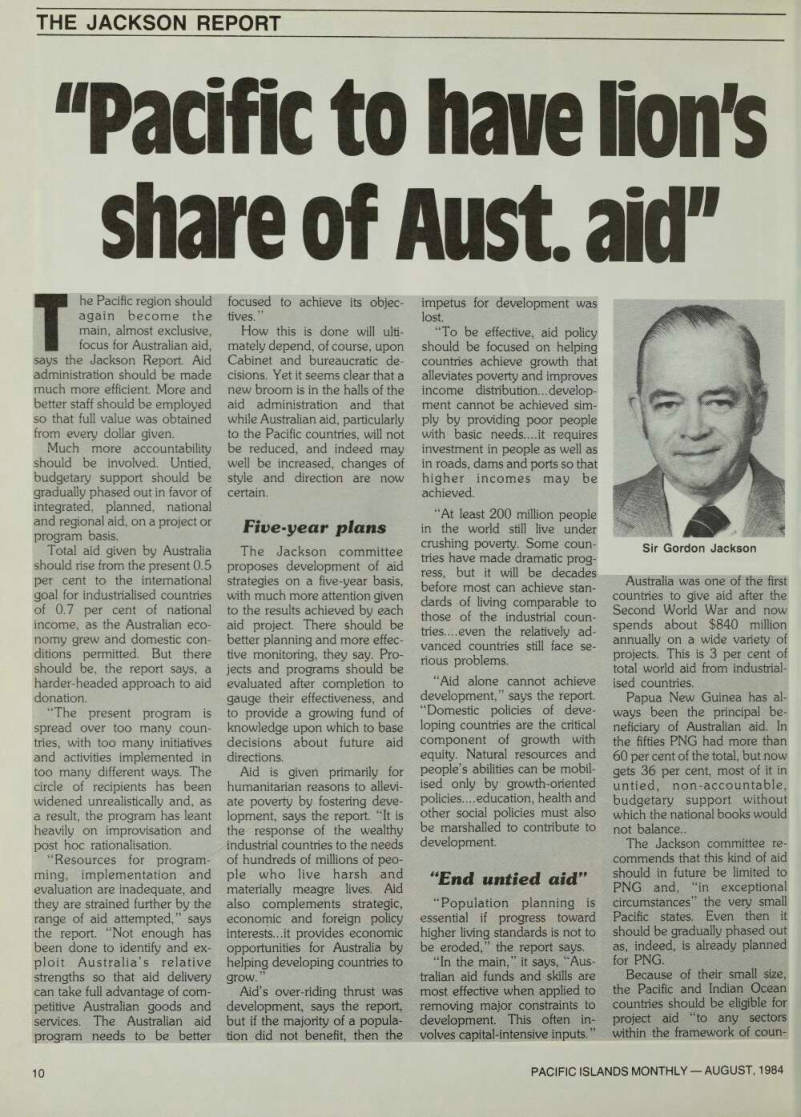
Sir Gordon Jackson
try and regional programming strategies. (This sort of bureaucratic buzz-wording has led to a degree of doubt in some Pacific minds about pre cisely what is intended, but it seems to indicate that overall planning should dictate what sort of aid projects and prog rams would be approved in the future. Projects would not only have to be good, but would have to “fit”).
No fast change
for PNG
The report goes on to say that as Australia’s relationships with some of its near neighbors move increasingly to a trading basis, the share of aid going to China and the South Asian countries could increase.
“A high level of aid should continue to flow to Papua New Guinea because of the special relationship with Australia,” says the report.
“There should be no major immediate change in the level and form of Australia’s aid to PNG, “ but, “consistently with the objectives of growing self reliance” aid should decline gradually, but predictably.
From the end of the current agreement in 1986 budget sup port should decline in real terms at the rate of 5 per cent a year.
This latter recommendation is in accord with the earlier Crawford report on aid to PNG and is broadly accepted by PNG itself. However, this re duction should be offset, says the committee, by gradual in troduction of extra assistance to give PNG more access to train ing, technical assistance, re search and support for volunt ary agencies.
“The overall decline in Aus tralia’s total aid should be, however, at least three per cent a year in real terms. In this way the aid relationship would be gradually normalised, although it would take 25 to 30 years for the balance of Australian aid to move from budget support to a normal bilateral country prog ram. ”
The Jackson report is quite critical of PNG’s growth and financial management. It con cedes that Australia was not a good colonial power in its ad
ministration of Papua New Guinea and that it left a legacy of serious problems. But, even allowing for that, the report says, “Papua New Guinea’s growth since independence has been somewhat disappointing.
Cohesion and stability have been achieved, but growth, particularly in the subsistence and other agricultural sectors, has been limited.
“Papua New Guinea’s growth in the seventies was only half way up the sub- Saharan Africa performance ladder and it lagged behind its ASEAN neighbors... it is now time for more debatable op tions that Papua New Guinea faces,” the report says.
“Australia should pay more attention to Papua New Guinea’s economic problems to maintain the close and harmo nious relationship between the two countries and to reassure Australian taxpayers that their money is being well spent.”
The report went on to recom mend that in-depth annual re views of the PNG economy should be undertaken by inde pendent professionals selected
by PNG and Australia. The findings of these professionals should be published, the report says.
“Bloody angry"
Critical references such as these led to some angry re
marks by prime minister, Michael Somare, during his visit to Sydney about three weeks before the report was pub lished. Mr Somare had received from person or persons uniden tified, but assumed to be very close to the committee, a draft of pages particularly affecting
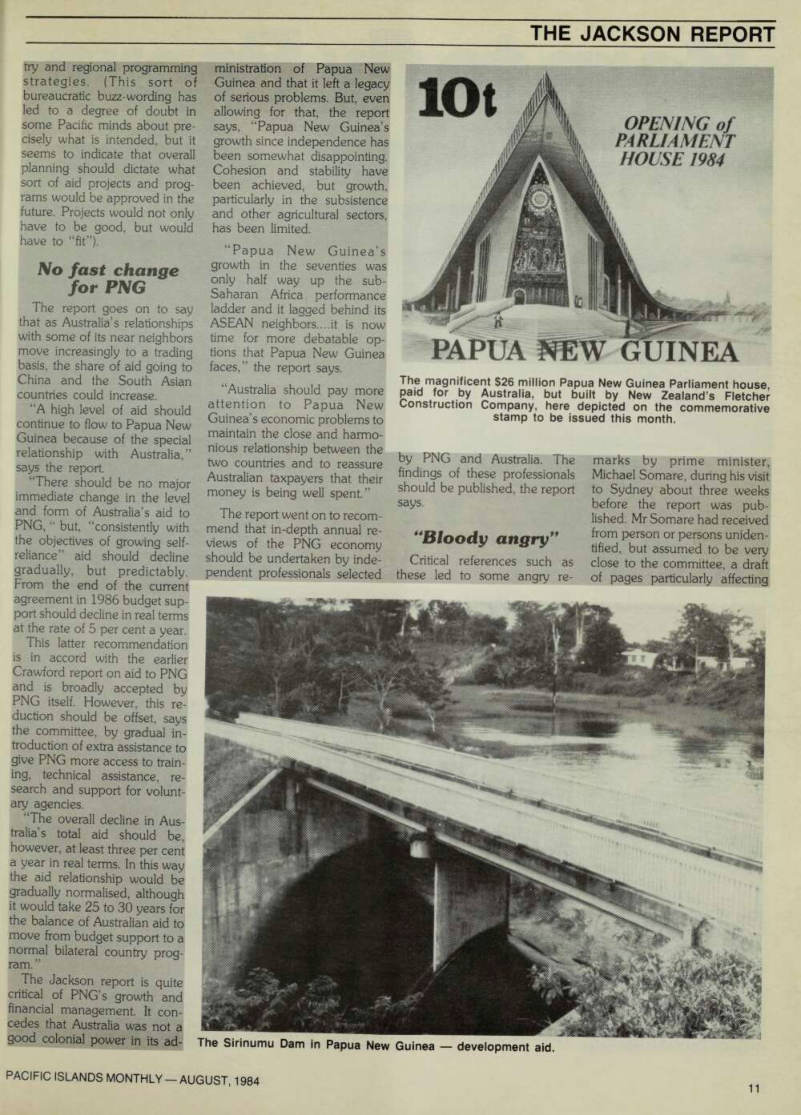
The magnificent $26 million Papua New Guinea Parliament house paid for by Australia, but built by New Zealand’s Fletcher Construction Company, here depicted on the commemorative stamp to be issued this month.
The Sirinumu Dam In Papua New Guinea development aid.
his country. This draft seemed to indicate that the committee would recommend an early end to budgetary support for PNG and led Mr Somare to say he was “bloody angry” about such a dire notion.
The report finally published was not nearly so blunt as the leaked pages suggested it was going to be. Whether this meant it had been rewritten at the last minute to take note of the PNG views has been kept a bureaucrats’ trade secret. Mr Somare has since sounded a good deal happier, although he remains less than charmed about some of the comparisons and assumptions made by the committee in its assessment of
Png.
In fact the report is at least as critical of Australia as it is of PNG or any other country.
Australia’s preparations for PNG independence were hasty, and ill-considered, the report says. Few PNG nationals had experience of public adminis tration. Departing officials hasti ly superimposed a few indi genous institutions on admi nistrative and legal framework
based upon inappropriate Australian models. It was all a very rushed job done for reasons more linked with Aus tralia’s regional and internatio nal image than the good future of PNG.
Papua New Guinea re mained dominated in its early independent years by Austra lian goods, services, standards and appetites. This tended to distort the economy in such areas as wages and divorce it from the local economy and culture, the report says.
Although it is large by South Pacific standards, PNG’s eco nomy is, in fact, very small.
Overall national income for 1982 is thought to have been about SA3 billion. By compari son, the Australian income in the same period was about SAISS billion. The monetised private sector in PNG is small.
High wages and rising job opportunities in the seventies had caused urban drift, which persisted to cause problems of law and order which, the report indicated, would have to be resolved if development was not to be impeded, and strains
not put upon the political system.
“National cohesion and stability have been achieved, but growth, particularly in the subsistence and other agricultu ral sectors, has been limited,” the report says.
Malnutrition Malnutrition was a problem in the community, said the report. This was not because of any food shortage, but due to “inappropriate dietary pat terns” caused by food taboos, neglect and lack of information and education. Children were particularly disadvantaged.
PNG could need an “invest ment in people” program, the report suggested.
Minister for Industrial Deve lopment, Karl Stack, who attended a lunch in Sydney last month at which the main speaker was Sir Gordon Jack son, admitted that the bulk of budgetary aid was spent on supporting a very large public service.
“But who left us a public service with 40,000 people?
Who left us a public service for which you must provide hous-
ing? You don’t have that in Australia,” said Mr Stack.
“There are not many deve loping countries which have that sort of burden. The cost to us of this accommodation is horrendous. 1 will repeat what my prime minister said. The report is very fair, but there is an element of buck-passing in it. If you talk literacy rates and compare them with Africa, you must remember PNG has been independent for only nine years, and we started with a few handicaps, including the beer you left us. And I would be interested to know what was the literacy rate when you handed over to us, and what it is today.
“Sir Gordon Jackson sug gests that Australian companies should have more of an advan tage in trading with PNG. I totally agree in many ways, but by the same token, if Australian industries were capable, the trade would be there today.
There isn’t much we can do about it. We have Toyotas and Nissans instead of Holdens. I notice you have them now, too,” he quipped.
“When we formulated our macro-economic policies at in dependence, we concentrated on the distribution of wealth. I have been informed by the report that per capita income has gone down. That fascinates me. I cannot challenge it, but it fascinates me,” said Mr Stack.
“The government of those days sacrificed growth in an effort to achieve better distribution of wealth. It is only since the formation of this latest govern ment, and the production of the White Paper on industrial deve lopment, that we are suddenly trying to swing the emphasis in PNG towards growth. But, if we had gone for growth from the outset we would have alienated huge sections of our commun ity.
“However, I totally agree with the idea of tied aid being replaced by project aid. Under the present agreement budget ary support from Australia is to decline at the rate of 5 per cent per annum. The committee re commends an increase in pro ject aid to reduce this decline to three per cent. It means we could get more, ” Mr Stack said.
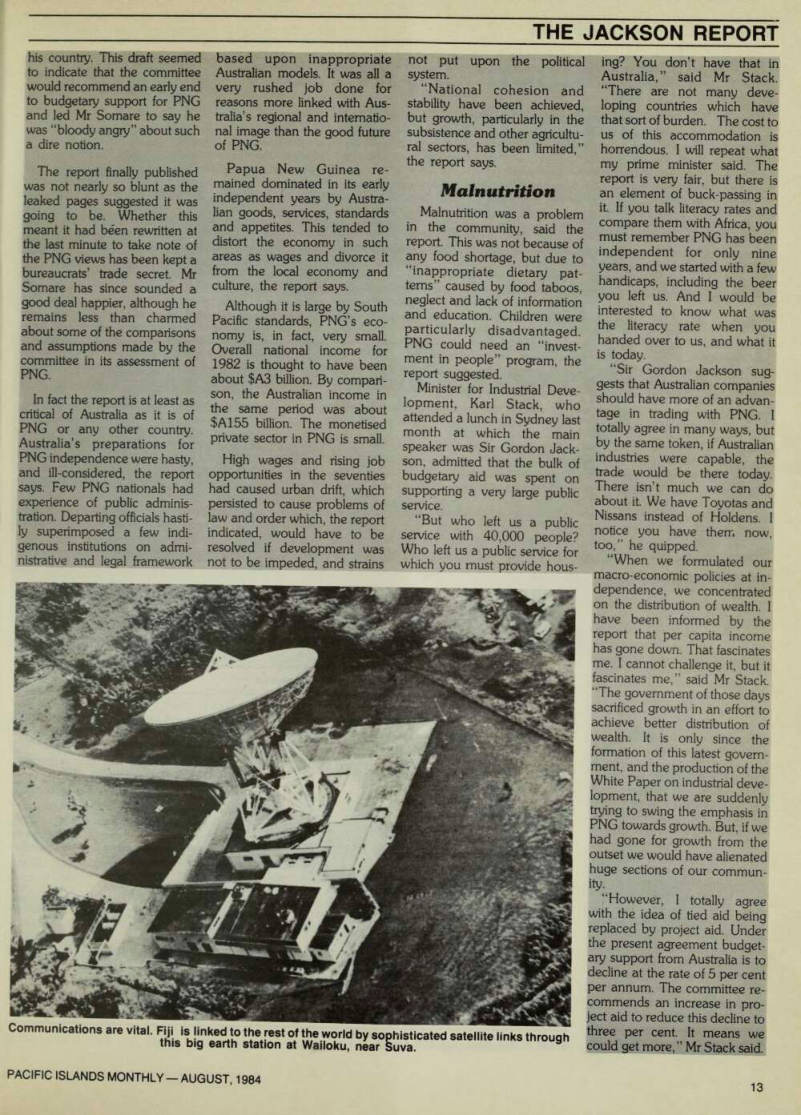
Communications are vital. Fiji is linked to the rest of the world by sophisticated satellite links through this big earth station at Wailoku, near Suva.