Energy—
pp. 41-43 · Read in the full issue
Alternative Energy Feature
not just an Arab preserve
The Pacific has abundant supplies of the World’s most essential commodity it just has to be harnessed.
ENERGY is our greatest single asset. Without it very little in the modern world would be possible. But, for much of industrial history man has wasted energy. Only now is there concern that our planet may run out of energy, bringing to a halt the developments, the comforts and the enterprises so many admire.
And yet the irony is that energy continues to fall upon us in virtually limitless quantities. Our problem is the harnessing of it. The hope of our future thus lies with the engineers who seek the keys to exploitation of alternative energy sources of which the vast and sunny Pacific possesses an abundance.
One might even dream that in the distant future the Pacific could become a major industrial region powered by the abundant sun, the great oceanic swells and the tides.
Wind, water, sunshine and trees are energy sources constantly renewed and fortunately not radio-active or, in most cases, damaging to the environment. In many parts of the world engineers and scientists already have projects well under way to use these great natural benefits.
In the following article, written with the help of Derk Dammers and David Hughes, of Antelope Engineering, of Neutral Bay, Sydney, we examine some of the alternative energy sources which come within the scope of the Pacific’s smaller island countries.
Pacific mythology is rich with stories of the gods of wind, sea and sun, and as things stand for our area as it speeds into the ever changing 21st Century, those gods, or at least their elements, could provide prosperity in a world only now bringing a proper enthusiasm to the search for energy after oil becomes too expensive, and then runs out.
Much of research so far has been in the rich, industrial, countries which are seek ing energy in vast quantities ... sufficient to power big cities. For them, probably, nuclear energy must be one of the essential options. Many of them also have access to vast supplies of coal which, in modern furnaces, may be burned without too greatly polluting the environment. The world’s coal reserves may last several centuries yet. The efficiency of exploitation methods for coal is growing rapidly not only in the design of furnaces and gasifiers, but also in the means of converting coal to liquid petroleum-type fuel.
But Pacific countries cannot afford immensively expensive nuclear power stations, and they have no coal.
So, price, size and resource are impor tant. Machines must be smaller than fully-industrialised countries require, they must be cheap, efficient, reliable and use what is available nearby as their fuel. For the Pacific, with its vast distances and high transportation costs, there is no point in an alternative energy system
which requires imported supplies. The machinery itself will probably need to be imported , although already much may be done in a simple way with what is locally available... but development is expensive, and why pay the price when overseas expertise supported on a much wider market can be imported?...unless, of course, one has the prospect of export sales. But the fuel, the consumables, must be locally-supplied.
Wind and water offer great opportuni ties. The trade winds blow steadily for long months of the year in most areas of the Pacific. Many more mountainous islands have streams which can be dammed for small hydro-electric plants.
There is abundant vegetation. A good deal of practical knowledge already has been gathered and applied.
The Fiji Sugar Corporation has for years generated and sold electricity using the bagasse which is the ’’waste” product of sugar cane crushing. This is, of course, a fairly large operation and not one most Pacific Islands could presently contem plate.
But there are plenty of small steam generating plants available which could be adapted to burn coconut husks, wood chips from sawmills, and other material probably now thrown aside and wasted.
Also in Fiji, a chicken-raising and proces sing company has set up a bio-mass plant which uses all waste material, including the manure from the chicken yards, in
various energy and money-saving ways.
The Fiji cement factory, which once used enormous quantities of oil, is now burning coal dust and may soon move to wood chips for at least a large percentage of its fuel needs, Fiji now being on the brink of exploiting its large introduced pine forests.
And, in Vanuatu the cement works is using waste wood to provide low press ure steam for an autoclave.
In a conventional, but also very cost effective way, wind is now being used in many parts of the world to generate electricity directly.
The most advanced plants are huge, with blades up to 100 metres in diameter, mounted on towers which threaten to rival the Eiffel. They are also very expensive, but down the scale are wind generators suitable for villages, small factories, and even individual houses.
A Dutch company, Polenko, builds a line of wind turbines which cost less than Aust.sBooo for 3.5 kW of generating capacity. Bigger machines, pushing out up to 100 kW cost $lOO,OOO and turbines three times that size cost about three times as much.
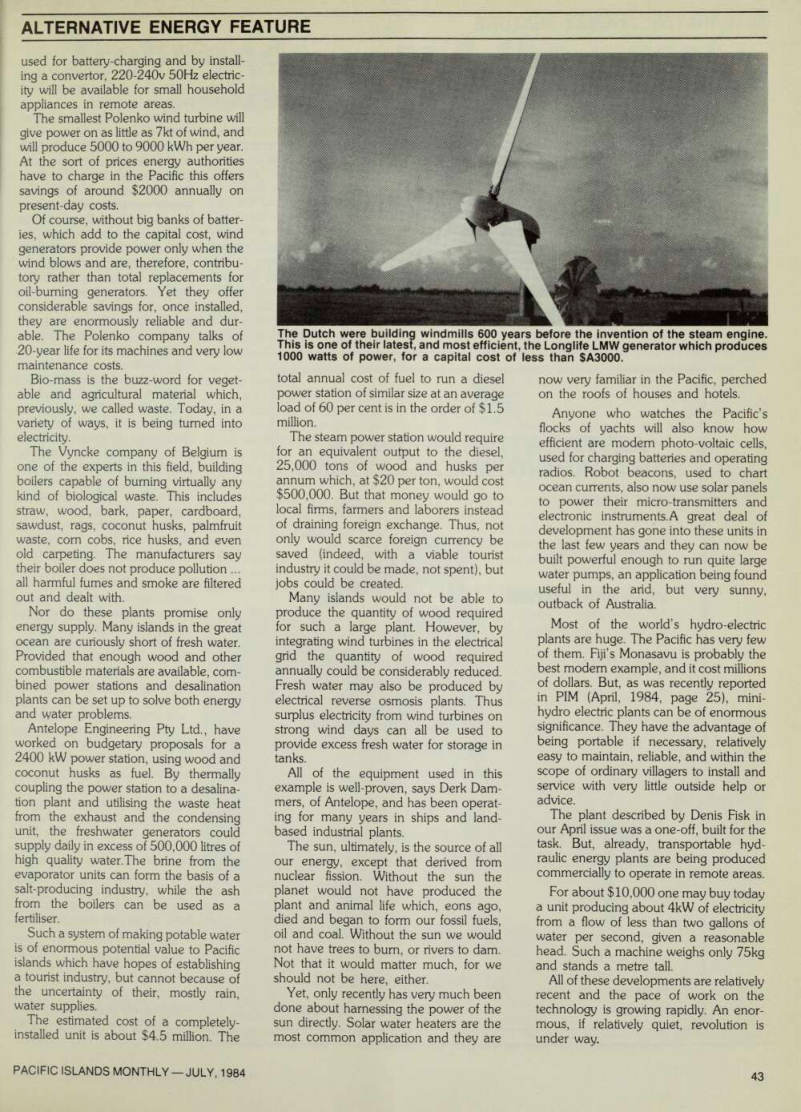
A small 1 kW unit is marketed under the name LMW2.S (2.5 metre diameter blades) and this unit costs SA3OOO, landed in the Pacific. This excludes the tower, as in view of the transport costs involved, a locally-built tower makes more sense. These small units can be
used for battery-charging and by install ing a convertor, 220-240 v 50Hz electric ity will be available for small household appliances in remote areas.
The smallest Polenko wind turbine will give power on as little as 7kt of wind, and will produce 5000 to 9000 kWh per year.
At the sort of prices energy authorities have to charge in the Pacific this offers savings of around $2OOO annually on present-day costs.
Of course, without big banks of batter ies, which add to the capital cost, wind generators provide power only when the wind blows and are, therefore, contribu tory rather than total replacements for oil-burning generators. Yet they offer considerable savings for, once installed, they are enormously reliable and dur able. The Polenko company talks of 20-year life for its machines and very low maintenance costs.
Bio-mass is the buzz-word for veget able and agricultural material which, previously, we called waste. Today, in a variety of ways, it is being turned into electricity.
The Vyncke company of Belgium is one of the experts in this field, building boilers capable of burning virtually any kind of biological waste. This includes straw, wood, bark, paper, cardboard, sawdust, rags, coconut husks, palmfruit waste, corn cobs, rice husks, and even old carpeting. The manufacturers say their boiler does not produce pollution ... all harmful fumes and smoke are filtered out and dealt with.
Nor do these plants promise only energy supply. Many islands in the great ocean are curiously short of fresh water.
Provided that enough wood and other combustible materials are available, com bined power stations and desalination plants can be set up to solve both energy and water problems.
Antelope Engineering Pty Ltd., have worked on budgetary proposals for a 2400 kW power station, using wood and coconut husks as fuel. By thermally coupling the power station to a desalina tion plant and utilising the waste heat from the exhaust and the condensing unit, the freshwater generators could supply daily in excess of 500,000 litres of high quality water. The brine from the evaporator units can form the basis of a salt-producing industry, while the ash from the boilers can be used as a fertiliser.
Such a system of making potable water is of enormous potential value to Pacific islands which have hopes of establishing a tourist industry, but cannot because of the uncertainty of their, mostly rain, water supplies.
The estimated cost of a completely installed unit is about $4.5 million. The
total annual cost of fuel to run a diesel power station of similar size at an average load of 60 per cent is in the order of $1.5 million.
The steam power station would require for an equivalent output to the diesel, 25,000 tons of wood and husks per annum which, at $2O per ton, would cost $500,000. But that money would go to local firms, farmers and laborers instead of draining foreign exchange. Thus, not only would scarce foreign currency be saved (indeed, with a viable tourist industry it could be made, not spent), but jobs could be created.
Many islands would not be able to produce the quantity of wood required for such a large plant. However, by integrating wind turbines in the electrical grid the quantity of wood required annually could be considerably reduced.
Fresh water may also be produced by electrical reverse osmosis plants. Thus surplus electricity from wind turbines on strong wind days can all be used to provide excess fresh water for storage in tanks.
All of the equipment used in this example is well-proven, says Derk Dam mers, of Antelope, and has been operat ing for many years in ships and land based industrial plants.
The sun, ultimately, is the source of all our energy, except that derived from nuclear fission. Without the sun the planet would not have produced the plant and animal life which, eons ago, died and began to form our fossil fuels, oil and coal. Without the sun we would not have trees to burn, or rivers to dam.
Not that it would matter much, for we should not be here, either.
Yet, only recently has very much been done about harnessing the power of the sun directly. Solar water heaters are the most common application and they are
now very familiar in the Pacific, perched on the roofs of houses and hotels.
Anyone who watches the Pacific’s flocks of yachts will also know how efficient are modem photo-voltaic cells, used for charging batteries and operating radios. Robot beacons, used to chart ocean currents, also now use solar panels to power their micro-transmitters and electronic instruments. A great deal of development has gone into these units in the last few years and they can now be built powerful enough to run quite large water pumps, an application being found useful in the arid, but very sunny, outback of Australia.
Most of the world’s hydro-electric plants are huge. The Pacific has very few of them. Fiji’s Monasavu is probably the best modem example, and it cost millions of dollars. But, as was recently reported in PIM (April, 1984, page 25), mini hydro electric plants can be of enormous significance. They have the advantage of being portable if necessary, relatively easy to maintain, reliable, and within the scope of ordinary villagers to install and service with very little outside help or advice.
The plant described by Denis Fisk in our April issue was a one-off, built for the task. But, already, transportable hyd raulic energy plants are being produced commercially to operate in remote areas.
For about $lO,OOO one may buy today a unit producing about 4kW of electricity from a flow of less than two gallons of water per second, given a reasonable head. Such a machine weighs only 75kg and stands a metre tall.
All of these developments are relatively recent and the pace of work on the technology is growing rapidly. An enor mous, if relatively quiet, revolution is under way.
The Dutch were building windmills 600 years before the invention of the steam engine.
This is one of their latest, and most efficient, the Longlife LMW generator which produces 1000 watts of power, for a capital cost of less than $A3000.