medical engineers
pp. 37-62 · Read in the full issue


NZ trains Islands medical engineers
Early this year 13 students from around the Pacific converged on the Central Institute of Technology in New Zealand’s Hutt Valley, near Wellington.
For 18 months from that time the trainees from the Cook Islands, Fiji, Niue, Papua New
took part in an orientation program which included visits to local industry, farms and island community groups. In this relaxed atmosphere, train ees and tutors got to know each other.
The training program was initiated by the World Health Organisation about 10 years ago when a need was recog-
Guinea, the Solomons, Tonga and Western Samoa would be studying biomedical engineer ing, specialising in the mainten ance and repair of medical and X-ray equipment.
During the first week of their stay in New Zealand, students
Continued on page 62
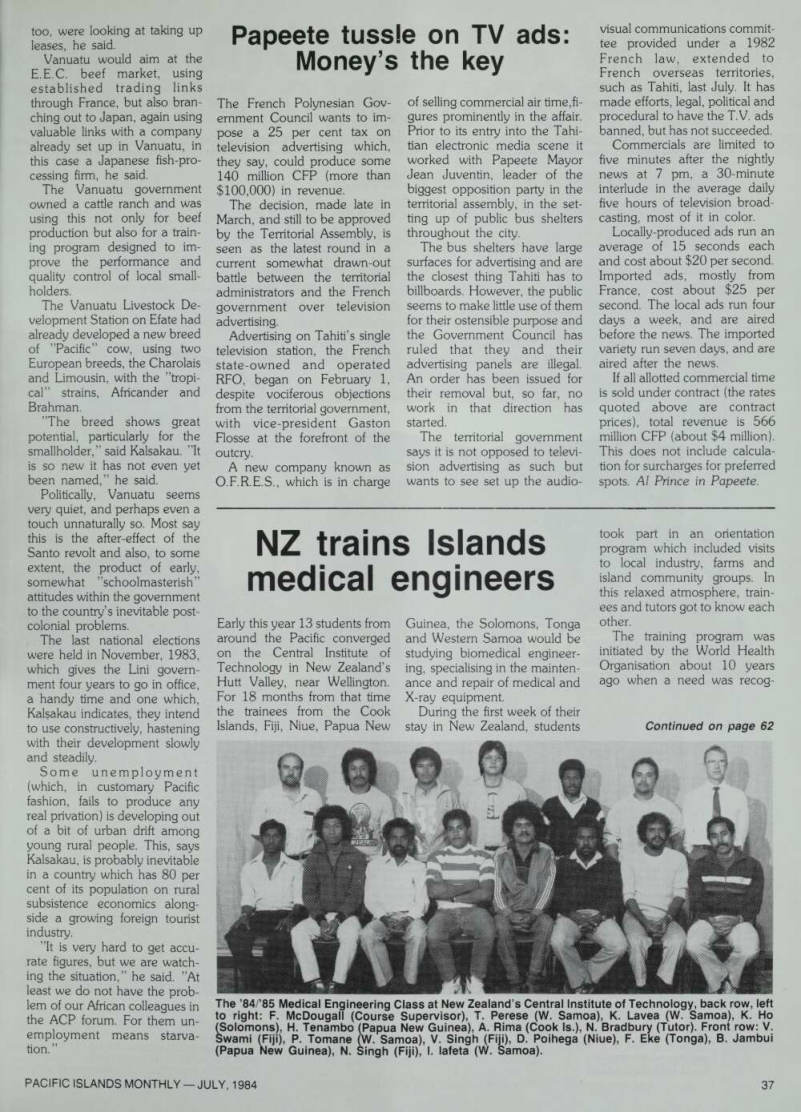
The ’84/’85 Medical Engineering Class at New Zealand’s Central Institute of Technology, back row, left to right: F. McDougall (Course Supervisor), T. Perese (W. Samoa), K. Lavea (W. Samoa), K. Ho (Solomons), H. Tenambo (Papua New Guinea), A. Rima (Cook Is.), N. Bradbury (Tutor). Front row: V.
Swami (Fiji), P. Tomane (W. Samoa), V. Singh (Fiji), D. Poihega (Niue), F. Eke (Tonga), B. Jambui (Papua New Guinea), N. Singh (Fiji), I. lafeta (W. Samoa).
nised for Western Pacific regional health departments to have trained local biomedical technicians on hand in order that advantage could be taken of modem technology. Follow ing visits by a team of W.H.O consultants to various countries in the region, recommendations were made that the training should be conducted in New Zealand because of that coun try’s close ties with the Pacific and its large Polynesian popu lation. The Central Institute of Technology was suggested as being an ideal venue, taking its facilities, which include campus accommodation for 500 stu dents, into account.
The New Zealand Govern ment and the institute were then approached, the result being the signing of a four-year joint project agreement be tween NZ and W.H.O. In 1977 the course supervisor, Fraser McDougall, was appointed to the CIT and he, along with a second W.H.O consultant from Australia, Graham Engisch, were commissioned to under take visits to participating na tions to determine individual requirements and to interview prospective candidates for training.
By the end of the four-year project in December 1982, two 18-month courses, specifically tailored to meet the needs of Pacific nations, had been con ducted. Twenty-five students from 13 nations received train ing, thus providing a nucleus of expertise from which future technicians would evolve.
On completion of the project, the course supervisor under took a four-month follow-up assignment for the NZ Ministry of Foreign Affairs to visit some participating nations to assist in the establishment of hospital maintenance programs to assess future training needs and to report on the overall effect iveness of the project. Findings of the visits, which took in Tonga, Western Samoa, the Cook Islands, Fiji, Kiribati and Solomon Islands were encour aging in that CIT trainees were playing an active and significant role within their respective health departments, including attending to equipment maint enance and repair.
With the main aim of the project being the establishment of effective biomedical sections in Pacific base hospitals, the provision of trained personnel, although a major factor, is by itself insufficient. To achieve the aim more rapidly, each tech nician is provided with a com prehensive tool kit and basic test equipment. In some cases a kit of electronic components and spares is also provided.
Also, technical backup and en couragement is available until such time as technicians be come fully confident.
At the outset, funding was provided for the establishment of specially equipped laborator ies, thus providing “hands-on” experience for trainees. Recent ly a number of manufacturers were approached regarding sponsorship of the project. This resulted in a number of very generous donations of equip ment from companies such as Philips, Roche, S & W Medica Teknik and 8.0. C. Medishield.
Such assistance is invaluable, since it enables technicians to be trained in the latest technology.
It is hoped that health depart ments in Pacific Island nations can now view the future with more certainty and be able to expand and improve their services by acquiring more modern equipment. Trained technicians will be on hand locally to ensure its continuing operation, without the prohib itively expensive presence of overseas experts. From a correspondent in Wellington. • • • Eel skin, tanned, dyed and stitched into sheets to make wallets, handbags, shoes and even briefcases, is becoming popular in many parts of the fashionable world and may pro vide Western Samoa with a handy export industry. Samoan eels are large and have beautifully decorated skins.
Tanned into leather they are stronger, lighter and more scratch-resistant than cowhide.
Paul Hartogh, a lecturer at the University of Samoa has been tanning the skins of both sea and fresh water eels and is in process of sending samples to a tannery in New Zealand for evaluation. He sees a good market for the skins in Australia, New Zealand and Hawaii.