trade winds
pp. 35-37 · Read in the full issue

‘Steady as she goes on Vanuatu economy,’ says Kalsakau
With Vanuatu now given an ”A 1 at Lloyds” style approval rating by the IMF, and tourism burgeoning, Australian and French interests are poised to make major investments in new hotel and resort complexes in the country, says Finance Minister Kalpokor Kalsakau.
After a difficult period since 1980 things were now looking bright, he told PIM during a short interview conducted aboard the Sydney ocean rac ing yacht Helsal 11, renamed “Spirit of Vanuatu” for her entry in the Sydney to Port-Vila race last month. Mr Kalsakau, as Minister for Tourism, and chairman of Air Vanuatu, has been closely involved with promotion of the big yacht race.
Sponsors were local Port-Vila businessman, Ken Berkeley, of Yachting World, the Asiaciti Trust, Air Vanuatu and the Cruising Yacht Club of Austra lia Mr Kalsakau said the planned quite major hotel development was to some extent contingent upon extension of the Vila airport which, at present, was large’ enough only for Boeing 737 aircraft such as that oper ated by Air Vanuatu. The na tional airline, a joint venture with Ansett Transport Industries of Australia, was keen to ex pand traffic and use larger aircraft, which runway exten sion and strengthening would allow.
Vanuatu had an application before ADAB (Australia’s deve lopment aid organisation) for help with the airport deve lopment. Kalsakau said he was confident the project would go through reasonably soon. ”It will make a huge difference to Air Vanuatu, particularly,” he said. At present there were weight limits on the Boeings but with the planned development completed a fully-laden Boeing
727 would be able to use the runway.
The other factor producing a high degree of optimism among tourism investors was the prog ress made with solving Vanuatu’s customary land problems. ”We had to develop a regis tration system for leases, ”Mr Kalsakau said. Registration was now going ahead and investors were able to get a bankable document covering the tenure of their development sites.
In rural areas farmer-settlers were re-negotiating leases with the customary owners and, in most cases, were retaining use of the land. In urban areas re-negotiation of a lease was ’’virtually automatic” for prior occupants, Kalsakau said.
The IMF, in its review of Vanuatu three months ago, gave the country a notable ”thumbs-up” saying its performance could be taken as a model for many others else where in the world, and some of them a good deal bigger countries, too. ”1 am absolutely delighted with their report,” said the minister. ’’They have given us a clean bill of health and an 18-month review period which is as long as the IMF gives anyone. ”
This seal of good economic housekeeping, coupled with re storation of order in the once very vexed land tenure ques tion, and the rise of tourist business gives Vanuatu a buoyant outlook. ’’The economy is impro ving,” said Kalsakau. ”We have a six per cent growth rate per annum and inflation is down to between three and four per cent. There is a balance of payments surplus, the only one in the region I believe, and we continue to operate on a ba lanced budget policy.
’The offshore finance busi ness is growing very quickly, and it will continue to grow, with government support,” he said.
A committee had now been established to report directly to the council of ministers on legislation required, and ways and means of improving deve lopment of Vanuatu as a finan cial centre. ”We plan to make it the best in the South Pacific,” he said.
Perhaps the biggest current problem was restoring morale on Santo. ”It is very quiet these days,” the minister said. ”We now plan to develop Santo’s agriculture, particularly in beef farming,” he said, adding that the plan included support for both large com panies (mostly foreign, but some joint-venture) and small
holders. One large French com pany was there, operating land, and also participating as the major shareholder in Santo’s abattoir. They were re-investing in cattle. Some other French companies, and Australians,
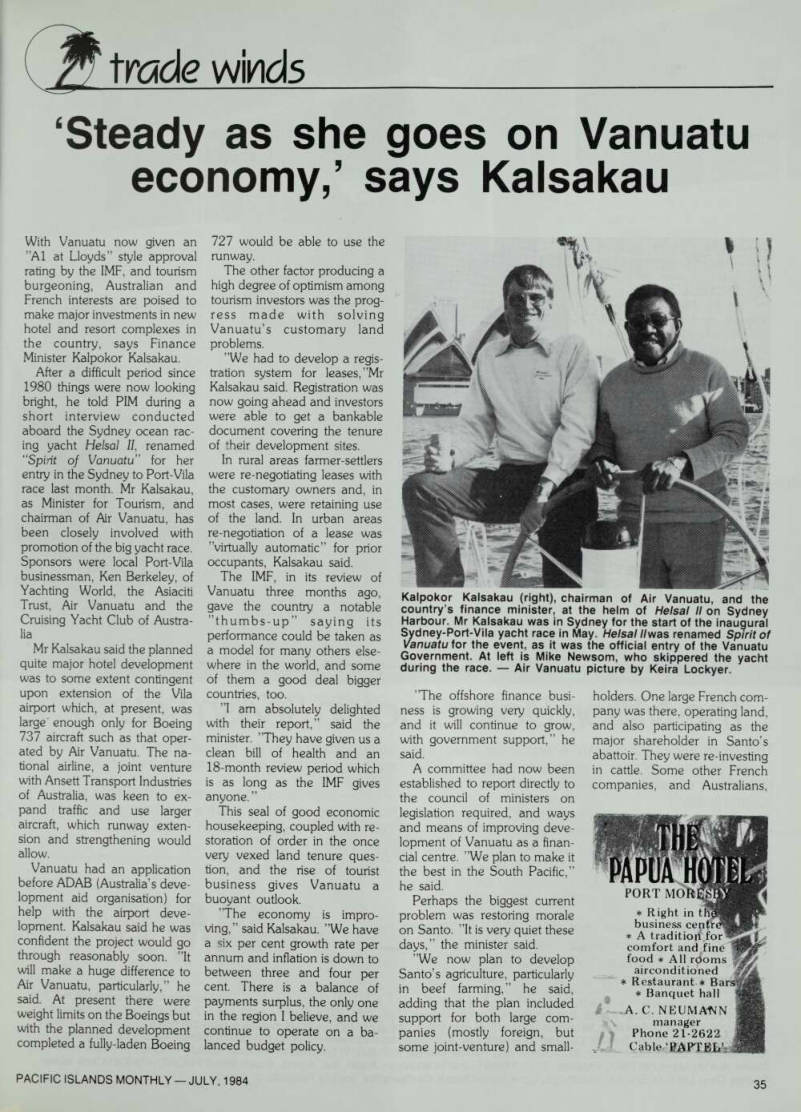
Kalpokor Kalsakau (right), chairman of Air Vanuatu, and the country’s finance minister, at the helm of Helsal II on Sydney Harbour. Mr Kalsakau was in Sydney for the start of the inaugural Sydney-Port-Vila yacht race in May. Helsal il was renamed Spirit of Vanuatu for the event, as it was the official entry of the Vanuatu Government. At left is Mike Newsom, who skippered the yacht during the race. Air Vanuatu picture by Keira Lockyer.
too, were looking at taking up leases, he said.
Vanuatu would aim at the E.E.C. beef market, using established trading links through France, but also bran ching out to Japan, again using valuable links with a company already set up in Vanuatu, in this case a Japanese fish-pro cessing firm, he said.
The Vanuatu government owned a cattle ranch and was using this not only for beef production but also for a train ing program designed to im prove the performance and quality control of local small holders.
The Vanuatu Livestock De velopment Station on Efate had already developed a new breed of ’’Pacific” cow, using two European breeds, the Charolais and Limousin, with the ’’tropi cal” strains, Africander and Brahman. ’’The breed shows great potential, particularly for the smallholder, ” said Kalsakau. ”It is so new it has not even yet been named,” he said.
Politically, Vanuatu seems very quiet, and perhaps even a touch unnaturally so. Most say this is the after-effect of the Santo revolt and also, to some extent, the product of early, somewhat ’’schoolmasterish” attitudes within the government to the country’s inevitable post colonial problems.
The last national elections were held in November, 1983, which gives the Lini govern ment four years to go in office, a handy time and one which, Kalsakau indicates, they intend to use constructively, hastening with their development slowly and steadily.
Some unemployment (which, in customary Pacific fashion, fails to produce any real privation) is developing out of a bit of urban drift among young rural people. This, says Kalsakau, is probably inevitable in a country which has 80 per cent of its population on rural subsistence economics along side a growing foreign tourist industry. ”It is very hard to get accu rate figures, but we are watch ing the situation,” he said. ”At least we do not have the prob lem of our African colleagues in the AGP forum. For them un employment means starva tion.”