Admiral on French N-tests
pp. 31-33 · Read in the full issue

Nuclear armaments ... nuclear ships ... nuclear testing ...These are the emotive phrases of our age.
They have led, and will doubtless continue to lead, to argument, demonstrations, misunderstandings and rage.
But, like it or not, and few sane people take any joy from the presence in the world of a force so indiscrimi nately destructive as the hydrogen bomb, the uneasy peace we have enjoyed in most, though far from all, the world, has been the product of the nuclear stand-off. We have had small wars instead of major international conflicts.
The main strength has always rested with the super-powers, The United States and the Soviet Union.
France’s decision to have her own nuclear force, however small by the standards of the others, has always been the subject of heated debate. It remains so, even today when the world shivers again in the icy blast of a renewed cold war between West and East.
The small nations of the Pacific have never liked the French doing their testing in this area and are keen to see an end to it. The French say they are spending their millions on the project as part of their effort to keep the
free world free. Besides, they say, opponents of the tests grossly exaggerate their dangers.
Declaration of some, or all of the Pacific as a nuclear-free zone will be the major item for discussion at the South Pacific Forum, to be held at Tuvalu from August 26 to 28. Emotionally this will be easy; politically quite difficult. For example, and although Micronesia is not within the Forum area, nuclear questions continue to involve minds working on the independence of Palau (see Pacific Report, this issue), and the future of French Polynesia.
In this latter Pacific country, a territory of metropoli tan France, and dependent upon French government aid, a program of nuclear testing has been the centre of dispute, domestic and international, for nearly 20 years.
Very rarely have ranking French officials ever talked about the program. In this article Vice-Admiral Jean Montpellier, commander of the Centre for Pacific Experimentation (C.E.P.) in French Polynesia, breaks the silence in an exclusive meeting with PIM, explains the French Government’s attitude on nuclear testing, and answers some recent media criticism by PIM columnists Bengt and Marie-Therese Danielsson.
France will resume underground nuclear testing on the Tuamotu atoll of Fangataufa, said Admiral Montpellier. Plans call for the tests to be conducted alternately on Fangataufa about 40km south of Moruroa where France has conducted most of her tests since 1966.
He declined to give a timetable for the tests, or to detail how many tests were scheduled in the current program. That was a matter of national security, he said. The last nuclear test on Fangataufa was an atmospheric one, made‘in 1970. The atoll was then abandoned as a test site because of radiation contamination.
The atoll was no longer contaminated, said Admiral Montpellier, “which is proved by the fact that we are returning. If we send workers to Fangataufa there’s nothing to worry a^out The Admiral rejected suggestions in the Australian magazine The Bulletin that Moruroa “has become so battered and polluted that France has decided to use Fangataufa for bigger and dirtier explosions.”
That is rubbish; quite false,” h e sai d.
Since 1975 the tests, which started in the atmosphere, had
been underground and all radio-active substances emitted had been trapped in the solid rock foundations of the atoll at depths ranging from 600 to 1000 metres below the surface, he said.
The Bulletins article con tained little or no material from French authorities and no effort had been made to check with them, the Admiral said. Among other things it asserted that the French tests would continue ’’indefinitely”. On this, the Admiral said, the tests would continue ”as long as necessary, although I truly hope not inde finitely. ”
The Danielssons, Bengt and Marie-Therese, PIM correspon dents who were asked to write the Bulletin article, say they have on previous occasions spoken with Admiral Montpel lier ... “but he always says things like ‘it’s safe’ or, ‘that’s a military secret...’” Marie-There se said. “To have interviewed anyone from C.E.P. would have been ’completely use less,”’ she said.
Mrs Danielsson and her hus band have been very vocal critics of the French nuclear testing program ever since 1962 when Paris announced it was moving from Algeria to the Tuamotus. Last February she
became leader of one of two rival committees formed to pro test about the testing. This group claims to be apolitical and is made up of members of two local opposition political parties, a women’s group, and a conservationist lobby. They staged a protest march in Pape ete on February 25 this year, attracting a crowd of about 1000.
On March 3, the rival Anti- Nuclear Committee attracted a crowd of about 500 for its march through Papeete. This group links an end to testing to independence for Tahiti.
Mrs Danielsson does not directly link Tahitian indepe dence with the nuclear ques tion, saying independence from France is for Polynesians to decide but, “if getting rid of the French is the only way to stop the testing, then I would say yes,” she said.
The important point, say the Danielssons, is that “there is plenty of land to do under ground testing in France.
Everyone knows that... there is plenty of military land in France. ”
The Bulletin article suggested that Australia was about to ask France why tests could not be done in France. It said a report on the question was in prepara-
tion for Foreign Minister, Bill Hayden, who might then “in crease pressure on France to end testing in the Pacific.”
Admiral Montpellier dismis sed as nonsense the idea of testing in Europe. “Where could one find an area in France where there is a 20 km radius from the testing site free of any population? It just doesn’t exist.”
Nor, he said, had he ever heard a suggestion that any French government had seriously entertained such a thing.
The Admiral said it was quite false that the 58 underground tests so far conducted at Morur oa were as injurious to human health as the 39 over-ground
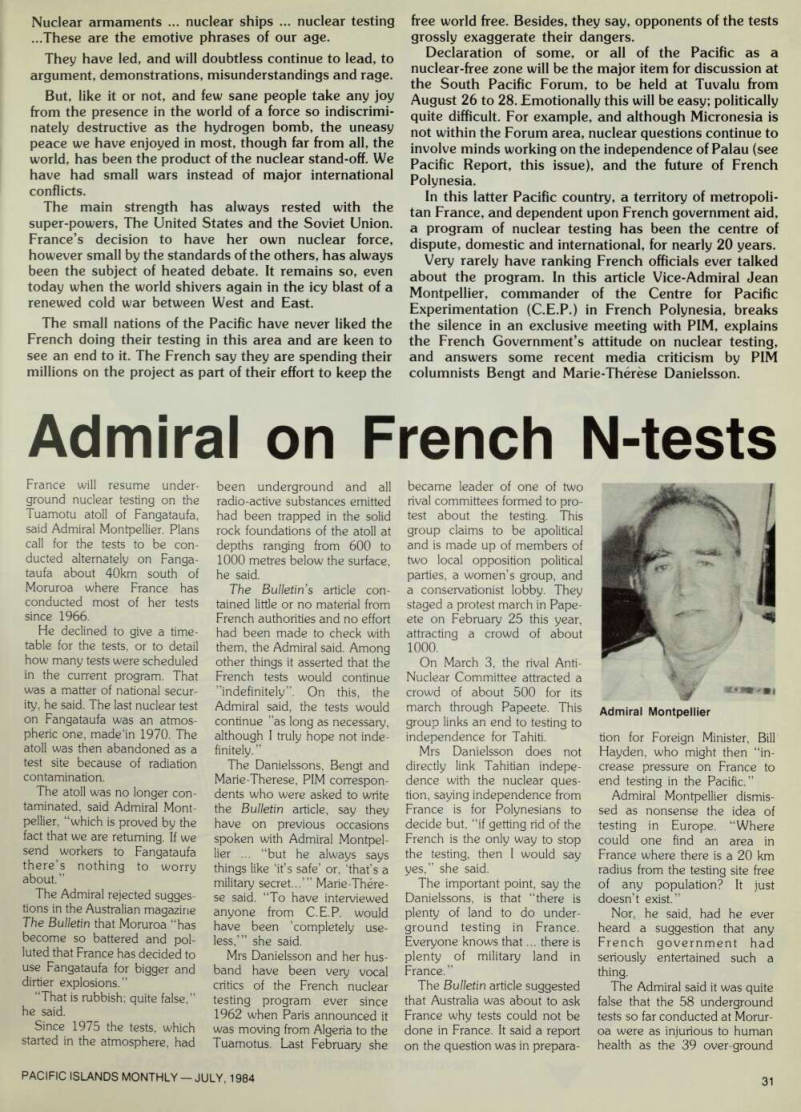
Admiral Montpellier
tests at Moruroa and the two at Fangataufa between 1966 and 1974.
He denied that the projected tests.at Fangataufa will be bigger than any yet made. ”It is too early; nobody knows yet,” he sai d- So much misinformation, guesswork and fantasy existed in the public mind about the effects of nuclear testing, said the Admiral. There had been Suggestions that miscalculations had resulted in major accidents on Moruroa, that explosions had been bigger than anticipated and that the outer wall of the atoll had been breached.
Admiral Montpellier said two French workers had been killed on July 6, 1979, but the accident had nothing to do with the testing. ’’They ignited a spark in a chamber with had just been cleaned with a substance which left explosive fumes,” he said.
Nor did the explosions cause tsunamis, or huge tidal waves. ’’Each underground test creates an earthquake effect which can cause waves, but they travel only about 500 metres,” he said.
Allegations that since 1966 the north coast of Mururoa has been used as a dumping ground for contaminated materials such as tools, clo thing, timber and so forth, were ’’crazy,” said the admiral. ”We do not dump anything in the sea.
“Nor has there been any abnormal increase in cyclones in the region since November, 1980. Moruroa has never been hit by a cyclone, including in that period from December, 1982, to April, 1983, when one tropical depression and five cyclones hit French Polynesia.
Cyclones have come within 80km of the atoll, but Moruroa has never suffered by cyclone damage,” he said.
“However, on March 11 and
12, 1981, a storm loosened some radio-active elements left over from atmospheric tests,” he said. “The atoll’s beaches were closed for a few days while the radio-active residue was cleaned up,” he said.
Since then technicians had regularly checked the state of the atoll, he said, and in spite of some very vigorous storms over the last few years, “no new radio-activity has been found,” he said.
No radio-active waste was scattered around the islands, or floating about in the Pacific, said Admiral Montpellier.
Allegations to that effect were “dangerous” because they led to public alarm, and they were primarily political in their aim, he said.
“People who do not like the French presence in the Pacific spread such stories. Others, who rely on France developing weapons for the free world, take no notice. Public opinion is pretty well-formed by now.”