West Irian: suffering[?] uncertrainry,go on
pp. 14-18 · Read in the full issue
The Free West Papua Movement is seen by the Indonesians as a bunch of lawless rebels to be hunted down ruthlessly and removed from West Irian’s political scene as quickly as possible.
Papua New Guinea’s government is forced by the realities of international politics to put aside the ethnic links strongly felt by many PNG people at grassroots level. Port Moresby now finds the OPM a source of embarrassment at home, and in relations with Jakarta, and Canberra. Australia sought to stay out of the spotlight, but was dragged in when a row developed with Michael Somare’s government over an Australian-made television interview with OPM leader, James Nyaro. PIM has also interviewed Mr Nyaro, in considerably greater depth than the Australian Broadcasting Corporation, and in the following pages reports his perhaps simplistic, but undoubtedly sincere, views as told to Alfred Sasako.
The Free West Papua (OPM) movement was formed 22 years ago at Sorong and Manokwari in the southern section of the island Papua New Guinea shares with Indonesia.
It was started by leading Melanesian activists, including Abner Asmuruf and Permenasi Awom, whose brother, Joel, a major in the Indonesian para military mobile group main tained in Jayapura, was said to be involved in the planning of
the abortive uprising in Jayapura in February this year, Asmuruf and Permenasi were captured in 1967 and, according to some West Irianese living in Port Moresby, were later brutally murdered by Indonesian troops.
Asmuruf was the chairman of the fledgling movement back in 1962. Until 1982 the OPM suffered setbacks in its drive to draw international attention to its problem, due largely to political in-fighting over the movement’s leadership.
Nobody who cares for the peace and stability of the Pacific Islands can have taken the slightest comfort from the epi sodes of clumsiness, and mis fortune, which marked the lat est round in the continuing saga of the West Irian border. The outbreaks of foot-in-mouth dis ease spread from Port Moresby, through Sydney, and even to Melbourne. Only Jakarta re mained immune. The Indone sians who are, by some counts, the villains of the piece, but who are, of course, still the legal proprietors, kept their mouths shut and proceeded deter minedly in the direction of what they wanted: the crushing of the Irianese OPM rebels.
Meanwhile, in a row over where a television interview took place with West Irian guer rilla leader, James Nyaro, Papua New Guinea put clamps on the operations of foreign journalists in PNG, largely gag ged the Australian Broadcasting Corporation’s office in Port Moresby, and announced it would not renew the work
permit of Mr Sean Domey, the resident ABC man.
This in itself was seen, even by the ministers issuing the order, as entirely unfortunate.
Mr Dorney was the meat in the sandwich; the sacrificial goat in a dispute with the Australian media for which Mr Somare had no taste, but in which he saw for himself no other course.
At the heart of this row was the very different way in which Australian, and other western, international reporters see their rights and duties, as compared with the attitudes of the leaders of developing countries.
The offending program was ABC television’s Four Comers which, in the 1982 Fiji general elections, also ran foul of prime minister, Ratu Sir Kamisese Mara. As Mr Somare did last month, Ratu Mara accused them of failing to realise the values and the sensitivities of third world nations, and of sensationalising a very delicate and difficult situation for their own programming ends.
Papua New Guinea insisted that the Four Comers reporter,
Mr Allan Hogan, had been told not to entice Mr Nyaro on to PNG territory. Mr Hogan said he had not been so instructed.
Most likely he had been so advised, but not in terms that he, as pretty much a stranger to Melanesian courtesies, would fully recognise.
The other pity of the media mess over the issue was that the program, and the interview, probably were not worth all the fuss.
In Australia, however, it all assumed fairly large propor tions when the relatively new, “clean-up the image” chair man, of the ABC, millionaire retailer Mr Ken Myer, delivered himself of words seen as critical of working foreign correspon dents. He said, broadly, that they should accept what might be seen by them as censorship and refrain from embarrassing foreign governments. That caused a media uproar in Aus tralia, led to demands for Mr Myer’s resignation, for the “sor ting out” of ABC management, which seemed to have caused the upset in the first place by
agreeing to a reqest from Mr Somare not to screen the rather poor one-minute film of Mr Nyaro.
Mr Somare’s concern was that PNG would be seen by Indonesia as harboring and aid ing the rebel pretender. In the end, the film was screened, but so much fuss was generated that Jakarta saw honor as satis fied and congratulated PNG on its disciplining of the foreign media.
Then, somewhere in the mid dle of the storm, PNG bagged a visiting Indonesian journalist, more or less accused him of spying, but had to apologise publicly when he was proved to be innocent.
The whole affair had some of the aspects of a Wagnerian opera, complete with Valkyrian choruses of outraged journal ists, concerned members of the public, and bags of wounded, not least of them the board and management of the Australian Broadcasting Corporation.
As an opera it was totally absorbing. As an exercise in foreign relations it was a dis
OPM president, Mr James Nyaro, is a man who has successfully gathered the “broken pieces” together, bringing unity among the Melanesian population ,n Inan Jaya.
In this exclusive interview, conducted at the border earlier this year, Mr Nyaro talks about the disunity in the past, the plight of Melanesians driven from their homeland and what he sees as the importance for Papua New Guinea of the OPM presence along the border. For almost five hours I sat questioning and cross-questioning the self-styled president of the OPM, James Nyaro, on the “whys, the whens, the ifs and
the hows” of his movement’s 22 year struggle for independ ence from Indonesia. -‘ W e do not want to be ruled by Indonesia and we will fight w 0 afe „ he me “I am sorry that until only last V ear political in-fighting for Power by the two main factions °f OPM one led by Jacob P ra i an d the other by Seth Rumkorem, both now living in ex^e i n Europe had pro jected a bad image interna tionally on our intentions. ”
“We, too, did not, and still do not want this,” Nyaro said, “Today I can assure you that we have achieved national uni ty and our goal now is a united
push for independence for the Republic of West Papua New Guinea,” he said.
Nyaro claimed PNG had to be “part of the struggle” to win this independence for the esti mated 2.5 million Melanesian people in Irian Jaya.
If PNG did not help then, “sooner or later” PNG would join West Irian under Indone sian military rule.
“For the past 22 years PNG has turned a deaf ear to our requests and appeals for help. I think it is now time for PNG to help us or we (the OPM) will look to other sources,” he said.
Fie did not specify what those “other sources” might be, but claimed that PNG, as the lead
ing Melanesian nation of the Pacific, had a duty to help
Opm.
“If PNG could help Vanuatu achieve its independence we do not see why we, as Melane sians, should not be accorded the same, or similar help,” he said.
The other reason for seeking PNG’s assistance was that “we believe PNG does not want communism along its border with Indonesia.”
“Our country, West Papua New Guinea, is a Christian country and we do not want to turn it into communism, ” Nyaro said.
But, as commander in chief of an estimated 35,000 Papuan
aster in which the real losers seem to have been the good guys, Mr Somare and his gov ernment Mr Somare is disadvantaged whatever he does, and can do precious little to change that fact. He cannot afford to be too accommodating to his Melane sian cousins to the west, be cause to do so would badly upset. Indonesia. Yet, among his own grassroots electors, there is a very strong sense of outrage at what is happening in West Irian, and criticism of Mr Somare for not “doing some thing” about it. But his options are extremely limited, and, for him, the political risks are high.
The initiative is with Mr So mare’s opponents inside PNG, and with the Indonesians who seem to have got off virtually scot-free so far as international criticism is concerned, despite the very oppressive nature of their approach to Melanesian interests in West Irian.
Perhaps the most poignant question of all is posed by Mr Nyaro in the interview we publ ish in this issue: “Mr Somare
went to the aid of our Melane sian brothers in Vanuatu; why does he ignore us now?” There are plenty of answers to that, none of them satisfactory to people on either side of the border.
Many people, among them the PNG opposition leader, lambakey Okuk, ask why can not the West Irian problem be returned to the United Nations and be re-examined by the colonialism and human rights committees? The United Na tions position is that West Irian was dealt with when the In donesians took over from the Dutch. None has taken up the cry.
The Port Moresby govern ment does not say so in stento rian tones, but is quite clear that it must live with Indonesia, that its first duty is to the 3.5 million people of Papua New Guinea and, however much they might be drawn by ethnic links, not to the Melanesians over the bor der. In stating this policy Mr Somare was aware that he was making himself unpopular in his own grassroots, but he felt he
had no choice.
In the brand-new, and beautiful parliament in Port Moresby the Foreign Minister, Rabbie Namaliu, who had been at the epicentre of the political cyclone, and who appeared to be speaking very much for Mr Somare, laid out the govern ment policy: “The maintenance of good relations with the gov ernments of neighboring coun tries is vital to our national interests. Members of parlia ment and other leaders, should, therefore, think carefully about what they say on the subject.
“The government of which I am a member recognises that there have been serious difficul ties on our border in recent months, and in our relations with Indonesia. But we believe that the discussions and other exchanges that have taken place have helped to reduce tensions and strengthen rela tions.”
And then a final word: “The government welcomes criticism and questions,” he said. “We ask only that they be responsi ble, positive, and sensitive to
our national interests.”
Meanwhile, Indonesia was also doing a little to ease the tension. In Jakarta a civil rights group was set to investigating the killing of Melanesian academic, Arnold Ap (reported in this issue).
Jakarta also reiterated its statement that when the border refugees were repatriated, and that, they indicated, would be a gradual, screened process, there would be no reprisals.
This did not convince the re fugees themselves, and no great campaign to sift them and send them back has yet begun, or even seriously been contem plated.
They, meanwhile, are being fed by the PNG government, assisted by Austcare of Austra lia, some promises of funds from Indonesia, and the Roman Catholic church.
The last word for the month on this continuing saga came from Jakarta where it was re ported that 55 OPM guerrillas had surrendered at an Indone sian army post near Jayapura.
freedom fighters, he said, time was running out for him. “We may be left with little option.
That message to PNG is short and clear.”
Nyaro said any resort to the seeking of help from a com munist power would be “a last resort” and that he and his men were “prepared to fight to the last man until we have an answer from PNG.”
Nyaro blamed Australia for advising PNG against giving him any assistance.
But why Australia? 1 asked him. After all, PNG is an inde pendent, sovereign nation.
“PNG’s independence is only a rubber stamp from Aus tralia and even to this day everything is controlled by Can berra,” he retorted.
Despite the stem and very blunt nature of his words, Nyaro, a Dutch-educated agri culturalist who now styles him self “general,” speaks very quietly, almost in a monotone, but his conviction of the justice of his cause is strong and very clear. He looks older than his 42 years; grey flecks speckle his beard. His eyes look tired.
There is a depression on his left cheek, which might be the mark
of an old injury. He has the air of a man who feels himself to be at the centre of great events.
But surely, if PNG helped the OPM Indonesia would retaliate, I said.
“Well, now is the time for PNG to help us before security is tightened,” he said. “And even if Indonesia did learn about such help, and wanted to retaliate militarily, or otherwise, we would join forces to meet any threat,” he said. Nyaro might not have many guns, but he does not lack confidence.
“PNG must not forget that it is a member of the United Nations and the Common wealth, and I have no doubt in my mind that members of the Commonwealth would not just stand by and watch while one of its members was in difficul ty,” he said.
And then Nyaro repeated again what he seems to regard as his “message” for Port Moresby; “If PNG stands idly by now it will be swallowed whole by Indonesia later on.”
Nyaro said he was convinced Indonesia would one day in vade PNG. Far from being an embarrassment, he claimed, the OPM was in fact of benefit
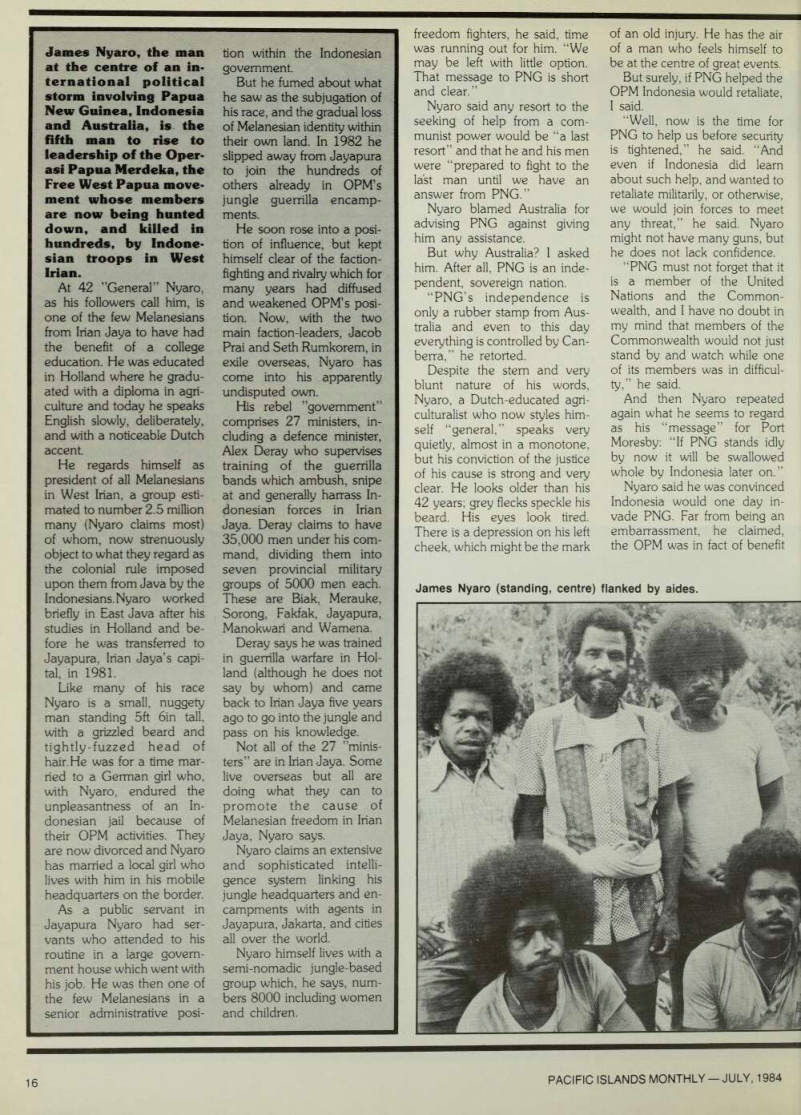
James Nyaro, the man at the centre of an In* ternational political storm involving Papua New Guinea, Indonesia and Australia, is the fifth man to rise to leadership of the Oper* asi Papua Merdeka, the Free West Papua move* ment whose members are now being hunted down, and killed in hundreds, by Indone* sian troops in West Irian.
At 42 ’’General” Nyaro, as his followers call him, is one of the few Melanesians from Irian Jaya to have had the benefit of a college education. He was educated in Holland where he gradu ated with a diploma in agri culture and today he speaks English slowly, deliberately, and with a noticeable Dutch accent He regards himself as president of all Melanesians in West Irian, a group esti mated to number 2.5 million many (Nyaro claims most) of whom, now strenuously object to what they regard as the colonial rule imposed upon them from Java by the Indonesians. Nyaro worked briefly in East Java after his studies in Holland and be fore he was transferred to Jayapura, Irian Jaya’s capi tal, in 1981.
Like many of his race Nyaro is a small, nuggety man standing sft 6in tall, with a grizzled beard and tightly-fuzzed head of hair. He was for a time mar ried to a German girl who, with Nyaro, endured the unpleasantness of an In donesian jail because of their OPM activities. They are now divorced and Nyaro has married a local girl who lives with him in his mobile headquarters on the border.
As a public servant in Jayapura Nyaro had ser vants who attended to his routine in a large govern ment house which went with his job. He was then one of the few Melanesians in a senior administrative posi
tion within the Indonesian government But he fumed about what he saw as the subjugation of his race, and the gradual loss of Melanesian identity within their own land. In 1982 he slipped away from Jayapura to join the hundreds of others already in OPM’s jungle guerrilla encamp ments.
He soon rose into a posi tion of influence, but kept himself clear of the faction fighting and rivalry which for many years had diffused and weakened OPM’s posi tion. Now, with the two main faction-leaders, Jacob Prai and Seth Rumkorem, in exile overseas, Nyaro has come into his apparently undisputed own.
His rebel ’’government” comprises 27 ministers, in cluding a defence minister, Alex Deray who supervises training of the guerrilla bands which ambush, snipe at and generally harrass In donesian forces in Irian Jaya. Deray claims to have 35,000 men under his com mand, dividing them into seven provincial military groups of 5000 men each.
These are Biak, Merauke, Sorong, Fakfak, Jayapura, Manokwari and Wamena.
Deray says he was trained in guerrilla warfare in Hol land (although he does not say by whom) and came back to Irian Jaya five years ago to go into the jungle and pass on his knowledge.
Not all of the 27 ’’minis ters” are in Irian Jaya. Some live overseas but all are doing what they can to promote the cause of Melanesian freedom in Irian Jaya, Nyaro says.
Nyaro claims an extensive and sophisticated intelli gence system linking his jungle headquarters and en campments with agents in Jayapura, Jakarta, and cities all over the world.
Nyaro himself lives with a semi-nomadic jungle-based group which, he says, num bers 8000 including women and children.
James Nyaro (standing, centre) flanked by aides.
to PNG. “Our presence helps keep the military regime of President Suharto from making any advances.
“But the time may be sooner than most people think when the Indonesians will come mar ching into PNG,” he said.
For many years, he said, the OPM had provided PNG with intelligence reports which, he claimed, “consistently pointed to Indonesia advancing east wards. ”
What form of help did he need from PNG?
“Our immediate problems are two-fold,” he replied. “We urgently need arms, including 2250 automatic rifles, machine guns, hand-grenades and other ammunition. Our other urgent request is that we be allowed exit through PNG so that I can take my people’s struggle for independence to international bodies, including the South Pacific Forum and the United Nations. ”
Nyaro conceded that at pre sent his men had few guns; those they carried were mostly gathered from Indonesian sol diers killed in jungle ambushes. (“Our Melanesian brothers have given their lives for the
arms we do have...”).
Some apparently reliable re ports say they have a few Israeli-made weapons, though nobody seems to know how many, or from whom they were obtained. But most OPM jungle fighters seem to use bows and arrows, spears and hatchets.
Food, medical care and shel ter seem to be of little concern to them. “We are living on soil, just like any other people, and food is the least of our worries,”
Nyaro said. “Even clothing is no problem.” Some of Nyaro’s men are deserters from the Indonesian forces and still wear the uniforms, and colorful red, bright blue and khaki berets of Indonesian regiments. Nyaro himself sometimes wears T shirts, and on other, perhaps more formal, occasions, dons a jungle green uniform without badges either of rank or identi ty- “ Medical care is our main problem. Because Indonesia is hostile to us, our sick children, women and men are just left to either recover without help, or die,” Nyaro said.
“In the past PNG was good to us, by allowing some of our sick people to be treated at
Vanimo (PNG’s most northern town on the 800 km long bor der), but this has been stopped by the Foreign Affairs Depart ment,” he said.
Could they not get treatment in Jayapura?
“Oh, no. We cannot go back to Jayapura. The Indonesians would just kill us, knowing that we are OPM members,” he said. Lately, however, he said, OPM had stopped sending its sick to Vanimo because the first batch, having been treated, was sent back to Jayapura. What had happened to them after that he did not know. Only the Indonesians knew, Nyaro said.
In the jungle the main killer diseases were cerebral malaria and diarrhoea.
Nyaro’s account of the Feb ruary clashes between OPM and Indonesian troops in Jayapura is somewhat different from official statements, and suggests much more activity, and considerably greater vio lence.
According to him about 150 Melanesian soldiers in the In donesian armed forces, includ ing the second-in-command of the para-military mobile bri gade (BRIMOB), Major Joel
Awom, held a meeting of dissi dents in Jayapura last Decem ber. They decided to activate OPM operations, firstly in Jayapura. Nyaro said a mes sage was relayed to him at OPM headquarters along the border that the troops were ready to strike on or about February 13.
He approved the plan, he said, but before it could be executed Indonesian intelli gence had intercepted it, for cing the planners to launch their attack four days early, on Feb ruary 9. (Other reports suggest the OPM adherents became over-excited by the prospect of an uprising and talked about their plans in the hearing of Indonesian agents or informers.
The Jayapura military com mander immediately began arresting known sympathisers.) Major Joel Awom, whose elder brother, Permenasi Awom, was one of the founders of OPM, moved out with those troops loyal to him, and broke into the army barracks in Jayapura. They seized a large quantity of guns and ammuni tion, said Nyaro, which enabled them to launch a series of hit-run attacks on Indonesian
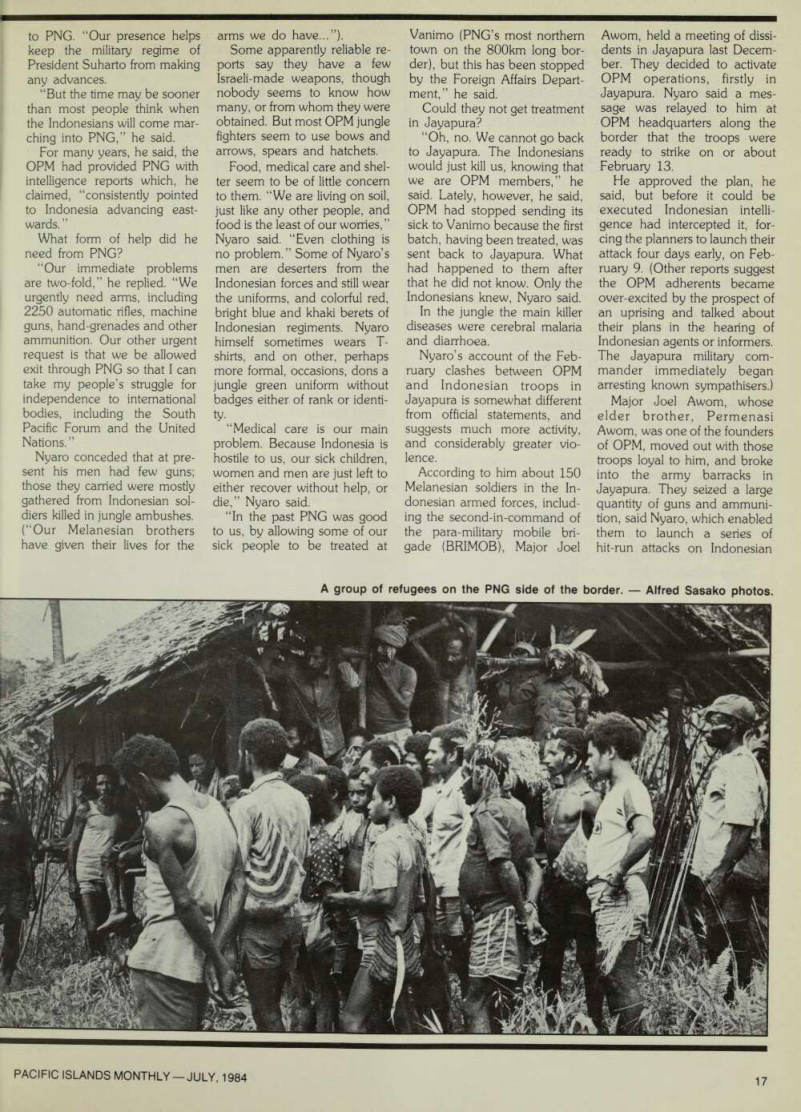
A group of refugees on the PNG side of the border. Alfred Sasako photos.
troops in and around Jayapura.
Other Melanesians in the In donesian forces deserted and joined the rebels. Some fled across the border and were among early groups of refugees collected at Vanimo and charged by PNG authorities with illegal entry.
Nyaro claims that Jayapura was blacked out totally as pow er and telecommunications were destroyed in violent clashes between OPM guerrillas and Indonesians. Two OPM members were shot dead as they tried to raise the move ment’s flag at the provincial parliament building in Jayapura.
The Indonesians began re taliatory attacks all over the town; the city’s residents, main ly women and children, began to flee into PNG. This flood has continued, as Indonesian re prisals have gone on.
They represent a grave embarrassment for the Port Moresby government which, undoubtedly, will be judged wrong , either by Indonesia, or by its own people, whatever it finally decides to do with the refugees.
For there can be no doubt that the refugees are very afraid about what could happen to them if they were pushed back over the border, and very little question but that their fears are well-grounded.
“We appeal to PNG to look after our children and women now in Vanimo and other bor der villages,” said Nyaro.
“Their lives are in great danger if they are returned to Jayapura. ”
On Indonesia’s transmigra tion policy Nyaro said that up to 1980 as many as 90,000 Javanese had been resettled along the PNG-Indonesian frontier.
“But don’t think these settlers are ordinary civilians,” he said.
“They are trained military per sonnel disguised as civilian set tlers,” he said. (This accords with other reports, some of them from Jakarta, which talk of Indonesian Army families being the “foundation” of new settlements along the road In donesia is building the length of the frontier).
As day dawned at the end of the interview, 1 asked Nyaro
what plans he had, if ever his people gained independence.
“Irian Jaya will retain the present seven districts (pro vinces) each under a comman ding militwry officer,” he said.
“Military rule will be imposed for two years after Indonesia grants our independence so that we can ensure proper and effective security against any clandestine operations by In donesia.
“When the 24-month period has elapsed, a national election will be held so that a democra tically-elected government can be installed. It will be up to the national parliament to decide on the number of provinces and whether West Papua New Guinea should have a president or a governor-general as head of state.
“All these things are en shrined in our constitution,” he said. “The fighting going on is indicative of how-soon we want to be independent from In
donesia. ”
Alfred Sasako.