Phosphates
p. 11 · Read in the full issue
and facts
Having been a reader of PIM for many years, I know that you share my belief that journalism cannot be made out of rumors and small-town polemics particularly in the delicate ba lance of the Pacific islands’ feelings and politics.
Yet I am shocked and appal led, as scientist, writer, and party to the subject-matter, by the lack of journalistic integrity and decency of the article of the Danielssons, “From Makatea to Mataiva” in PlM’s April issue.
Its unbroken string of errors and untruths could have been easily avoided by checking the public records or simply calling some of the concerned parties; the companies’ representatives, the administrative or government officers informed, the local service of mines, or myself.
What makes the thing worse is that your columnists built up their misrepresentations into some kind of plot and personal attack against the “French ty coon” Jean Breaud, of Tahiti, who, ironically, never assumed the possible existence of Mataiva; did not play any part in setting up the original Califor nia-based group of companies which initiated the prospecting; did not even ever attend any of the Raro Moana consortium meetings; has no active role and only a minority interest in my local company, Polymin, that he accepted to join as a friend of my family, with and for his son Olivier later assassin ated; and finally, has always spoken about the Mataiva pro ject more as an advocate of French Polynesia’s interests at large than of his own indirect and very modest interests in the venture.
The existence of Mataiva phosphates, or similar under water atollian deposits was nev er and nowhere hinted when I originated the idea in 1972 and started our explorations which took us, at some risk, during the last 10 years, across surfs, reefs, and storms, through some 75 Pacific atolls and 12 jurisdic tions. I frankly resent that the Danielssons deny me altogether the concept, the organisational effort and the discovery; that they take away my company from me: and that they don’t give me a phone call to check their facts!
The discovery of Mataiva occurred in 1976, not in 1978.
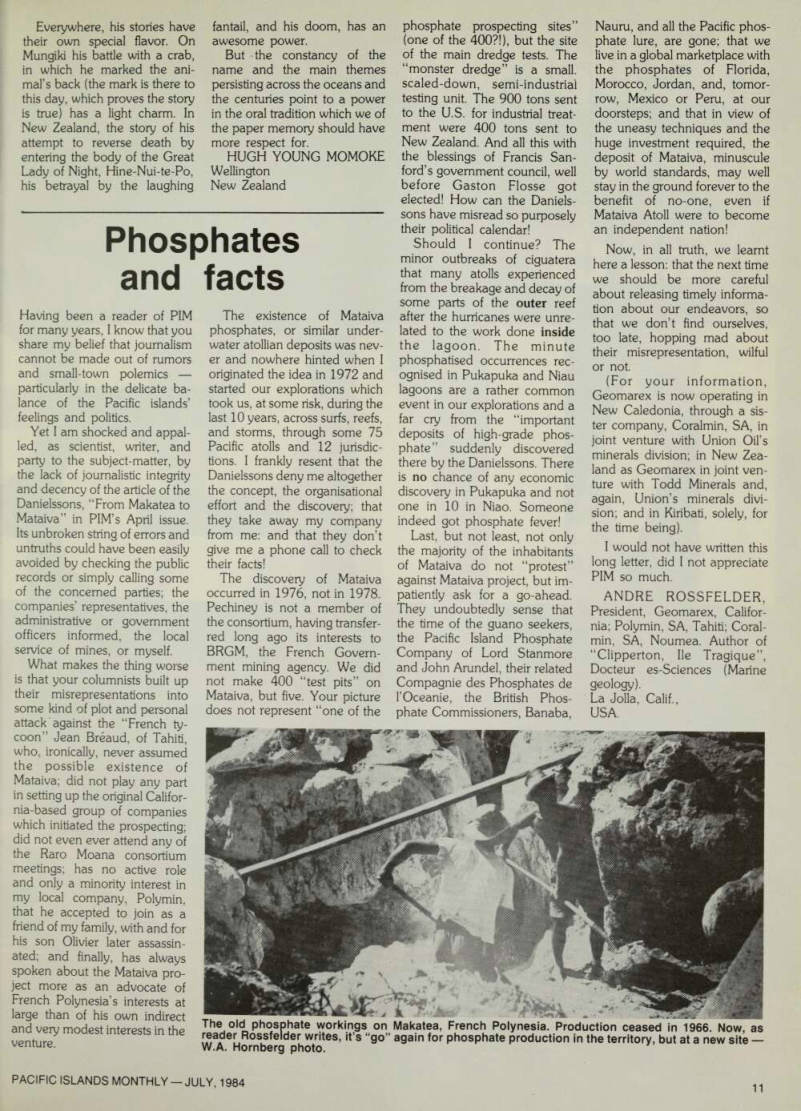
Pechiney is not a member of the consortium, having transfer red long ago its interests to BRGM, the French Govern ment mining agency. We did not make 400 “test pits” on Mataiva, but five. Your picture does not represent “one of the
phosphate prospecting sites” (one of the 400?!), but the site of the main dredge tests. The “monster dredge” is a small, scaled-down, semi-industrial testing unit. The 900 tons sent to the U.S. for industrial treat ment were 400 tons sent to New Zealand. And all this with the blessings of Francis San ford’s government council, well before Gaston Flosse got elected! How can the Daniels sons have misread so purposely their political calendar!
Should I continue? The minor outbreaks of ciguatera that many atolls experienced from the breakage and decay of some parts of the outer reef after the hurricanes were unre lated to the work done inside the lagoon. The minute phosphatised occurrences rec ognised in Pukapuka and Niau lagoons are a rather common event in our explorations and a far cry from the “important deposits of high-grade phos phate” suddenly discovered there by the Danielssons. There is no chance of any economic discovery in Pukapuka and not one in 10 in Niao. Someone indeed got phosphate fever!
Last, but not least, not only the majority of the inhabitants of Mataiva do not “protest” against Mataiva project, but im patiently ask for a go-ahead.
They undoubtedly sense that the time of the guano seekers, the Pacific Island Phosphate Company of Lord Stanmore and John Arundel, their related Compagnie des Phosphates de I’Oceanie, the British Phos phate Commissioners, Banaba,
Nauru, and all the Pacific phos phate lure, are gone; that we live in a global marketplace with the phosphates of Florida, Morocco, Jordan, and, tomor row, Mexico or Peru, at our doorsteps; and that in view of the uneasy techniques and the huge investment required, the deposit of Mataiva, minuscule by world standards, may well stay in the ground forever to the benefit of no-one, even if Mataiva Atoll were to become an independent nation!
Now, in all truth, we learnt here a lesson: that the next time we should be more careful about releasing timely informa tion about our endeavors, so that we don’t find ourselves, too late, hopping mad about their misrepresentation, wilful or not. (For your information, Geomarex is now operating in New Caledonia, through a sis ter company, Coralmin, SA, in joint venture with Union Oil’s minerals division; in New Zea land as Geomarex in joint ven ture with Todd Minerals and, again, Union’s minerals divi sion; and in Kiribati, solely, for the time being).
I would not have written this long letter, did I not appreciate PIM so much.
Andre Rossfelder,
President, Geomarex, Califor nia; Polymin, SA, Tahiti; Coral min, SA, Noumea. Author of “Clipperton, He Tragique”, Docteur es-Sciences (Marine geology).
La Jolla, Calif.,
Usa.
The old phosphate workings on Makatea, French Polynesia. Production ceased in 1966. Now, as reader Rossfelder writes, it’s “go” again for phosphate production in the territory, but at a new site W.A. Hornberg photo.