tropicalities
pp. 59-61 · Read in the full issue

Bringing order to the Pacific babel
Pacific Island nations are diffe rent from nations of the rest of the world in many ways: they are exceptionally small in land area and population, excep tionally large in sea area, excep tionally beautiful, and excep tionally young politically as na tions. They are also, of course, exceptionally diverse in terms of culture and language.
The Pacific represents, with no doubt whatsoever, the world’s most polyglot area.
Each country has at least one completely unique indigenous language, that is shared by no other nation, and many coun tries have considerably more than one. Papua New Guinea has a staggering 750 languages.
Of all the countries of the world, Vanuatu tops the list in terms of “language density”, even ahead of Papua New Guinea, with over 100 distinct lan guages (and I definitely do mean distinct languages, and not just dialects of languages!), spoken by a population that is considerably smaller than a city the size of Newcastle in the Australian state of New South Wales. Even the largest Pacific languages, such as Tahitian, Melpa (of PNG) and Western Dani (of West Papua) with 100.000 speakers each, or Enga (of PNG) with over 150.000 speakers, or even Sa moan with a quarter of a million speakers, are absolutely tiny by world standards. Who in the Pacific has ever heard of Lahn da but it has eight and a half millions speakers. (It is spoken in India.) Eleven of the Pacific’s micro states have banded together in an international agreement to provide a unique system of tertiary education, in the form of the University of the South Pacific. This agreement links Solomon Islands, Vanuatu, Fiji, Tonga, Western Samoa, Kiriba ti, Tuvalu, Naum, Nive, Toke lau and the Cook Islands. The
university is now in its second decade, and has produced a large, and growing, number of much-needed graduates to sup ply the higher-level labor mar ket of these small Pacific na tions.
Until 1983, it could be said that the courses of the USP did very little to reflect the linguistic diversity of the region that it was set up to serve. There are approximately 220 indigenous languages spoken in the 11 countries of the USP region, yet almost all courses offered to Pacific students were either in or about English, which in the eyes of some can be called a colonial language. The minis ters of education of the coun tries that “subscribe” to USP met together in December, 1981, and collectively asked that the university provide courses that better reflect the actual linguistic situation, in all of its diversity.
The university was daring enough to set up this new unit, not in Suva, where most of its
other courses are taught, but in Port-Vila. However the choice of Port-Vila for such a unit was only logical. Not only does Vanuatu have more languages per head of population than any other country in the world, but it also contains about two thirds of all the languages of the USP region.
Vanuatu is also the only country in the USP region in which a Pacific language is declared by its constitution to be the national language. (The national language is Bislama.) And Vanuatu is the only USP
country in which French is an official language of education, in addition to English. If you determine the size of a nation’s language problems by the num ber of its languages, Vanuatu certainly has the biggest! The university set up its Atoll Re search and Development Unit in Kiribati where the atolls are. So too, it set up its Pacific Languages Unit in Vanuatu where most of the languages are!
However, while this unit is based physically in Port-Vila, it is intended to service the needs of the region as a whole.
Courses are being taught by correspondence to students in a number of countries simul taneously, with tutorials being conducted regularly by means of a satellite hook-up. Courses are also taught in special sum mer schools, in which staff go to different places in the USP region and teach concentrated courses which have full univer sity credit.
Nobody has suggested that it will be an easy job to organise such a system. It is obviously going to be impossible for the university to allow students to major in all of the 220 lan guages of the region. A more
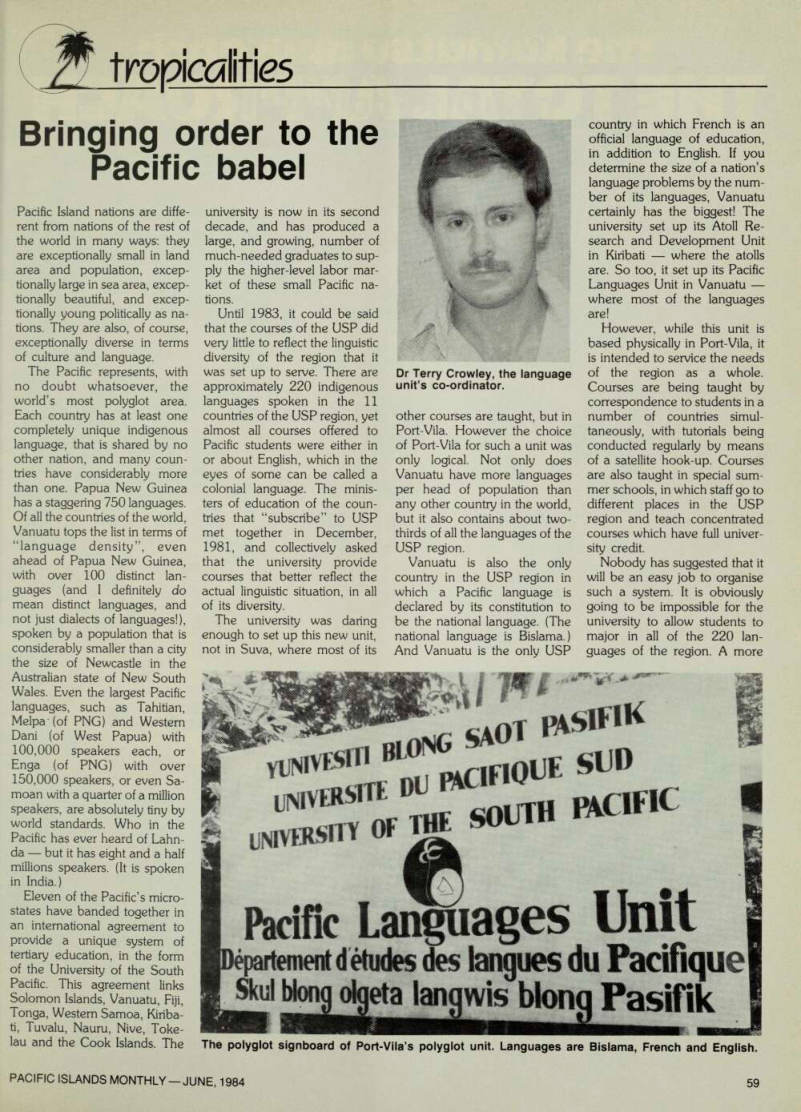
The polyglot signboard of Port-Vila’s polyglot unit. Languages are Bislama, French and English.
Dr Terry Crowley, the language unit’s co-ordinator.
practical aim is to teach courses that will enable Padific Islanders to analyse the language situa tion in their own countries, and to try to develop solutions themselves to the particular problems that are found there.
Just as Pacific countries are diverse linguistically, so too are they diverse in the kinds of problems they face. The prob lems faced by Western Samoa, for example, with its relatively large, single language which it shares with a neighboring country, American Samoa (a unique situation in the USP region, incidentally) are quite different from those faced by countries like Vanuatu and Solomon Islands, with their many, tiny languages.
So far, students in Solomon Islands, Vanuatu, Kiribati and Cook Islands have taken the first-year level course Introduc tion to Language Studies, and more students throughout the region will be taking the course in 1984. During the summer schools held in January and February this year, students in Tuvalu and Vanuatu were tak ing courses in translation tech niques, which was also at first year level, and students in Kiribati were taking a course in language planning and deve lopment. In co-operation with the Vanuatu ministry of edua tion, the unit conducted a work shop on Tanna in Vanuatu which looked at the possibility of producing teaching materials for primary school children, us ing Vanuatu languages them selves as the medium of instruc tion, rather than English or French. This is a concept that is new for many people in Vanuatu, who have become accustomed to thinking that only English or French could ever be used for such purposes.
There is clearly a long way for the university to go in recognising the linguistic di versity of its region. Without a doubt, the original languages of colonialism, English and French, will always remain im portant to the development of the Pacific, but it is also vital that we recognise and develop the original languages of the area. Terry Crowley * *Dr Crowley, a linguistic specialist whose main interest is Oceanic languages, is co-ordi nator of the USP Pacific Lan guages Unit, Port-Vila.