anniversary of the
pp. 61-62 · Read in the full issue
Book honors 40th anniversary of the liberation of Guam
Forager was the American code name for the capture of the Marianas from the Japanese in 1944. Principally, the islands of Saipan, Tinian and Guam were included in the planning, with Rota being an island allowed to “die on the vine”, in the opera tion.
The American commander in-chief of naval forces in the Pacific, Admiral Chester Nimitz, had several purposes in mind when he selected these islands for capture.
First, they would provide bases from which the new, long-range American bombers the B-29s could fly raids directly against the home is lands in Japan. A second reason was that the Marianas would provide bases which could isolate and neutralise the central and western Carolines.
The Japanese had bases of considerable size at Truk, and also Woleai.
Stevedore was the code name for Guam in particular. A
lot of planning went into the Guam operation. Guam had been American territory since 1898, and the people there were seen as avidly loyal to America. In the months before the invasion word went about among the American com mands that would be involved that if there were any Guama nians serving in them, they could have the chance to be connected with the force that would invade the Marianas.
Many took them up on it.
D-day was July 21. Assaults were made in the middle of the island along the west coast. The troops went ashore on two separate beaches and the sup porting fire came from the battleships and cruisers offshore. The ship fire support was asisted by carrier-based
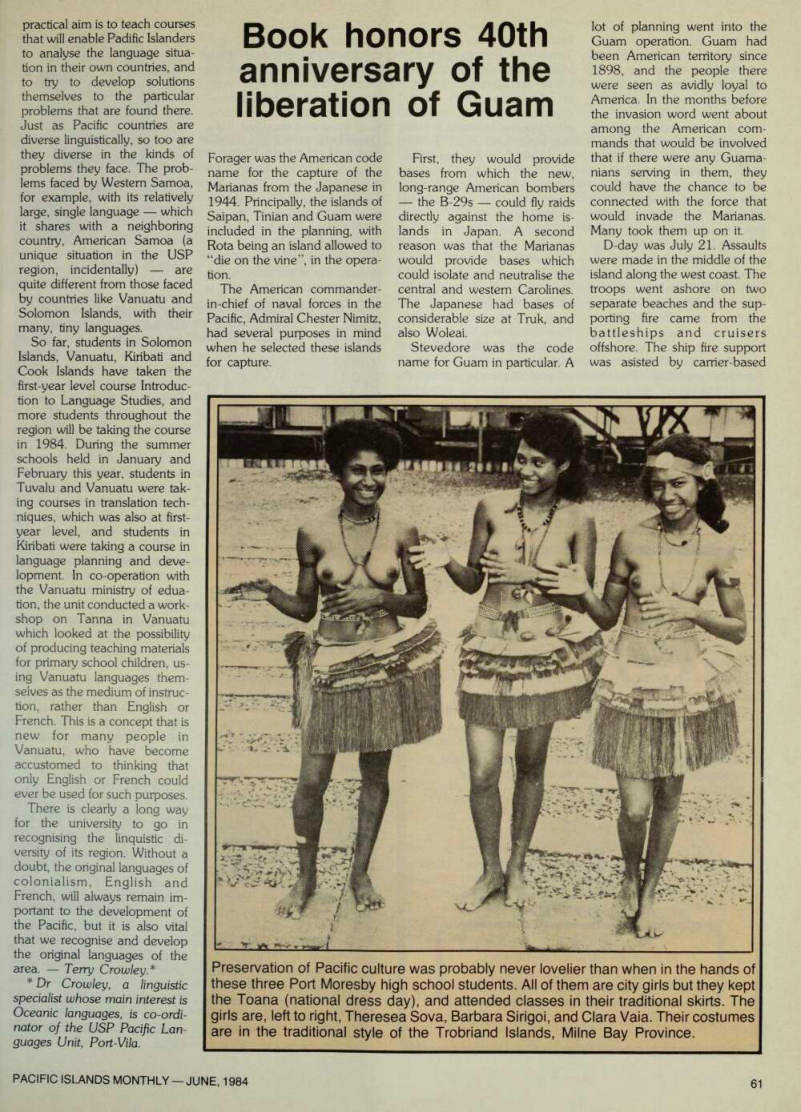
Preservation of Pacific culture was probably never lovelier than when in the hands of these three Port Moresby high school students. All of them are city girls but they kept the Toana (national dress day), and attended classes in their traditional skirts. The girls are, left to right, Theresea Sova, Barbara Sirigoi, and Clara Vaia. Their costumes are in the traditional style of the Trobriand Islands, Milne Bay Province.
planes. Inland from the beaches was high ground which had to be secured by the Marines before the beaches would be safe for greater organisation, regrouping, and just plain liv ing, for the Marines. As ad vances were made on to the high ground, the Japanese re pulsed the attacks with a series of bloody banzai charges which resulted in heavy casualties on both sides but worse for the Japanese. The Marines 3rd Di vision and the Army’s 77th Infantry Division made up the American assault strength.
Enter now, 40 years later, Don Farrell. He has prepared a book The Pictorial History of Guam: Liberation 1944 which more than adequately tells the story of the Guam invasion from the historical accounts available. This re search has been done quite effectively. But, the great strength of Farrell’s effort lies in the story he tells of the people of Guam and the suffering they endured under the Japanese occupation, and also through the days of the invasion holo caust.
The Chamorros had many heroes during the war years.
There was Father Duenas, a local priest who could never abide the Japanese presence on the island, and resisted continuously after repeated efforts by the Japanese to make him cease and desist. Several days before the American inva sion and recapture, he was martyred in his cause of resist ance when the Japanese be headed him.
There were many Chamor ros who suffered quietly under the heavy hands of the Japan ese task masters who impressed them into labor duties in the closing months of the war which were as arduous, humiliating and terrible as any reported in the war. In a num ber of instances, these Chamor ro patriots rose up against the Japanese when the opportuity presented itself. All this, and much more, is recorded by author Farrell in a series of exciting tales which are high lighted with poignancy in the greatest collection of pictures of the Guam war years and inva sion that has ever been assem
bled in one volume.
Because of the photos, and the amount of new data which Farrell brings to light through his many interviews with surviv ing eye-witnesses, Liberation —, 1944 is more than a memorial to all those who struggled, it is a contribution to the historiogra phy of the Pacific War, and of Guam’s role in it particularly.
Not only will the people of Guam and succeeding genera tions feel a gratitude for this effort of Farrell’s, but historians will as well.
Finally, and of special signi ficance, this entire effort was a local production. Not only is Don Farrell a Guam resident and contributing member of the community, but many others who were involved in the book’s publication are also local people resident on Guam. Far rell made optimum use of all the local resources available to him. For this he is to be especially congratulated since he joins in and encourages the growing competence and intel lectual energy that is presenting itself, not only on Guam and in Micronesia, but throughout the Pacific. Dirk Anthony Bal lendorf in Guam.