In off the palace roof . . .
pp. 57-58 · Read in the full issue
Memories Of The Nukualofa Club
Aucklander J. EDWARD BROWN takes a nostalgic backward look at the 1950 s when he was stationed in Tonga’s capital, and drew much comfort from belonging to the Nukualofa Club.
The British flag flew outside the Nukualofa Club, and bougainvillaea cascaded over the front of the building.
“In off the palace roof,” wajs the irreverent late night description of a poorly played billiard shot by bachelor expatriate members.
Just across the road was the palace of Queen Salote, but that was another world we had no part of.
The Nukualofa Club was a gentlemen’s club, not an anachron ism in those times of the mid-19505, though one could not become a member unless one was male and white. It was elitist, and the 40 members enjoyed it. In the atmosphere, even a New Zealander could almost imagine that he was an English gentleman enjoying a part of “home” he had brought with him to that distant part of the empire.
It was still the age of starched cotton shirts and longs for work, white dinner jackets for formal evening affairs, and tins of 50 English cigarettes, though it was Australian canned beer, it was Australian rum, and Australian flying boats on the lagoon.
The club’s architecture was galvanised iron, clapboard walls, and tongue-and-groove preserved colonial era.
It was a pleasant billiard room, the baize green under the old fashioned coolie-hat lights, brushed and ironed regularly by the club stewards. The leather settees were suitably old and cracked.
The slate billiard tables were levelled by a specialist who called into the kingdom for the purpose at intervals.
The high stud bar room had a slowly turning ceiling fan, and portraits of the rulers of England from the days of Edward VII to Queen Elizabeth II on the walls. It had mahogany tables and chairs with white linen seat covers, and swift silent Polynesian stewards, a brass rail at the bar, comfortable.
Females were not allowed inside the club, except on the occasion of the annual ball, and on Tuesday and Friday mornings between 10 am and noon (unless it was also a steamer day) when they could visit the library to borrow books. Because that room
could be approached off a side verandah, they did not have to enter the main rooms.
One afternoon an innocent female member of an air force aircrew did enter. The steward looked aghast. One of the older members almost frothed at the mouth, “No females in here,” he shouted in a very ungentlemanly voice.
The Nukualofa Club was founded in 1914 by some 15 gentlemen, mostly wealthy planters, of whom Tonga had many in those days. In its early days it was very, very exclusive, the members bound to England by the mails which brought the Sphere, The Illustrated London News, the Manchester Guardian Weekly, Punch, the airmail edition of the London Times, all of which still lay on the long green baize-covered reading room table encircled with old-fashioned cane baskets chairs. Over each was a hanging light and a push button for summoning the steward.
Around the walls of the reading room were photographs of Royal Navy ships which at various times were based in New Zealand. In the balmy days before World War II these ships visited the Pacific islands every year on winter cruises. The officers were always automatically visiting members.
There were worm-eaten ancient volumes of the Encyclopaedia Britannica. There were three silver cups on the long table for snooker and billiard contests long since forgotten and disconti nued. There were writing tables where nobody ever wrote, and government gazettes which nobody ever read. There was Webster’s dictionary, leather-bound and ancient, but often referred to along with Whitaker’s Almanack and the newly published Guinness Book of Records to settle bar arguements.
On the writing table lay the suggestions book dating from 1914.
A series of entries concern a suggestion that spittoons be provided for the members. The original proposal had many comments appended, but the final curt one by the secretary wrapped it up, “Gentlemen don’t spit.”
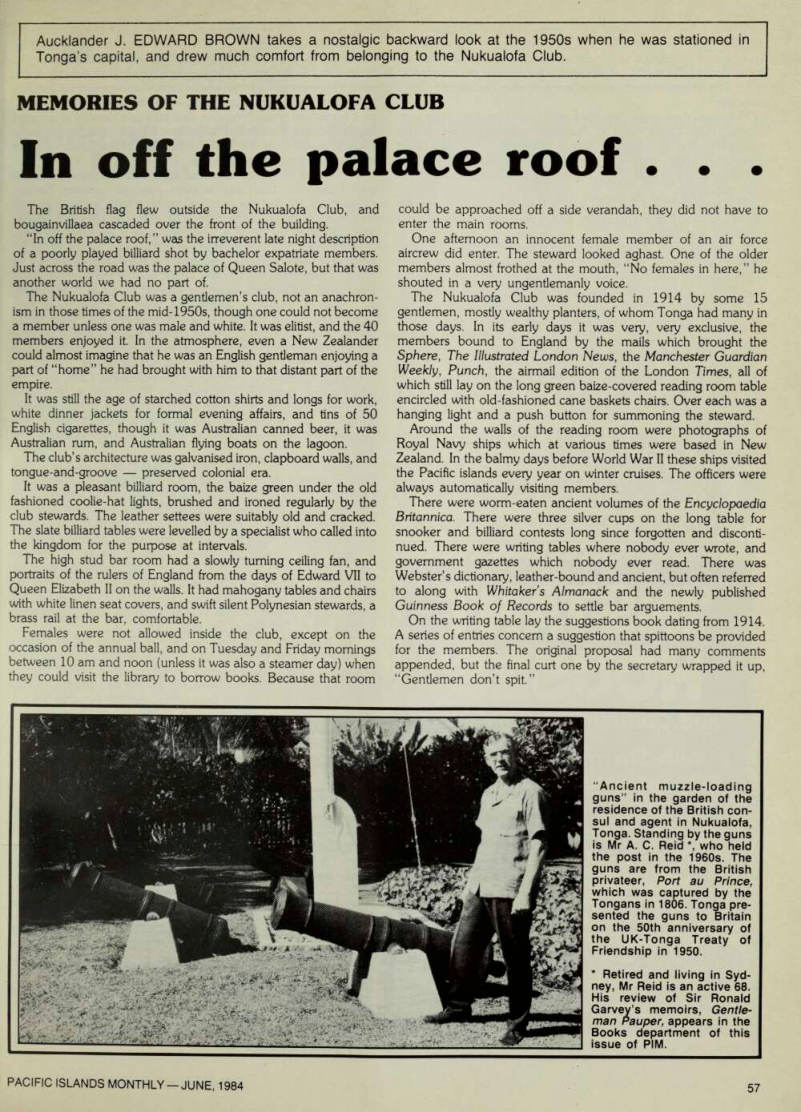
“Ancient muzzle-loading
guns” in the garden of the residence of the British con sul and agent in Nukualofa, Tonga. Standing by the guns is Mr A. C. Reid *, who held the post in the 1960s. The guns are from the British privateer, Port au Prince, which was captured by the Tongans in 1806. Tonga pre sented the guns to Britain on the 50th anniversary of the UK-Tonga Treaty of Friendship in 1950. * Retired and living in Syd ney, Mr Reid is an active 68.
His review of Sir Ronald Garvey’s memoirs, Gentle man Pauper, appears in the Books department of this issue of PIM.
The club had hundreds of books on its shelves and a new parcel arrived from England once a month. A curious collection, or maybe not so curious in the circumstances, the author with the most books in it was P.G. Wodehouse. What could be more British than Wodehouse novels with characters like Jeeves and Bertie Wooster?
However, there were very few English members then, they were mostly New Zealanders or Australians. Fresh copies of the magazines and newspapers were a relic of the old days. Other magazines were gradually being introduced the American Saturday Evening Post , Time, the Australian People , though there was opposition.
The president was English, for by custom he was always the British consul, but the secretary was a New Zealander, and the treasurer was stateless.
In the old days, when members of the committee met, they dressed in white tie and tails. In the ’sos, it was sufficient if they wore ties, and sometimes they didn’t even do that, though the line was drawn at hula shirts after all, it was still a gentlemen’s club.
On the billiard tables the gentlemen’s game of billiards had been replaced by snooker or perhaps pool, or games like slosh or rafferty snooker. Though once a month there was a formal games evening when billiards and snooker competitions were held. The general, who was English, retired, touring, came along one night. “I can’t play,” he said in his barking voice. “They wouldn’t let me play in the mess in India, too bad a player, had to wait until there was nobody there and play the steward. Only man I had a hope of winning against.”
He then proceeded to rack up a large score and win the competition, in fine old English style.
There was a small card room, but nobody played cards, though years ago the members played regularly, and for high stakes, and one night a member lost his plantation on the turn of cards, so it was said.
There were difficulties in running a club in remote Nukualofa. A
visiting ship’s officer complained that he didn’t like drinking gin with raspberry (though it said ginger beer on a bottle). It had to be explained to him that this was just one of the trials of living in Nukualofa. Aerated waters were made locally, but nobody knew what they were going to get when a bottle was opened. Apparently the system the manufacturer used was to make a batch of waters, be it lemonade or anything else, then pick up a handful of assorted labels and slap them on the latest brew, so that ordinary lemonade became ginger beer, raspberry, kola, tropical fruit salad, or more exotically pineapple champagne.
In my time the stewards were Lua and Ella, somewhat Laurel and Hardy-ish. Lua was a stem man of massive Tongan proportions, his skirt-like uala held up by a large leather belt with an enormous brass buckle, while Ella, who was actually a Niuean who had lived in Tonga a long time, was a laughing old man.
Inside the club it was a world without women, except when the telephone rang. Perhaps Lua knew his place, but sometimes he couldn’t resist stepping out. He would answer the telephone and then bend deferentially over the wanted member: “Telephone, sir.” And if it was a woman he always added dead pan, “long-haired voice.” Or, in a tone of disappointment, “short-haired voice.” And if a member should commit the faux pas of bringing out a book of Yacht Club bar tickets to pay for drinks he lifted them disdainfully from the silver tray, “no picture tickets.”
George Quensell, a member of the Nukualofa Club, died. He was the only man who had swum to Tonga, and in later years established the famous Tin Can Island postal service. His coffin was carried to the cemetery on the back of a truck. The only two persons allowed aboard the truck were the two club stewards, Lua and Ella.
Twenty-four hour drinking was possible in those days in Tonga.
One could get a morning bracer at 8 am when the club opened and cold beers could be had through until 11 pm but the services of the steward could be retained by paying 10 shillings an hour overtime.
There was no limit on overtime and some nights the club never closed, overtime being paid until 8 am when it normally opened.
There was another gentlemen’s club at Vavau in northern Tonga, the Vavau Club, run on more or less conventional lines, but it couldn’t compete with Nukualofa Club. A European who had lived in Vavau said thoughtfully: “They have no jiggers for their billiard table, so that members climb up on the table to play those difficult shots. Not done, old boy.”
The Nukualofa Club was the nearest I’ll ever get to being a member of a club modelled on a London gentlemen’s club. Sure, the sweet aphrodisiacal scent of frangipani often wafted through the bar room, smothering the aroma of beer and whisky, and the trade winds rustled the coconut palms, and the sun was hot and blinding, but it was an English club, despite the steady antipodean erosion of its values and its customs.
A hansom cab outside would not have been out of place, and late at night, moonless, it was akin to a pea soup London fog for some members who had imbibed.
There was Her Majesty’s palace adjacent, but of course that was wooden, with colonial fretwork, corrugated iron, hardly Bucking ham Palace; and there was that damned tortoise, Tu’imalila, allegedly brought to Tonga by Captain Cook, which often wandered from the palace into the club grounds, hardly corgi-like, and a danger to an unsteady body who had been attempting to forget the isolation and exile. Nevertheless it was an oasis of civilisation, comforting. One could lounge there drinking Australian Foster’s beer and stare at the picture of Queen Elizabeth newly ascended to the throne, and know that with orb and sceptre underhand she was thinking of this kingdom which was under her protection.
Only a few hundred yards down the road, past the palace, was Her Britannic Majesty’s Agent and Consul’s residence, also with the British flag flying in the front garden, with ancient muzzle loading cannons pointing seaward, ensuring that the Tongans’ foreign relations didn’t go wrong, that the kingdom’s finances didn’t go awry. It was a different age and one felt so secure.
J. Edward Brown.