Trobriands: The cult of yams,
pp. 53-55 · Read in the full issue

and of sexual exuberance
ROBERTO and MARCO PETTINI CODtinu© their “Melane sian Journey,” sharing the daily lives of the villagers of Obulabula, on Kiriwina Island in Papua New Guinea’s Trobriand group. It is, they say, “one of the most beautiful stories of our whole journey..
“We will never know to what extent our amorous exploits depended on Isoba, rather than our particular charms. .
Among Papua New Guinea’s many island groups, the Trob riands are certainly the most renowned.
For the people in the High lands, the Trobriand Islanders are famous for their sexual mores, so free and so different not only from their own, but also from those of all other cultures in the country.
On the coast, the Trobriands are known as the “islands of yams and feats.”
In Milne Bay Province, everybody knows them from the “kula,” the traditional ex change of custom money, per formed every year between cer tain islands in the province.
We had also learned that the Trobriand Islanders represent a very rare example of Papua New Guineans who have deve loped a system of hereditary chieftains, who continue as the local aristocracy to this day.
Fate decreed that during our time in Port Moresby we should meet Martin Morobubuna, only son of the chief of one of the villages in Kiriwina, main island of the Trobriand group. Martin was studying at the art school, and as soon as he learned that we were on our way to his home islands, he urged us to go to Obulabula, the village where his parents and many of his clan live.
So this time the story started like this: with a lucky encounter in the city and a letter of introduction, but with few other indications that in the place where we were headed we would end up living one of the most beautiful stories of our whole journey.
We arrive in Obulabula in the late afternoon. The village is in the interior, a few hundred metres from the single dusty road which starts from the southern swamps and crosses the whole island, right up to the beaches on the northern coast.
Outside the house of Moro bubuna and Isoba Martin’s father and mother we are completely surrounded by the village folk. The Trobriand
Islanders have very strong Polynesian features. Many of them are very handsome.
Some come to shake our hands, others to ask for tobac co. We are given betel nuts and asked scores of questions, all at the same time. As soon as Morobubuna finishes reading
his son’s letter and publicly invites us to stay, the enthu siasm and general confusion increase. Plates of yams and piping hot cups of tea arrive.
We are adorned with flower necklaces and bracelets of colored leaves. We are even asked to repair an old wrist
watch, while a couple of dogs that have infiltrated the group try desperately to avoid being trampled on.
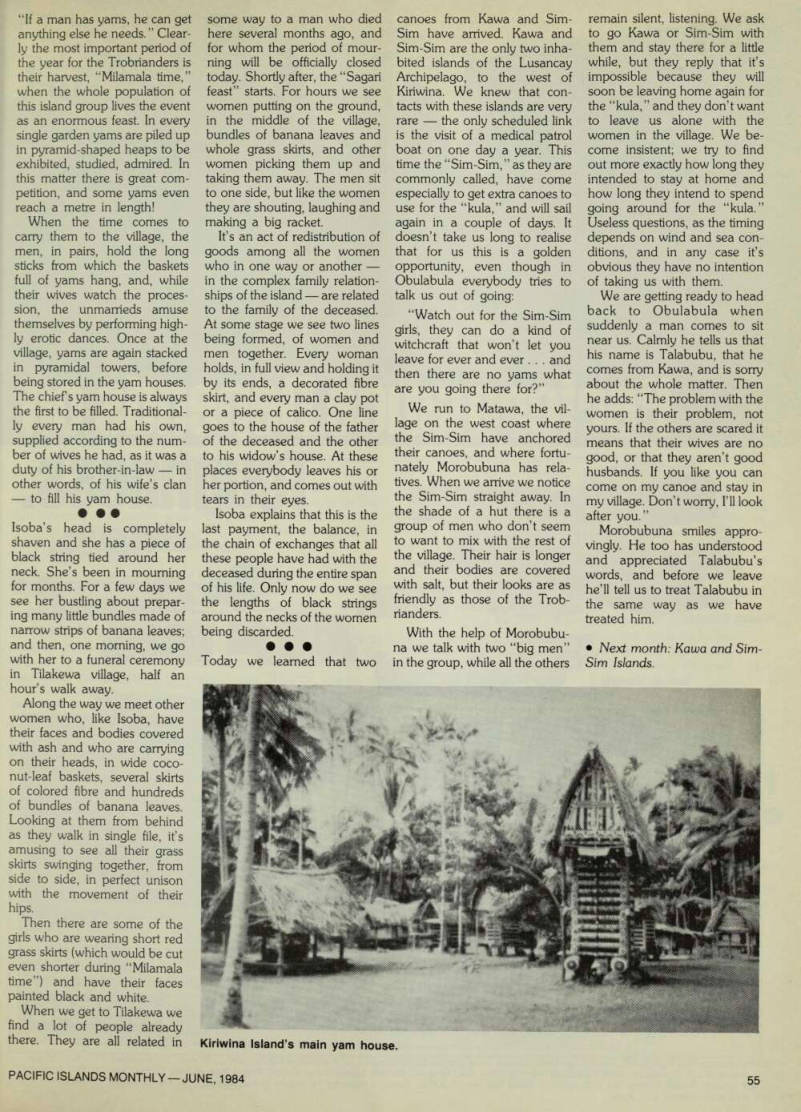
Obulabula is a typical Trob riand village. It’s circular and completely surrounded by coconut palms and tall, slender betel trees. The dwellings are all built on the ground and are very small in relation to the number of people who eat and sleep in them. A great part of the day, though, is spent in the open in the gardens, or sitting and chewing betel, chat ting and smoking under the huts without walls built in front of the dwellings of each family group. Then there are the yam houses, also located in a circle, like a ring internal to the village itself. They are taller, better finished, painted and deco rated, and much more beauti ful, than the dwellings them selves.
Water for drinking and cook ing must be fetched every day from caves and natural springs quite a distance from the vil lage, while to have a wash people use water from tiny wells dug in among the vegeta tion, and only far enough away for privacy.
The village is full of life.
There are always people com ing and going, some carving ebony, others talking loudly, others arguing, others waving to you as they walk by. There is always someone to whom you have to give something and to receive something from in ex change. It is not conceivable here to possess something that can be distributed and not do so, as the whole of Trobriand society is based on a system of continuous exchanges.
This time we didn’t have to wait long. Unexpectedly, and from the very first days, we found and felt ourselves part of the Morobubuna family and consequently involved in their exchange relationships. Prac tically every time we came back to the village with fish or a bunch of bananas, only a part was left for us. Likewise, it’s
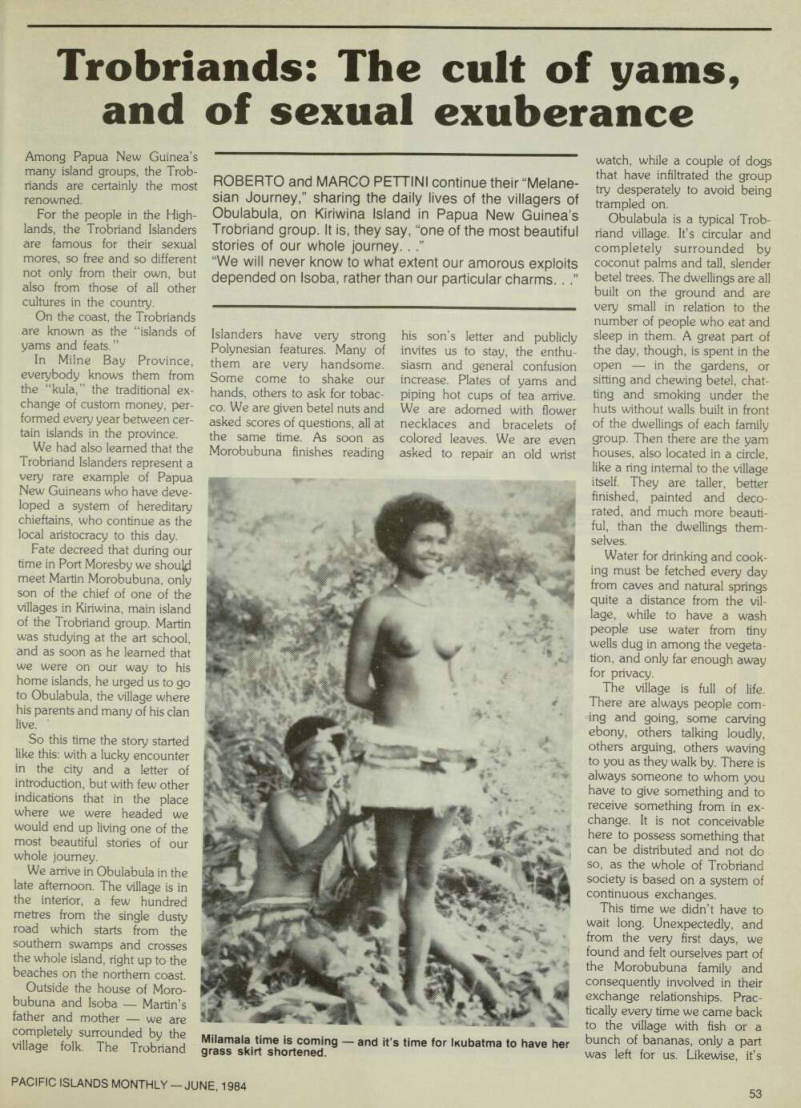
Milamala time is coming - and it’s time for kubatma to have her grass skirt shortened.
practically inconceivable even to consider smoking a whole cigarette, or even this happened to us several times chewing a bit of bubble gum without having to pass it on
sooner or later, for someone else to chew. . . They even get to the extreme position that those who tend to isolate them selves are readily thought to be sick, or are suspected of having
been hit by witchcraft. Such was the case of Aliadou, a mature man who for this reason hadn’t succeeded in getting himself a wife.
We stay more than a month in Obulabula.
Wearing a “kaleko” and al ways like other single youths and girls in the village with flowers in our hair, we live the same carefree life reserved for all young unmarried people on the island. We spend most of the day with the other young folk of Obulabula. Sometimes we all go fishing together on the coral reef, often we spend the day in some neighboring vil
lage. But every night, straight after dinner, we sprinkle our hair with talcum powder, put perfumed leaves in our bracelets, paint each other’s faces, and go dancing. While two or three guitars pass from hand to hand until late at night, our joy is expressed in a thousand laughs, in constant teasing and good-natured mockery, in spontaneous physi cal approaches which always end with a quick escape into the bush. Amorous encounters are very often the final phase of this play. Each unmarried person of either sex here is not only free, but is in fact positively encour aged to have as many amorous experiences as possible before deciding on the most suitable partner with whom to start a family.
Morobubuna and Isoba are wonderfully warm and kind to us, and show their attention in a thousand ways. For example, a few days after our arrival, they thought that we would feel more free if we were lodged in two different huts, and together with us built the walls to trans form their meeting house into a proper dwelling. Marco will live there until we leave, while I’ll remain alone in Martin’s little house now empty next to his parents’ place.
Isoba, who for the time being considers us her adopted sons, will be the organiser of our intricate love affairs. Many nights she will wait patiently for us, to whisper to us which girl she has done witchcraft on for us, and to explain in detail the rules to follow so as not to allow the intrigue to be discovered.
We will never know to what extent our amorous exploits depended on Isoba, rather than our own particular charms. . . With both Moro bubunas, husband and wife, we go quite a few times to their gardens. They have four in different places, and the time just flies as we chat, cut weeds and dig out the yams to take home for dinner.
In the Trobriands, yams are not only the staple food but also part of a ritual, a sign of status and a link among villages and clans. They are so important that Morobubuna once told us:
Morobubuna and his pyramid of yams.
“If a man has yams, he can get anything else he needs. ” Clear ly the most important period of the year for the Trobrianders is their harvest, “Milamala time,” when the whole population of this island group lives the event as an enormous feast. In every single garden yams are piled up in pyramid-shaped heaps to be exhibited, studied, admired. In this matter there is great com petition, and some yams even reach a metre in length!
When the time comes to carry them to the village, the men, in pairs, hold the long sticks from which the baskets full of yams hang, and, while their wives watch the proces sion, the unmarrieds amuse themselves by performing high ly erotic dances. Once at the village, yams are again stacked in pyramidal towers, before being stored in the yam houses.
The chief s yam house is always the first to be filled. Traditional ly every man had his own, supplied according to the num ber of wives he had, as it was a duty of his brother-in-law in other words, of his wife’s clan to fill his yam house. • •• Isoba’s head is completely shaven and she has a piece of black string tied around her neck. She’s been in mourning for months. For a few days we see her bustling about prepar ing many little bundles made of narrow strips of banana leaves; and then, one morning, we go with her to a funeral ceremony in Tilakewa village, half an hour’s walk away.
Along the way we meet other women who, like Isoba, have their faces and bodies covered with ash and who are carrying on their heads, in wide coco nut-leaf baskets, several skirts of colored fibre and hundreds of bundles of banana leaves.
Looking at them from behind as they walk in single file, it’s amusing to see all their grass skirts swinging together, from side to side, in perfect unison with the movement of their hips.
Then there are some of the girls who are wearing short red grass skirts (which would be cut even shorter during “Milamala time”) and have their faces painted black and white.
When we get to Tilakewa we find a lot of people already there. They are all related in
some way to a man who died here several months ago, and for whom the period of mour ning will be officially closed today. Shortly after, the “Sagari feast” starts. For hours we see women putting on the ground, in the middle of the village, bundles of banana leaves and whole grass skirts, and other women picking them up and taking them away. The men sit to one side, but like the women they are shouting, laughing and making a big racket.
It’s an act of redistribution of goods among all the women who in one way or another in the complex family relation ships of the island are related to the family of the deceased.
At some stage we see two lines being formed, of women and men together. Every woman holds, in full view and holding it by its ends, a decorated fibre skirt, and every man a clay pot or a piece of calico. One line goes to the house of the father of the deceased and the other to his widow’s house. At these places everybody leaves his or her portion, and comes out with tears in their eyes.
Isoba explains that this is the last payment, the balance, in the chain of exchanges that all these people have had with the deceased during the entire span of his life. Only now do we see the lengths of black strings around the necks of the women being discarded. • • • Today we learned that two
canoes from Kawa and Sim- Sim have arrived. Kawa and Sim-Sim are the only two inha bited islands of the Lusancay Archipelago, to the west of Kiriwina. We knew that con tacts with these islands are very rare the only scheduled link is the visit of a medical patrol boat on one day a year. This time the “Sim-Sim,” as they are commonly called, have come especially to get extra canoes to use for the “kula,” and will sail again in a couple of days. It doesn’t take us long to realise that for us this is a golden opportunity, even though in Obulabula everybody tries to talk us out of going: “Watch out for the Sim-Sim girls, they can do a kind of witchcraft that won’t let you leave for ever and ever . . . and then there are no yams what are you going there for?”
We run to Matawa, the vil lage on the west coast where the Sim-Sim have anchored their canoes, and where fortu nately Morobubuna has rela tives. When we arrive we notice the Sim-Sim straight away. In the shade of a hut there is a group of men who don’t seem to want to mix with the rest of the village. Their hair is longer and their bodies are covered with salt, but their looks are as friendly as those of the Trob rianders.
With the help of Morobubu na we talk with two “big men” in the group, while all the others
remain silent, listening. We ask to go Kawa or Sim-Sim with them and stay there for a little while, but they reply that it’s impossible because they will soon be leaving home again for the “kula,” and they don’t want to leave us alone with the women in the village. We be come insistent; we try to find out more exactly how long they intended to stay at home and how long they intend to spend going around for the “kula.”
Useless questions, as the timing depends on wind and sea con ditions, and in any case it’s obvious they have no intention of taking us with them.
We are getting ready to head back to Obulabula when suddenly a man comes to sit near us. Calmly he tells us that his name is Talabubu, that he comes from Kawa, and is sorry about the whole matter. Then he adds: “The problem with the women is their problem, not yours. If the others are scared it means that their wives are no good, or that they aren’t good husbands. If you like you can come on my canoe and stay in my village. Don’t worry, I’ll look after you.”
Morobubuna smiles appro vingly. He too has understood and appreciated Talabubu’s words, and before we leave he’ll tell us to treat Talabubu in the same way as we have treated him. • Next month: Kawa and Sim- Sim Islands.
Kiriwina Island’s main yam house.