on turn-of-century
pp. 45-47 · Read in the full issue
Well-crafted novel on turn-of-century British New Guinea
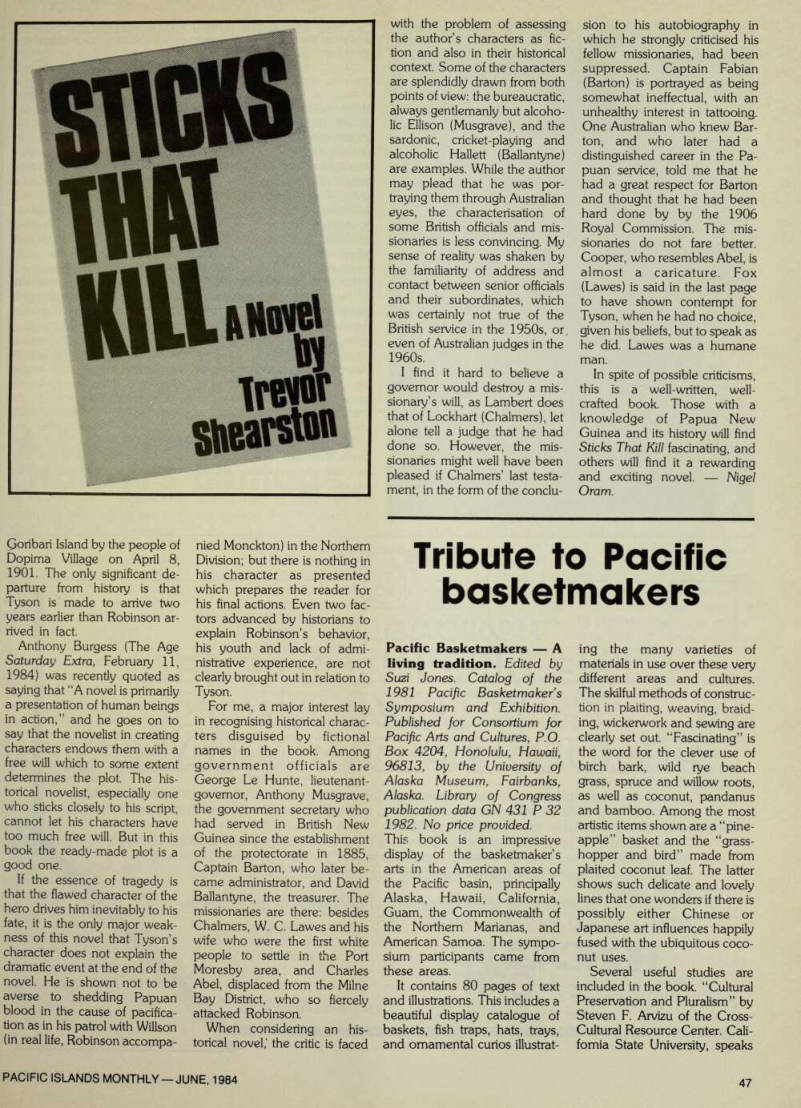
Sticks that Kill. By Trevor Shearston. Published by Uni versity of Queensland Press, 1983. pp ix, 592. ISBN 0 7022 1804 9. Price $A14.95.
I had greatly enjoyed Trevor Shearston’s book of short stories, Something in the Blood, and I set out to read this novel, Sticks that Kill, with great interest. I was not disappointed.
It is an historical novel set in the period from 1901 until June, 1904 when British New Guinea, which became known as Papua after 1906, was legally under the Colonial Office but was being transferred to Australian control as Austra lian Federation was achieved. It was a time when the senior officials came from Britain, the majority of subordinate officers were Australian, there was some Australian resentment over government restrictions on
European enterprise, and the London Missionary Society mission was out of sympathy with the government.
The first chapters are de voted to the mise en scene. The extent of the author’s know ledge of the country and the depth of his research are re vealed in his excellent descrip tions of places, whether of the uninspiring little colonial backwater that was Port Mores by, or the swamp-ridden vil lages of the Papuan Gulf, or the mountains of the Binandere country. In his picture of life in Port Moresby, some of the sub-plots are based on fact.
There was a white market gar dener, for example, who died in the circumstances described in the book; and an official who died when he fell down some steps, probably when drunk, and whose widow married an other local official.
Events are largely seen through the eyes of John Rhys, a young Australian clerk who has come to New Guinea in search of adventure. He in cludes an account of events and his comments on them in letters to his brother. He quickly leams Motu, the local Papuan lan guage, which enables the au thor to provide some insights into Papuan society. Rhys forms, or rather has imposed upon him, a friendship with Judge Tyson, in spite of his disapproval of some of Tyson’s attitudes and actions. This brings him close to the main theme of the book the killing of missionary James Lockhart and Tyson’s reactions, and the subsequent punitive expedi tions carried out by the admin istration.
The novel follows history very closely. Tyson resembles Christopher Robinson, an Aus tralian lawyer who became acting administrator at the age of 32. Lockhart is James Chal mers, still affectionately known to many Papuans as Tamate, who with Tierney (Tomkins), a young white missionary, and a party of Papuans, was killed on
Qoribari Island by the people of Dopima Village on April 8, 1901. The only significant departure from history is that Tyson is made to arrive two years earlier than Robinson arrived in fact.
Anthony Burgess (The Age Saturday Extra, February 11, 1984) was recently quoted as saying that “A novel is primarily a presentation of human beings in action,” and he goes on to say that the novelist in creating characters endows them with a free will which to some extent determines the plot. The historical novelist, especially one who sticks closely to his script, cannot let his characters have too much free will. But in this book the ready-made plot is a good one.
If the essence of tragedy is that the flawed character of the hero drives him inevitably to his fate, it is the only major weakness of this novel that Tyson’s character does not explain the dramatic event at the end of the novel. He is shown not to be averse to shedding Papuan blood in the cause of pacification as in his patrol with Willson (in real life, Robinson accompa-
nied Monckton) in the Northern Division; but there is nothing in his character as presented which prepares the reader for his final actions. Even two fac tors advanced by historians to explain Robinson’s behavior, his youth and lack of admi nistrative experience, are not clearly brought out in relation to Tyson.
For me, a major interest lay in recognising historical charac ters disguised by fictional names in the book. Among government officials are George Le Hunte, lieutenant governor, Anthony Musgrave, the government secretary who had served in British New Guinea since the establishment of the protectorate in 1885, Captain Barton, who later be came administrator, and David Ballantyne, the treasurer. The missionaries are there; besides Chalmers, W. C. Lawes and his wife who were the first white people to settle in the Port Moresby area, and Charles Abel, displaced from the Milne Bay District, who so fiercely attacked Robinson, When considering an his torical novel; the critic is faced
with the problem of assessing the author’s characters as fic tion and also in their historical context. Some of the characters are splendidly drawn from both points of view: the bureaucratic, always gentlemanly but alcoho lic Ellison (Musgrave), and the sardonic, cricket-playing and alcoholic Hallett (Ballantyne) are examples. While the author may plead that he was por traying them through Australian eyes, the characterisation of some British officials and mis sionaries is less convincing. My sense of reality was shaken by the familiarity of address and contact between senior officials and their subordinates, which was certainly not true of the British service in the 19505, or even of Australian judges in the 19605.
I find it hard to believe a governor would destroy a mis sionary’s will, as Lambert does that of Lockhart (Chalmers), let alone tell a judge that he had done so. However, the mis sionaries might well have been pleased if Chalmers’ last testa ment, in the form of the conclu
sion to his autobiography in which he strongly criticised his fellow missionaries, had been suppressed. Captain Fabian (Barton) is portrayed as being somewhat ineffectual, with an unhealthy interest in tattooing.
One Australian who knew Bar ton, and who later had a distinguished career in the Pa puan service, told me that he had a great respect for Barton and thought that he had been hard done by by the 1906 Royal Commission. The mis sionaries do not fare better.
Cooper, who resembles Abel, is almost a caricature. Fox (Lawes) is said in the last page to have shown contempt for Tyson, when he had no choice, given his beliefs, but to speak as he did. Lawes was a humane man.
In spite of possible criticisms, this is a well-written, well crafted book. Those with a knowledge of Papua New Guinea and its history will find Sticks That Kill fascinating, and others will find it a rewarding
and exciting novel.
Nigel
Oram.