books
pp. 43-45 · Read in the full issue

Governor’s memoirs long on dash, short on detail
Gentleman Pauper. By Sir Ronald Garvey. Published by blew Horizons (Transeuros Ltd), Bognor Regis, United Kingdom, 1983. ISBN 0 86116 885 2. Price UK 4.95 pounds.
About the time R. W. Robson was laying the foundations of his Pacific Islands Monthly, a young man with an inexhausti ble appetite for life and an accompanying fund of good humor was in the early stages of his own career at one of the most out-of-the-way comers of the Pacific the south-eastern Solomons.
A decade later we find the two travelling together to Ocean Island, only weeks away from the outbreak of the Japan ese War, with Robbie’s identity mysteriously cloaked in a pseudonym. PIM is now 53 years old, its former proprietor in his 99th year, and the young man over 80 but he evident ly retains his youthful exuber ance, if this book is anything to go by.
Sir Ronald Garvey emerges from its pages a romantic figure, yet one well endowed with the resilience and resourcefulness to cope with the problems that were always liable to beset an administrator in isolated island communities.
The first two chapters of Gentleman Pauper concern boyhood and university days, the rest deals with the author’s varied experiences from cadet to governor in the former colo nial service. The list of territories touched on is an impressive one; the Solomons, the Gilbert and Ellice (now Kiribati and Tuvalu), Tonga, the New Heb rides (now Vanuatu) and New Caledonia, Ocean Island or Banaba, Nyasaland (now Mala wi), St Vincent, British Hon duras (now Belize), Fiji and Pitcairn Island. Two-thirds of his service were devoted to the South Pacific and few men had
a wider knowledge of it in his day. “Whatever the circum stances,” the secretary of state for the colonies roundly de clared after a slip-up in his own office had gravely embarrassed Sir Ronald, “we could rely upon you to take the right action.”
The plan of the book is to introduce each territory with a brief, descriptive note and then the author launches into his rich reminiscing. It would be a mis take, however, to assume it is all light-hearted summoning up of a past which is gone for ever.
The Belize chapter with its reference to Soviet infiltration in Central America at the begin ning of the ’sos has a distinctly topical ring about it: “It is as well”, the author comments, “to remember the Cuban saying that revolution is like a water melon; the more you slice it the redder it gets.”
The spread of the money economy throughout the third world has brought in its wake special problems for peoples whose way of life has hitherto been largely a subsistence one.
Sir Ronald makes a strong plea (the most serious section of the book) in support of credit un ions the aim of which is to teach people how to manage money.
The movement has achieved much during the last 30 years in Fiji, where a training school has been established to cater for the needs of the surrounding is lands. In the book’s prologue there is a positive barrage of home truths voiced by the Fijian director of this credit union school, underlining the sensitivity of many small na tions in particular, towards the patronising attitudes adopted by metropolitan deve lopers.
For the most part, however, throughout these memoirs the raconteur takes first place. The
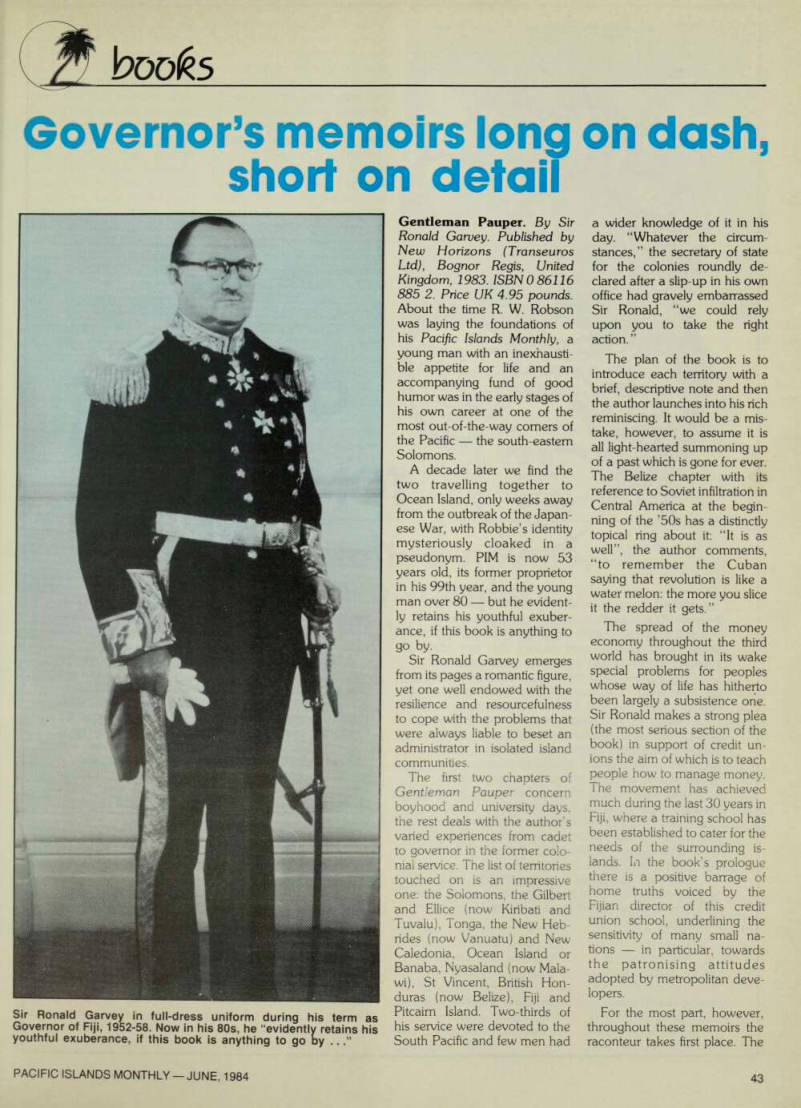
Sir Ronald Garvey in full-dress uniform during his term as Governor of Fiji, 1952-58. Now in his 80s, he “evidently retains his youthful exuberance, if this book is anything to go by .."
man Pauper ignores one of the major issues. This was the con frontation between a French warship, the Dumont d’Urville whose captain, a forceful character once met, never for gotten, was a strong supporter of Vichy, and H.M.A.S.
Adelaide, laid on as a result of London/Canberra consulta tions to escort Henri Sautot from Vila to Noumea. Far from having left for Indo-China as asserted by Sir Ronald, the Dumont d’Urville was in Noumea harbor. She remained there for six days after Sautot’s arrival and it was only after some tense negotiating by Cap tain H. A. Showers of the Adelaide that she and her formidable commander with drew without a clash.
Adelaide continued on at Noumea for another nine days, her presence helping to stabilise conditions ashore. Second only to the gallant Sautot himself, the Australian captain was the right man for the occasion.
Memoirs inevitably tend to emphasise the personal side but, when it comes to events of
style is expansive without bothering over much about in accuracies. Textual errors occur fairly frequently and one gains the impression that the contents have been put together unre vised. There are, for example, within 27 pages no fewer than three descriptions in similar terms of the Fijian yaqona (kava). The author avowedly relies on memory and personal record but, when it comes to certain events over 40 years ago, this reviewer for one would hesitate to depend on his memory alone without re course to official documenta tion. A case in point is the celebrated coup d’etat of September 19, 1940, when the government of New Caledonia was taken over by Gaullist elements under the leadership of Henri Sautot, French resi dent commissioner from the New Hebrides.
Sir Ronald at that time was assistant to R. D. Blandy, the British resident commissioner in the condominium, and he has this to say; “By the time I had settled into my new job it was time for Blandy to go on leave so that I became acting resident commissioner at a particularly interesting time. France had fallen, the Retain government had been brought into being by the Germans and de Gaulle was about to establish the Free French movement.” In reality the general had already issued his rallying call d la France Libre some two months earlier (June 18, 1940), the author having assumed duty as assistant at Vila on August 25, while Blan dy did not proceed on leave until January of the following year. The latter’s name does not appear again in the pages of Gentleman Pauper but he was one of the principal participants in the build-up to the historic event at Noumea and should be remembered as such.
Although the coup turned out to be bloodless, it was no pushover as might be inferred from its treatment by the au thor. A recent, carefully resear ched work ( The Cross of Lor raine in the South Pacific by John Lawrey, reviewed in RIM, July 1982) indicates it was a rather more complicated affair.
While it is not the function of this review to describe in detail the sequence of happenings, it has to be recorded that Gentle-
historical significance, there is an added obligation to present a balanced record.
Apart from that aspect, how ever, there is much to interest the reader in the less fre quented byways of the South Pacific featuring in this book such as the kingdom of Tonga,
Pitcairn, the Line Islands or the Santa Cruz group. The chapter on the last-named is a delightful melange of history, archeology, ethnology and adventurous voyaging in search of a “lost” island to claim for the Crown.
This is the stuff at which the
author excels.
A. C. Reid.
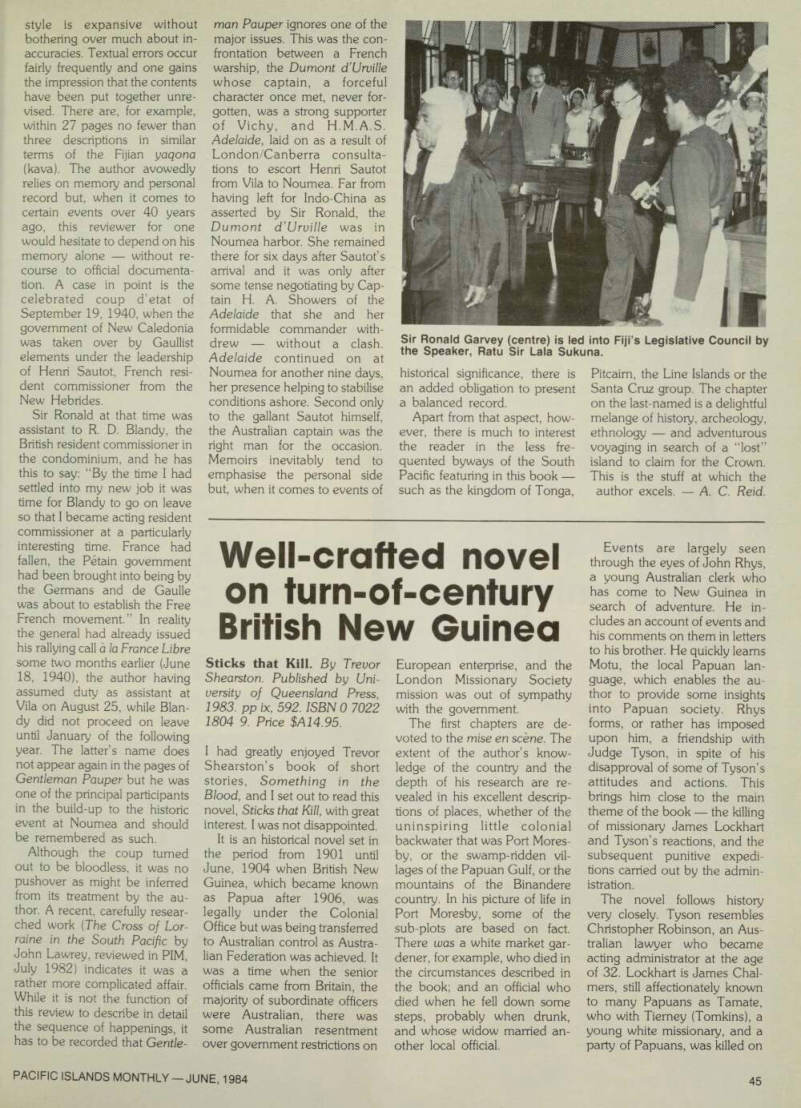
Sir Ronald Garvey (centre) is led into Fiji’s Legislative Council by the Speaker, Ratu Sir Lala Sukuna.