of fishing pressure’
pp. 41-50 · Read in the full issue


trade winds
Tuna: Experts warn of ‘pockets of fishing pressure’
NEVILLE PEAT, a New Zealand ministry of foreign affairs , information officer, reviews developments in the tuna fishing business in the South Pacific.
Tuna occupies a favored place on the economic platter of Pacific Island countries.
Right across the South Paci fic, national development plans are highlighting the prospect of a tuna bonanza based on na tionally owned export opera tions, joint ventures, or the licensing of foreign vessels or a combination of all three.
Many of the smaller states regard the tuna fishery at least, their portion of it as the means by which they can pro gress towards, if not ultimately achieve, economic self-suffi ciency.
But in developmental terms the island countries are only just acquiring a taste for tuna. And it is not altogether clear they will get what they order.
Clouding the prospect, at one level, is a biological factor: tunas move about a lot. Some species track across thousands of kilometres of tropical and sub-tropical ocean, unmindful of territorial waters, 200-mile economic zones, or relative economic interests. Regional research programs have yet to plot the tuna migrations with any degree of certainty. But the research has shown the total resource to be considerable.
The fishermen know that now. The chase is on by foreign fleets and some locally owned vessels for the main commercial tunas, yellowfin and skipjack. Other species, including bonito, bluefin and albacore, are of interest too.
Fisheries scientists report the possibility of “extremely large” yields and “phenomenal” catches by the purse-seine fleets.
Fishing methods, catching patterns and vessel size and origin have all changed drama tically in recent years.
Back in the 1950 s tuna fisheries were the preserve of
subsistence fishermen and a few small-scale operations.
Longlining was introduced by Asian fleets in this decade, but they sought only the larger species of tuna and fished far from shore. Their impact on the
subsistence fishing grounds was unnoticeable.
In the 19605, pole-and-line vessels from Japan entered the region.
By the early 19705, some island governments were sup
porting joint ventures based on the pole-and-line technology, which involves the entire crew of a vessel individually trying to hook and hoist aboard the smaller tuna, like skipjack.
The late 1970 s saw the arri val in force of the expensive purse-seine technique, which involves the encirclement of schools of fish with nets, a much less selective method than pole-and-line.
Japanese and American
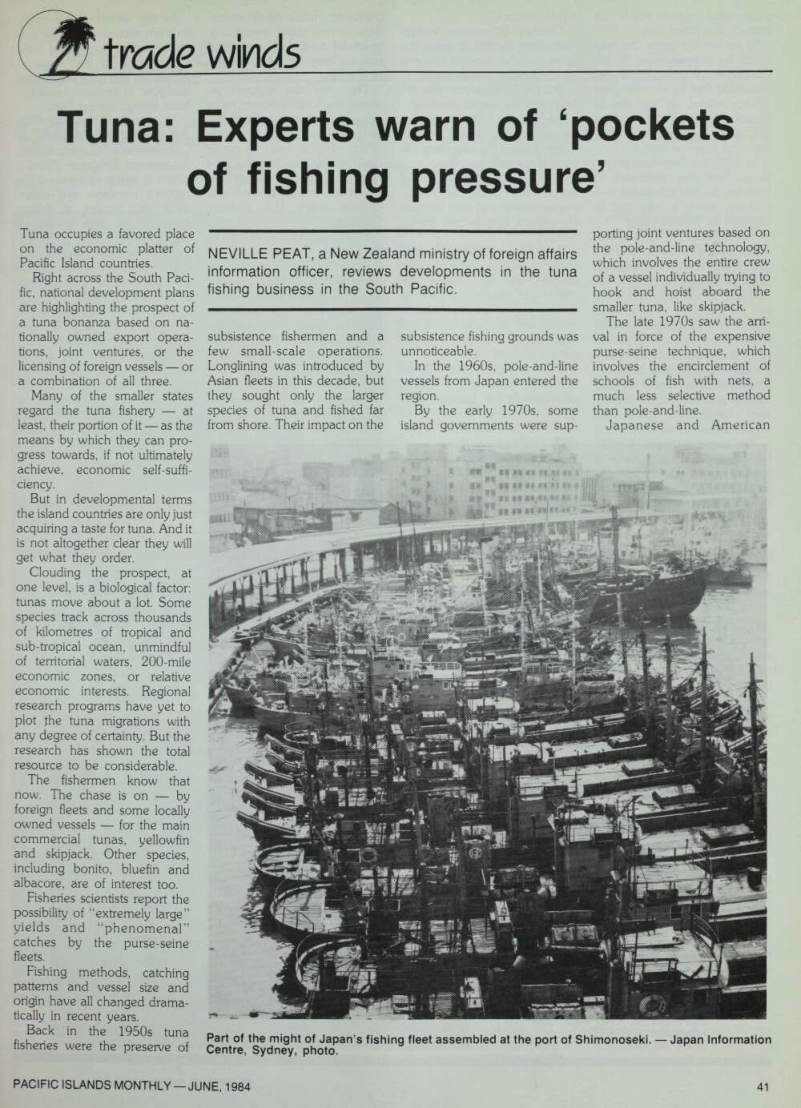
Part of the might of Japan’s fishing fleet assembled at the port of Shimonoseki. - Japan Information Centre, Sydney, photo.
purse-seine vessels made an impact in a short time.
In the last few years, the tuna catch by purse-seining in the Central and Western Pacific has exceeded that by all other gear types. Indeed, as the use of purse-seining has spread, there has been a decline in pole-and line and longline fleets.
In 1983 the American purse seine fleet was estimated at between 50 and 60 vessels a number which is expected to increase to 90 this year.
Yet last year the industry was in the throes of a slump. Tuna prices were low. A glut affected some American canneries. And changes in oceanic conditions in the Eastern Pacific (the Southern Oscillation/E/ Nino de Nauidad phenomenon) altered tuna migration habits and caused many of the American vessels to work more assured fishing grounds in the South west Pacific, far from their traditional areas of operation.
The purse-seiners seek main ly the big yellowfin tuna, a species more abundant in the South Pacific than previously thought. Studies show this, and
so do catches.
Catches by certain foreign fleets now exceed in value the gross national product of some of the smaller island states.
But the fisheries scientists are beginning to sound warnings.
Pockets of fishing pressure are expected to have a regional bearing given the migratory na ture of tunas.
There is now officially “cause for concern” about the increas ing exploitation of tuna fisheries by vessels engaged in purse seining.
As for the skipjack tuna, the goal of pole-and-line vessels, catches are well within the maximum sustainable yield of known stocks, although the sci entists are quick to point out that fishery inter-action is still poorly understood.
Optimum yields will only be achieved, they say, if fishing effort heeds the distribution of fish in other words, some form of management is re quired at regional level.
Fisheries officers in island governments are warned to look out for evidence of “heavy localised exploitation” by, in
particular, purse-seine opera tions, which take everything, yellowfin tuna and everything else enclosed by the great bite of the net.
This year the regional re search work will try to win more catch-and-effort data from the distant-water fleets data which can be used to better evaluate the standing stocks of tuna and the inter-action be tween and among fisheries that comes from the fishing pressure.
What regional bodies such as the Forum Fisheries Agency (Honiara) and the South Pacific Commission (Noumea) are trying to demonstrate is that although the total resources may be great, they are not infinite, and that the best-laid management plans for one country’s 200-mile zone can come unstuck if due account is not taken of the fishing activities going on next door.
These two organisations are committed to identifying the resources available to each of the island member countries, and to maximising economic returns.
As one aspect of this effort, an international conference due to be held in Noumea in June will attempt to find ways of improving the tuna catch data available to research scientists from foreign fishing fleets.
The conference arises from the work of the South Pacific Commission’s Tuna and Billfish Assessment Program (TBAP), which is trying to evaluate the region’s resources and deter mine the impact of fishing pressure on tuna fishery in particular.
Up until now research has been hampered by the lack of catch-and-effort data from foreign fishing fleets.
The TBAP was set up in October, 1981, as a successor to a four-year program of re search into one commercial species of tuna, skipjack.
New Zealand, under its offi cial regional aid program in the South Pacific, contributed $BO,OOO towards the TBAP in 1982-83 and $60,000 in the current year.
continued on page 50
from page 42
The proposed September, 1984, completion date was ex tended by two years at the 23rd South Pacific Conference at Saipan (Northern Mariana Is lands) last October.
The same meeting accepted a recommendation from a technical committee that the program’s priorities be revised in 1984-86 to give emphasis to assessing levels of exploitation of the commercially-important tuna species. This would be achieved largely through obser ver programs on distant-water fishing vessels, and increased catch sampling.
In addition, the TBAP will study “inter-action” in greater depth, from three perspectives: Regional how fishing pres sure on highly migratory spe cies is reflected in the various country fisheries.
National how the various fisheries within a country inter act (for example, the impact of foreign fishing vessels’ activities on subsistence fisheries).
Technical a comparative study of the different gear types, including purse-seine,
pole-and-line, and longline, and their impact on various fisheries.
Other priorities in the 1984- 86 extension period include studies to compare the biologi cal data of major species with relevant oceanographic and en vironmental information, stu dies of baitfish biology and ecology, and monitoring of the use of fish aggregation devices such as anchored rafts.
In support of the new priori ties, the Saipan conference agreed to the idea of a round table meeting of coastal states, distant-water fishing nations and international organisations with experience in the field, with the aim of improving the “input” of distant-water fishing nations.
The SPC Secretariat was directed to consult with the Forum Fisheries Agency in Honiara about convening this June meeting in Noumea.
A draft budget for the TBAP in 1984-86 estimates expendi ture at over $4 million with more than half of the cost being
for vessel charter.
Neville
Peat.