basketmakers
pp. 47-49 · Read in the full issue
Tribute to Pacific basketmakers
Pacific Basketmakers A living tradition. Edited by Suzi Jones. Catalog of the 1981 Pacific Basketmakers Symposium and Exhibition.
Published for Consortium for Pacific Arts and Cultures, P.O.
Box 4204, Honolulu, Hawaii, 96813, by the University of Alaska Museum, Fairbanks, Alaska. Library of Congress publication data GN 431 P 32 1982. No price provided.
This book is an impressive display of the basketmaker’s arts in the American areas of the Pacific basin, principally Alaska, Hawaii, California, Guam, the Commonwealth of the Northern Marianas, and American Samoa. The sympo sium participants came from these areas.
It contains 80 pages of text and illustrations. This includes a beautiful display catalogue of baskets, fish traps, hats, trays, and ornamental curios illustrat
ing the many varieties of materials in use over these very different areas and cultures.
The skilful methods of construc tion in plaiting, weaving, braid ing, wickerwork and sewing are clearly set out. “Fascinating” is the word for the clever use of birch bark, wild rye beach grass, spruce and willow roots, as well as coconut, pandanus and bamboo. Among the most artistic items shown are a “pine apple” basket and the “grass hopper and bird” made from plaited coconut leaf. The latter shows such delicate and lovely lines that one wonders if there is possibly either Chinese or Japanese art influences happily fused with the übiquitous coco nut uses.
Several useful studies are included in the book. “Cultural Preservation and Pluralism” by Steven F. Arvizu of the Cross- Cultural Resource Center. Cali fornia State University, speaks
of the continuing importance of culture in the survival of a people even though it can be ignored in the daily affairs of government and the policies of community organisations. He says; “A great debt is due to indigenous artists from the Paci fic region, for their work is symbolic of the importance of recognising, preserving and transmitting cultural traditions within and between groups.”
“Northern American and Pacific Basketry: Some Perspectives” by Roger G.
Rose, Head, department of ethnology, Bishop Museum, Hawaii, is very useful, highlight ing as it does the different basketry techniques and the great variety of raw materials used.
“The Basket Imperative” by Barre Toelken, director, folk lore and ethnic studies, Univer sity of Oregon, is a strong plea for the values of tribal or folk art. Such art “can provide the
best of indications that art can actually be an integral part of an entire culture’s expressive out put”. He adds a new dimension to our understanding through his summing-up of the results of the symposium. It is warmly sensitive to the integral relation ships between nature (its gift of materials to be used), the indi vidual weaver, and the wider connections to the wholeness of the life within the weavers’ community through many gen erations, binding past, present and indeed the future in a concept that basket-weaving makes containers not just for “objects”, but for highly esoteric concepts as well.
He also speaks of the association of basketmakers with song, prayer, tales and symbolism. The following quotation from one of the parti cipants in the symposium, Rita Blumenstein, is important for all to consider; “These baskets are not just things to be put into a
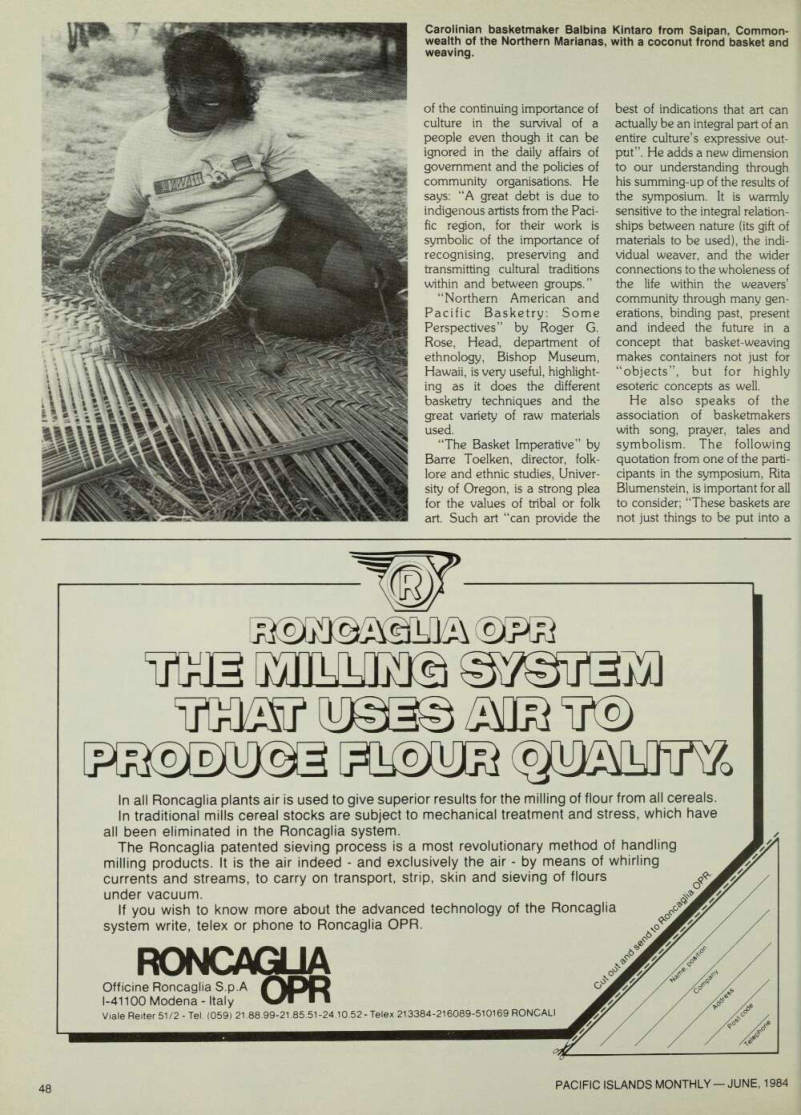
Carolinian basketmaker Balbina Kintaro from Saipan, Common wealth of the Northern Marianas, with a coconut frond basket and weaving.
glass case, they’re like music, like songs: each has its own melody, its own words, its own rhythm or style.” Barre Toelken argues; “Anything that has rhythm to it comes from the deepest part of our being; and any art form that has maintained such rhythms through such incredibly long periods of human existence must surely have its sources in the deepest and most meaningful aspects of our inheritance. If these baskets are not art, and if these basketmakers are not true artists, it would certainly be difficult to make any case for any art whatever.”
The book is well produced and contains over 70 photographs, 23 of them in full color as well as some useful drawings illustrating basketry techniques, and a bibliography. It is unfortunate in such a fine book
that it does not go further and include the wealth of basketmaking tradition in the islands of the South Pacific, However, recently at Pago Pago, this lack of recognition was somewhat remedied when a stimulating Symposium of South Pacific basket-weavers was held under the auspices of the Jean P. Haydon Museum, A centrepiece of this display was the fine white Rito weaving by the Cook Island representa tive who, in the celebrated Manihiki style, used the rare centre shoots of new palm leaves. Because of its beauty, Rito work is in great demand, but lack of quantity of the natural resource means firstly that it is little known outside the Cook Islands, and secondly that it cannot serve a large market, and will remain a skill of rare finesse. Beth Dean.
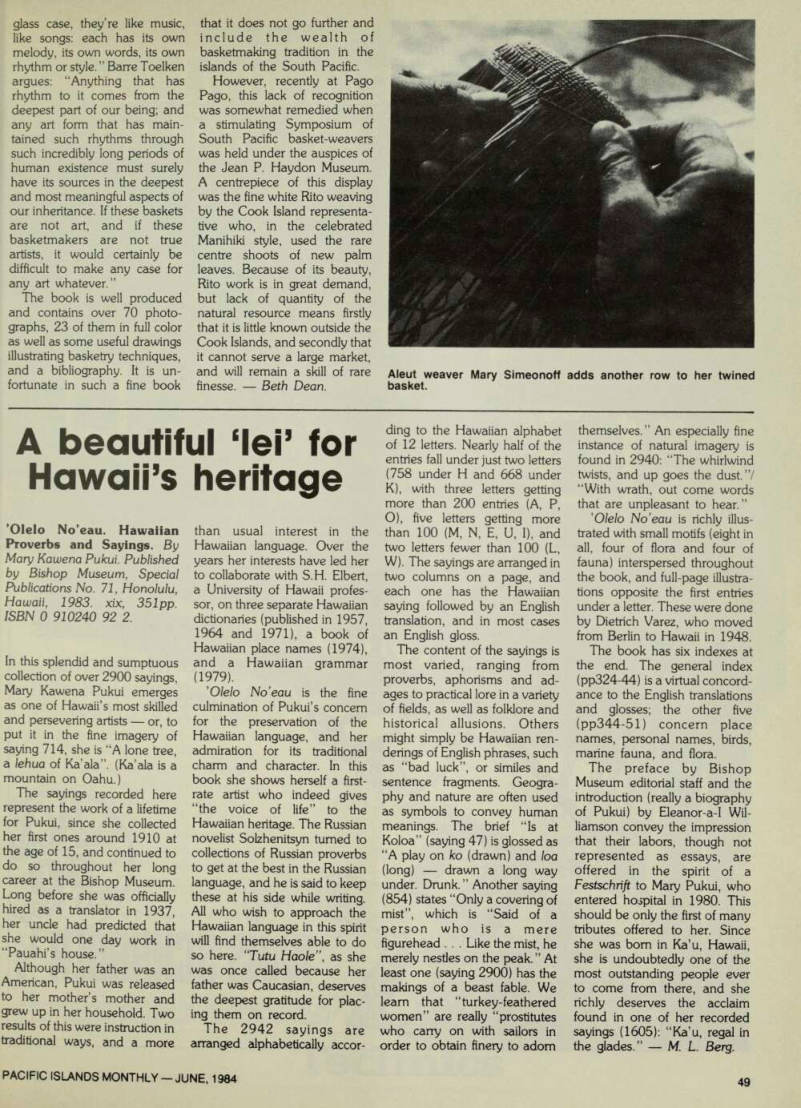
Aleut weaver Mary Simeonoff adds another row to her twined basket.