A difficult visit
pp. 30-32 · Read in the full issue
for Mr Lemoine
Independence Front (IF) mem bers boycotted the visit in early April of French Minister for Overseas Territories, Georges Lemoine. Mr Lemoine, who visited New Caledonia twice in 1983. came this time to discuss the five-year autonomy statute proposed by his government.
However, unlike previous trips,
the minister spent most of his time in the countryside and only met with political leaders the day of his departure.
In calling the boycott, and for demonstrations in the villages visited by the minister, the IF accused France of using the autonomy statute to continue colonialism for another five
years, and of ignoring their call for a precise timetable leading to independence.
But the first demonstration encountered by Mr Lemoine was put on by the Caledonian Front, a hard-line group opposed to independence.
About 100 Caledonian Front members, led by Republican member of the territorial assem bly, Justin Guillemard, demon strated outside the administra tive headquarters at La Foa on the west coast. The demonstra tors told the minister they were fed up with harassment from the IF in the countryside and with land occupations. They called for an end to the land reform system, and for respect for private property and for democratic rights. One Caledo nian Front member warned there could be “regrettable inci dents”, because European far mers had reached the limits of tolerance.
Throughout his tour of the northwest and the top half of the east coast Mr Lemoine encountered a cold reception from Kanak villagers. At Noelly, in the mountain chain, demon strators told the minister they rejected his autonomy project, and the tribal spokesman hesi tated to accept a custom gift. At Neamy, further on in the chain, the village was deserted save for an old man and children at kindergarten.
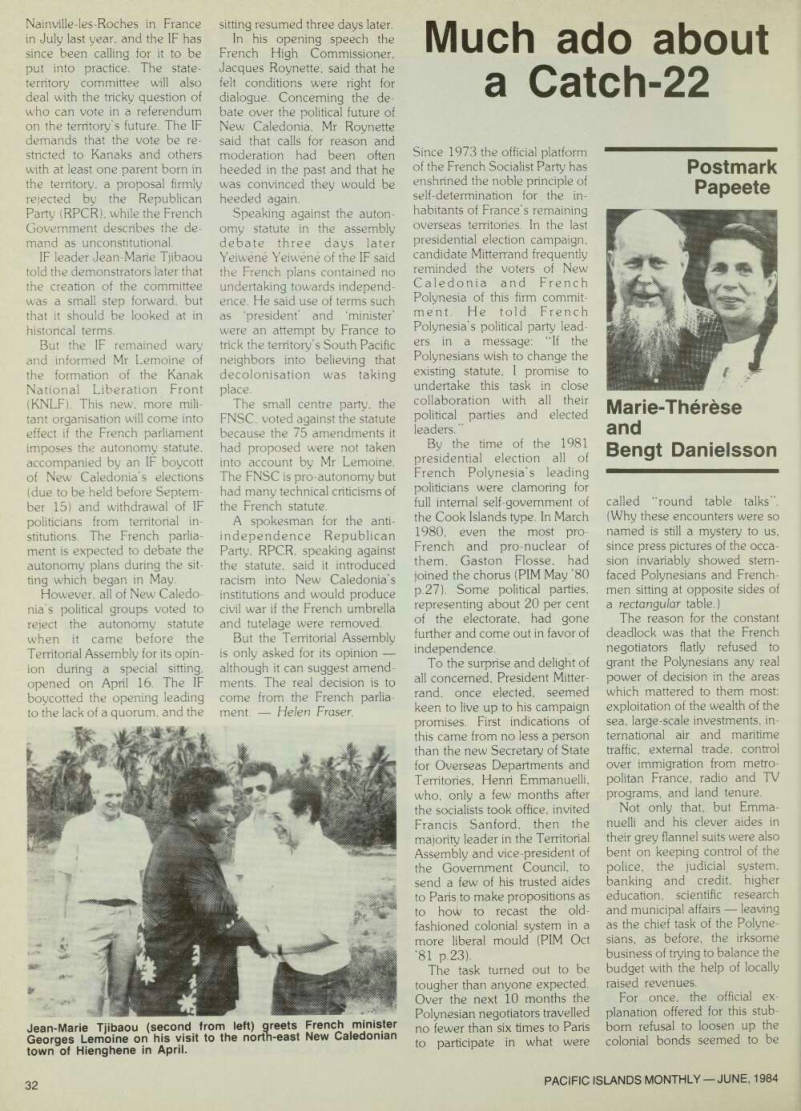
At Bopope, members of the Palika Party demonstrated against the autonomy statute and later discussed some of their claims with the minister. At Hienghene, on the northeast coast, Mr Lemoine lunched with mayor and IF leader Jean- Marie Tjibaou, as well as the great chiefs of the region. Mr Tjibaou explained to PIM that arrangements for Mr Lemoine’s visit to his town had been made before the IF decision to boycott. At the site for the Hienghene Cultural Centre Mr Lemoine was greeted by a demonstration and the Kanak independence flag flying from a traditional house.
Later the minister encoun tered a road block outside Ponerihouen where IF and Pali ka members told him they rejected the autonomy plans, and accused him of trying to divide the Kanak people. How ever, Mr Lemoine received a
warm welcome at Neoueta tribe at Ponerihouen where he spent the night. The minister was also greeted with traditional wel comes in the tribal villages in the southern district of Yate that he visited.
However, it was in Noumea that the largest demonstration awaited Mr Lemoine. About 600 IF and Palika members demonstrated on the minister’s last day in the territory, while he was holding talks with local political leaders. Led by IF leaders and members of the Territorial Assembly, the demonstration met up with a cordon of helmeted and shield carrying police, with the garde mobile behind them.
The police had received orders not to allow the demon strators to approach the gates of the French High Commission where the minister was en gaged in the talks. However, faced with the evident de termination of the demonstra tors to advance the 30 metres requested, even if it meant a battle with police, they were allowed to move forward. After speeches a delegation of 12 IF and trade union leaders were received by Mr Lemoine and spent 90 minutes with him.
The result of these talks was a joint statement, in which the IF and the minister agreed on the creation of a special state territory committee. The task of this committee will be to pre pare what was termed “the exercise of the innate and active right of the Kanak people to independence by way of a referendum.’’ This right was recognised by France during the round table talks held at
Noumea Notebook
Helen Fraser
Nainville-les-Roches in France in July last year, and the IF has since been calling for it to be put into practice. The state territory committee will also deal with the tricky question of who can vote in a referendum on the territory's future. The IF demands that the vote be re stricted to Kanaks and others with at least one parent born in the territory, a proposal firmly rejected by the Republican Party (RPCR). while the French Government describes the de mand as unconstitutional.
IF leader Jean-Marie Tjibaou told the demonstrators later that the creation of the committee was a small step forward, but that it should be looked at in historical terms.
But the IF remained wary and informed Mr Lemoine of the formation of the Kanak National Liberation Front (KNLF). This new. more mili tant organisation will come into effect if the French parliament imposes the autonomy statute, accompanied by an IF boycott of New Caledonia's elections (due to be held before Septem ber 15) and withdrawal of IF politicians from territorial in stitutions. The French parlia ment is expected to debate the autonomy plans during the sit ting which began in May.
However, all of New Caledo nia's political groups voted to reject the autonomy statute when it came before the Territorial Assembly for its opin ion during a special sitting, opened on April 16. The IF boycotted the opening leading to the lack of a quorum, and the
sitting resumed three days later.
In his opening speech the French High Commissioner.
Jacques Roynette. said that he felt conditions were right for dialogue. Concerning the de bate over the political future of New Caledonia. Mr Roynette said that calls for reason and moderation had been often heeded in the past and that he was convinced they would be heeded again.
Speaking against the auton omy statute in the assembly debate three days later Yeiwene Yeiwene of the IF said the French plans contained no undertaking towards independ ence. He said use of terms such as ‘president’ and ‘minister’ were an attempt by France to trick the territory’s South Pacific neighbors into believing that decolonisation was taking place.
The small centre party, the FNSC. voted against the statute because the 75 amendments it had proposed were not taken into account by Mr Lemoine.
The FNSC is pro-autonomy but had many technical criticisms of the French statute.
A spokesman for the anti independence Republican Party. RPCR. speaking against the statute, said it introduced racism into New Caledonia's institutions and would produce civil war if the French umbrella and tutelage were removed.
But the Territorial Assembly is only asked for its opinion although it can suggest amend ments. The real decision is to come from the French parlia
ment.
Helen Fraser.
Jean-Marie Tjibaou (second from left) greets French minister Georges Lemoine on his visit to the north-east New Caledonian town of Hienghene in April.