‘Rick’ Montoya’s
p. 29 · Read in the full issue
tough message
There has not been anyone like Richard Montoya to hit Mic ronesia and Guam in years.
The 35-year-old Hispanic, who comes from the State of New Mexico, was confirmed earlier this year as the assistant secre tary of interior for territorial and international affairs. He re places Pedro Sanjuan, and is the top official in the Reagan administration for territorial matters.
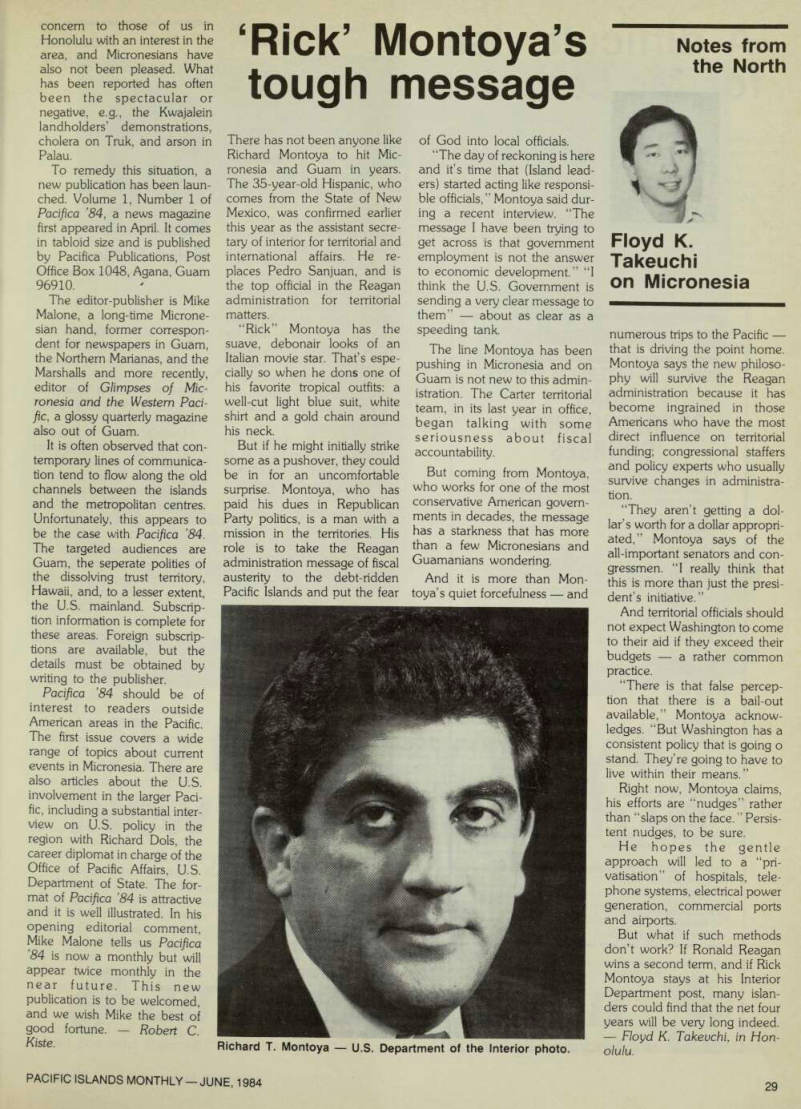
“Rick” Montoya has the suave, debonair looks of an Italian movie star. That’s espe cially so when he dons one of his favorite tropical outfits: a well-cut light blue suit, white shirt and a gold chain around his neck.
But if he might initially strike some as a pushover, they could be in for an uncomfortable surprise. Montoya, who has paid his dues in Republican Party politics, is a man with a mission in the territories. His role is to take the Reagan administration message of fiscal austerity to the debt-ridden Pacific Islands and put the fear
of God into local officials.
“The day of reckoning is here and it’s time that (Island lead ers) started acting like responsi ble officials,” Montoya said dur ing a recent interview. “The message I have been trying to get across is that government employment is not the answer to economic development.” “I think the U.S. Government is sending a very clear message to them” about as clear as a speeding tank.
The line Montoya has been pushing in Micronesia and on Guam is not new to this admin istration. The Carter territorial team, in its last year in office, began talking with some seriousness about fiscal accountability.
But coming from Montoya, who works for one of the most conservative American govern ments in decades, the message has a starkness that has more than a few Micronesians and Guamanians wondering.
And it is more than Mon toya’s quiet forcefulness and
numerous trips to the Pacific that is driving the point home.
Montoya says the new philoso phy will survive the Reagan administration because it has become ingrained in those Americans who have the most direct influence on territorial funding; congressional staffers and policy experts who usually survive changes in administra tion.
“They aren’t getting a dol lar’s worth for a dollar appropri ated,” Montoya says of the all-important senators and con gressmen. “I really think that this is more than just the presi dent’s initiative.”
And territorial officials should not expect Washington to come to their aid if they exceed their budgets a rather common practice.
“There is that false percep tion that there is a bail-out available,” Montoya acknow ledges. “But Washington has a consistent policy that is going o stand. They’re going to have to live within their means.”
Right now, Montoya claims, his efforts are “nudges” rather than “slaps on the face. ” Persis tent nudges, to be sure.
He hopes the gentle approach will led to a “pri vatisation” of hospitals, tele phone systems, electrical power generation, commercial ports and airports.
But what if such methods don’t work? If Ronald Reagan wins a second term, and if Rick Montoya stays at his Interior Department post, many islan ders could find that the net four years will be very long indeed.
Floyd K. Takeuchi, in Hon-
olulu.
Richard T. Montoya - U.S. Department of the Interior photo.
Notes from the North
Floyd K.
Takeuchi on Micronesia