Reaganomics
pp. 27-29 · Read in the full issue
the month
Reaganomics for the islands
The training conference and trade exhibition “Pacific Island- United States Trade Through Private Sector Development”, held in Honolulu in March (18-24), reflected the present U.S. administration’s economic orientation and emphasised its faith that the private sector can play an important role in the development of Pacific Island economies.
This emphasis was consistent with the involvement of private business interests in the last two South Pacific Conferences, both held in American territor ies. As will be recalled, Amer ican Samoa’s Governor Peter Coleman arranged to have about 50 private sector spon sors for the 22nd conference in Pago Pago in 1982. The North ern Marianas followed suit with the 23rd conference at Saipan last year and had a pre-confer ence session for private in terests.
With regard to the recent Honolulu affair, the attendance was substantial. At least 16 nations and territories were re presented the Marshalls, Nauru, New Caledonia, and Wallis and Futuna were absent.
The participants were approx imately 220 in number. About 150 of them came from the island Pacific outside of Hawaii, and while there was a sprinkling of expatriate faces, the majority were indigenous islanders. The other 70-odd people were re presentatives of various federal agencies, business concerns, and interested observers.
A total of $75,000, or about half of the funding in support of the conference and exhibition, was provided by the U.S. Agen cy for International Deve lopment. Other major contribu tors were the Foundation for the Peoples of the South Paci fic, the Asia Foundation, and the United Nations Deve lopment Program.
About 80 of the islands parti
cipants received some financial subsidy which allowed them to travel to Honolulu. The aid was entirely for non-American re gions participants from American flag islands were fin anced by themselves or their governments. The main organ iser was the recently formed Pan Pacific Alliance for Trade and Development, a private organisation designed to foster U.S./Pacific interests (PIM, Dec ’B3 pls).
The conference dealt with practical issues such as how to: assess potential American mar kets; promote products in the U.S.; deal with federal regula tory agencies such as customs, food and drug administration, agriculture, etc., and develop business contacts. Problems of transportation and shipping were also discussed.
The organisers were quite pleased with the results, and there may be an attempt to stage a repeat next year.
To this observer, the quality and success of the conference’s sessions were quite uneven, and at times there were or ganisational problems. In a good number of instances, it was painfully clear that U.S. officials did not know enough about the Pacific to understand
or to be sensitive to its deve lopmental needs. A few island participants also expressed some distaste if not distrust about the rah-rah glad handing style of some of the business types. As most obser vers in the region are well aware, aggressive self aggrandisement is not appreci ated in most of the Pacific.
There was no doubt, how ever, that there was a good deal of enthusiasm on the part of all, and the island participants evi denced an eagerness to crack American markets. There was also no doubt that the trade fair was well received. Pacific pro ducts were attractively dis played, and the event was enjoyed by all concerned.
As far as American policy is concerned, much of the U.S.
Agency for International Deve lopment’s effort in the region over the next five or so years will be guided by a focus on the development of private enter prise. It is projected that training will be offered in technology transfer, marketing skills, man agement and understanding the marketplace.
At the core of such a deve lopmental focus is the belief that the private sector might well play an important role in promoting the local manufac turing of goods that can be substituted for items that are now imported. For example, it does seem unfortunate to im port such things as cooking oils and many soap products when
the oil of coconut palms is available locally in abundance.
It would seem, however, that when dealing with the private sector, it cannot be assumed that the “profit motive” works in the Pacific as it does in North America. Priorities often lie elsewhere as most island peo ples still place value upon their kin and other social obligations.
‘Pacifica ’B4’
Turning to another matter, when the office of the High Commissioner, U.S. Trust Territory of the Pacific, began phasing out its operations a few years ago, the Micronesian News Service was closed down.
It had been the main source of news that reached Honolulu from Micronesia, and reporting has been spotty at best ever since. This has been a source of
A View from Honolulu
Robert C. Kiste looks at the Pacific
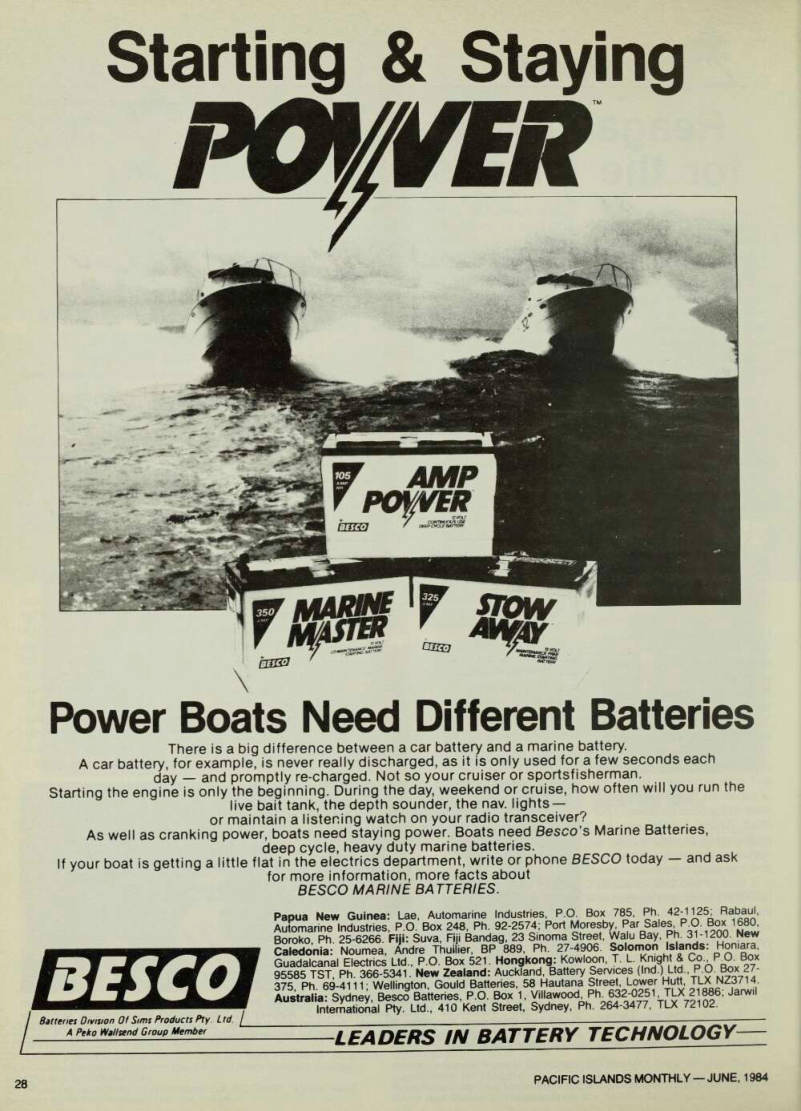
At the private-sector trade conference in Honolulu, left to right: Edgar C. Harrell, acting assistant administrator, Bureau for Private Enterprise, U.S. Agency for International Development; Governor Peter Tali Coleman, American Samoa; Ambassador Fred M. Zeder, U.S. Office of Micronesian Negotiations; Phillip Cridge, assistant secretary, trade and investment promotion, Papua New Guinea. -Caroline Yacoe photo.
concern to those of us in Honolulu with an interest in the area, and Micronesians have also not been pleased. What has been reported has often been the spectacular or negative, e.g., the Kwajalein landholders’ demonstrations, cholera on Truk, and arson in Palau.
To remedy this situation, a new publication has been laun ched. Volume 1, Number 1 of Pacifica ’B4 , a news magazine first appeared in April. It comes in tabloid size and is published by Pacifica Publications, Post Office Box 1048, Agana, Guam 96910.
The editor-publisher is Mike Malone, a long-time Microne sian hand, former correspon dent for newspapers in Guam, the Northern Marianas, and the Marshalls and more recently, editor of Glimpses of Mic ronesia and the Western Paci fic, a glossy quarterly magazine also out of Guam.
It is often observed that con temporary lines of communica tion tend to flow along the old channels between the islands and the metropolitan centres.
Unfortunately, this appears to be the case with Pacifica ’B4.
The targeted audiences are Guam, the seperate polities of the dissolving trust territory, Hawaii, and, to a lesser extent, the U.S. mainland. Subscrip tion information is complete for these areas. Foreign subscrip tions are available, but the details must be obtained by writing to the publisher.
Pacifica ’B4 should be of interest to readers outside American areas in the Pacific.
The first issue covers a wide range of topics about current events in Micronesia. There are also articles about the U.S. involvement in the larger Paci fic, including a substantial inter view on U.S. policy in the region with Richard Dols, the career diplomat in charge of the Office of Pacific Affairs, U.S.
Department of State. The for mat of Pacifica ’B4 is attractive and it is well illustrated. In his opening editorial comment, Mike Malone tells us Pacifica ’B4 is now a monthly but will appear twice monthly in the near future. This new publication is to be welcomed, and we wish Mike the best of
good fortune.
Robert C.
Kiste.