a Catch-22
pp. 32-33 · Read in the full issue
Much ado about a Catch-22
Since 1973 the official platform of the French Socialist Party has enshrined the noble principle of self-determination for the in habitants of France's remaining overseas territories. In the last presidential election campaign, candidate Mitterrand frequently reminded the voters of New Caledonia and French Polynesia of this firm commit ment. He told French Polynesia’s political party lead ers in a message; "If the Polynesians wish to change the existing statute, I promise to undertake this task in close collaboration with all their political parties and elected leaders."
By the time of the 1981 presidential election all of French Polynesia's leading politicians were clamoring for full internal self-government of the Cook Islands type. In March 1980. even the most pro- French and pro-nuclear of them. Gaston Flosse. had joined the chorus (PIM May 'BO p. 27). Some political parties, representing about 20 per cent of the electorate, had gone further and come out in favor of independence.
To the surprise and delight of all concerned, President Mitter rand. once elected, seemed keen to live up to his campaign promises. First indications of this came from no less a person than the new Secretary of State for Overseas Departments and Territories, Henri Emmanuelli, who, only a few months after the socialists took office, invited Francis Sanford, then the majority leader in the Territorial Assembly and vice-president of the Government Council, to send a few of his trusted aides to Paris to make propositions as to how to recast the old fashioned colonial system in a more liberal mould (PIM Oct 'Bl p. 23).
The task turned out to be tougher than anyone expected.
Over the next 10 months the Polynesian negotiators travelled no fewer than six times to Paris to participate in what were
called "round table talks”. (Why these encounters were so named is still a mystery to us, since press pictures of the occa sion invariably showed stern faced Polynesians and French men sitting at opposite sides of a rectangular table.) The reason for the constant deadlock was that the French negotiators flatly refused to grant the Polynesians any real power of decision in the areas which mattered to them most; exploitation of the wealth of the sea, large-scale investments, in ternational air and maritime traffic, external trade, control over immigration from metro politan France, radio and TV programs, and land tenure.
Not only that, but Emma nuelli and his clever aides in their grey flannel suits were also bent on keeping control of the police, the judicial system, banking and credit, higher education, scientific research and municipal affairs leaving as the chief task of the Polyne sians, as before, the irksome business of trying to balance the budget with the help of locally raised revenues.
For once, the official ex planation offered for this stub born refusal to loosen up the colonial bonds seemed to be
Postmark Papeete
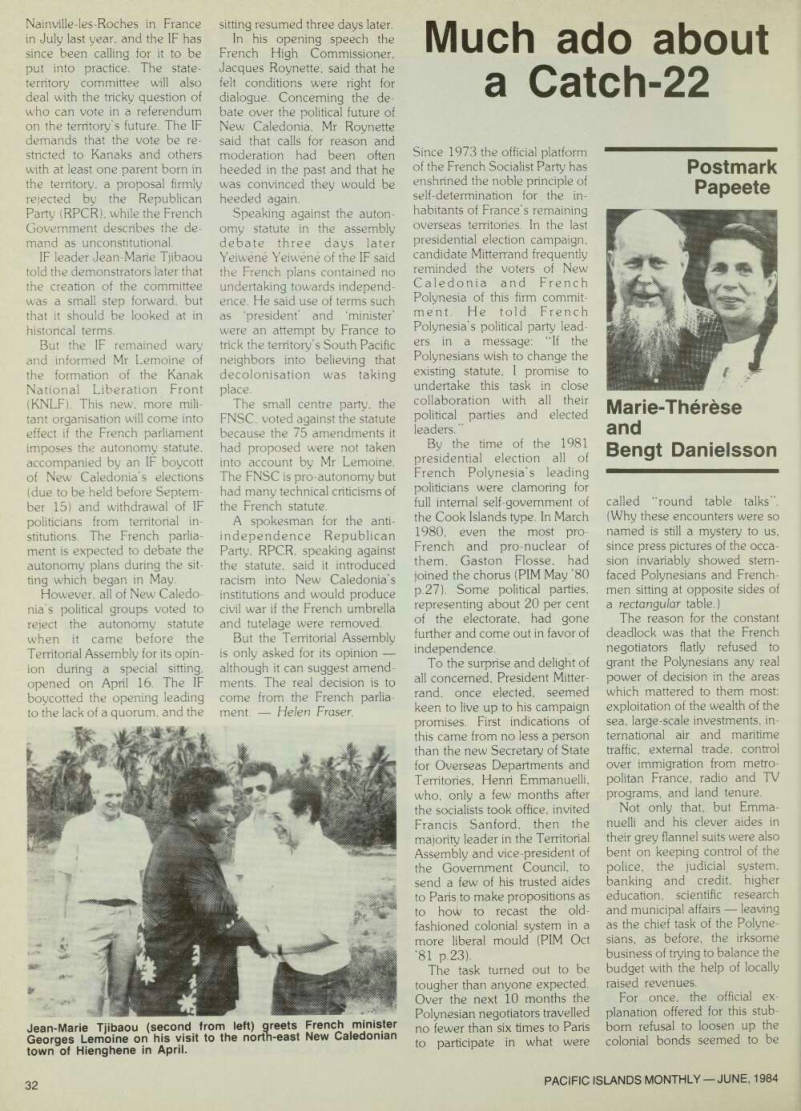
Marie-Thérèse and Bengt Danielsson
the true one; to give the natives any real power would set them on the slippery path to inde pendence. This the French Government could not abide, as long as Moruroa and Fanga taufa were needed as testing sites for nuclear weapons.
The already stiff attitude of the Paris bureaucrats hardened even further when, in the May 1982 territorial elections. Fran cis Sanford was booted out of office by the Tahoeraa party leader Gaston Flosse. who by this time had become a staunch supporter and close friend of Jacques Chirac, boss of the Rightwing RPR party, and Mit terrand’s most acerbic critic (PIM July 'B2 p. 22).
Sure enough, when the draft of the “new statute granting internal self-government to French Polynesia” was at long last completed in August 1983, under the supervision of Georges Lemoine (who had succeeded Emmanuelli), it turned out to be nothing more than a muddled rewrite of the existing statute, long ago re jected as totally inadequate by all Polynesian parties.
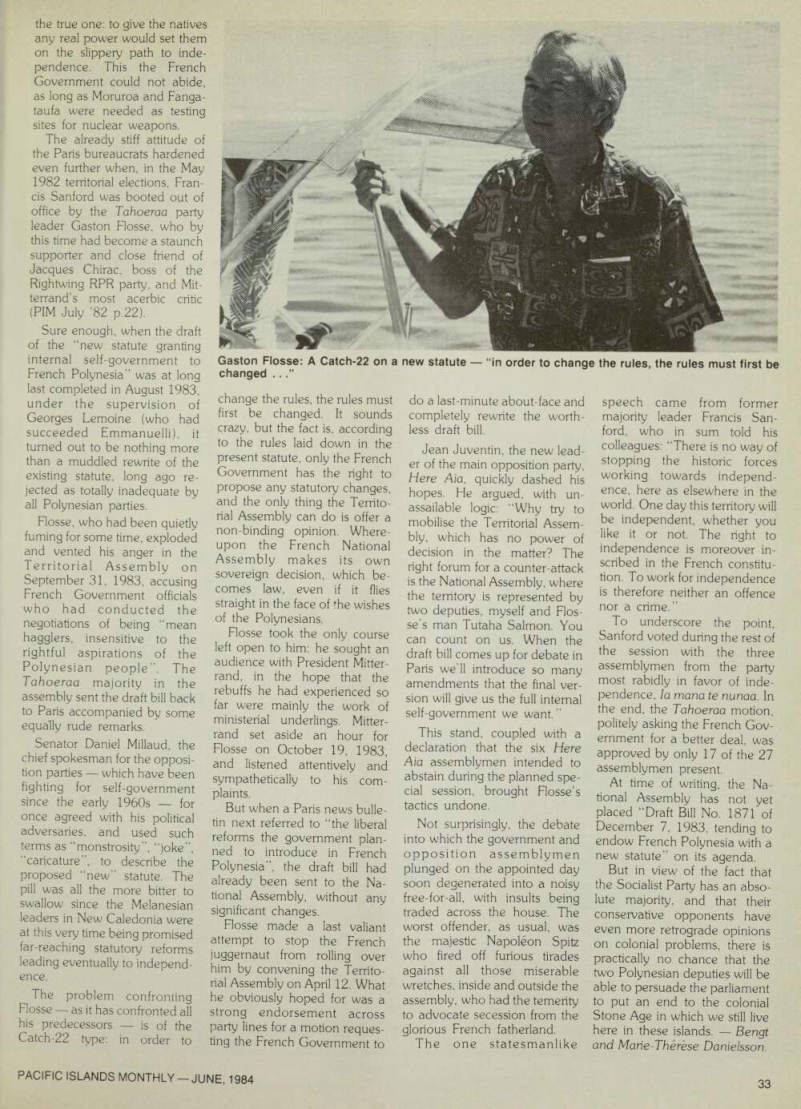
Flosse, who had been quietly fuming for some time, exploded and vented his anger in the Territorial Assembly on September 31. 1983, accusing French Government officials who had conducted the negotiations of being “mean hagglers, insensitive to the rightful aspirations of the Polynesian people”. The Tahoeraa majority in the assembly sent the draft bill back to Paris accompanied by some equally rude remarks.
Senator Daniel Millaud. the chief spokesman for the opposi tion parties which have been fighting for self-government since the early 1960 s for once agreed with his political adversaries, and used such terms as “monstrosity”, “joke”, “caricature”, to describe the proposed “new” statute. The pill was all the more bitter to swallow since the Melanesian leaders in New Caledonia were at this very time being promised far-reaching statutory reforms leading eventually to independ ence.
The problem confronting Flosse as it has confronted all his predecessors is of the Catch-22 type; in order to
change the rules, the rules must first be changed. It sounds crazy, but the fact is, according to the rules laid down in the present statute, only the French Government has the right to propose any statutory changes, and the only thing the Territo rial Assembly can do is offer a non-binding opinion. Where upon the French National Assembly makes its own sovereign decision, which be comes law, even if it flies straight in the face of the wishes of the Polynesians.
Flosse took the only course left open to him: he sought an audience with President Mitter rand, in the hope that the rebuffs he had experienced so far were mainly the work of ministerial underlings. Mitter rand set aside an hour for Flosse on October 19, 1983, and listened attentively and sympathetically to his com plaints.
But when a Paris news bulle tin next referred to “the liberal reforms the government plan ned to introduce in French Polynesia”, the draft bill had already been sent to the Na tional Assembly, without any significant changes.
Flosse made a last valiant attempt to stop the French juggernaut from rolling over him by convening the Territo rial Assembly on April 12. What he obviously hoped for was a strong endorsement across party lines for a motion reques ting the French Government to
do a last-minute about-face and completely rewrite the worth less draft bill.
Jean Juventin, the new lead er of the main opposition party.
Here Aia . quickly dashed his hopes. He argued, with un assailable logic: "Why try to mobilise the Territorial Assem bly, which has no power of decision in the matter? The right forum for a counter-attack is the National Assembly, where the territory is represented by two deputies, myself and Flos se's man Tutaha Salmon. You can count on us. When the draft bill comes up for debate in Paris we’ll introduce so many amendments that the final ver sion will give us the full internal self-government we want.”
This stand, coupled with a declaration that the six Here Aia assemblymen intended to abstain during the planned spe cial session, brought Flosse’s tactics undone.
Not surprisingly, the debate into which the government and opposition assemblymen plunged on the appointed day soon degenerated into a noisy free-for-all. with insults being traded across the house. The worst offender, as usual, was the majestic Napoleon Spitz who fired off furious tirades against all those miserable wretches, inside and outside the assembly, who had the temerity to advocate secession from the glorious French fatherland.
The one statesmanlike
speech came from former majority leader Francis San ford, who in sum told his colleagues: "There is no way of stopping the historic forces working towards independ ence, here as elsewhere in the world. One day this territory will be independent, whether you like it or not. The right to independence is moreover in scribed in the French constitu tion. To work for independence is therefore neither an offence nor a crime.”
To underscore the point.
Sanford voted during the rest of the session with the three assemblymen from the party most rabidly in favor of inde pendence, la mono te nunaa. In the end, the Tohoeraa motion, politely asking the French Gov ernment for a better deal, was approved by only 17 of the 27 assemblymen present.
At time of writing, the Na tional Assembly has not yet placed "Draft Bill No. 1871 of December 7. 1983, tending to endow French Polynesia with a new statute” on its agenda.
But in view of the fact that the Socialist Party has an abso lute majority, and that their conservative opponents have even more retrograde opinions on colonial problems, there is practically no chance that the two Polynesian deputies will be able to persuade the parliament to put an end to the colonial Stone Age in which we still live here in these islands. Bengt and Marie-Therese Danielsson.
Gaston Flosse: A Catch-22 on a new statute - “in order to change the rules, the rules must first be changed ..."