The Death of Captain Cook
pp. 51-53 · Read in the full issue
Printed below is the second and concluding part of the lecture by Professor Greg Dening on the death of Captain Cook The lecture, the first part of which appeared in PIM April, was given at the State Library of NSW on February 14 1984 the 205th anniversary of the death of Cook.
So Lono’s canoe in the form of the Resolution left Kealekekua Bay on February 4 loaded as it ever was with the paraphernalia of the temple and the gifts of food that came from the land. Cook told them that he would be back at the same time next year after another season on the northwest coast, and they said they were expecting him. He would have been back next year, but four days out the Resolution sprang a mast and he was back in Kealekekua Bay in 10 days to repair it. The atmosphere was changed. They were unwelcome. The Hawaiians were sullen, the chiefs unwilling and hostile. The carpenters set the damaged mast on Lono’s temple, but there were thefts. The British saw how different things were and attributed it to the renewed burden of 300 mouths to feed.
The truth was, of course, they were out of season. It was a time of Ku not of Lono. They were strangers, competing power. They disturbed the polity, did not legitimise it. They were sharks that walked on the land. They were rivals in violence. The British reacted to the changed scene by being violent. There was an extraordinary scene on February 13 when Cook, a pistol in hand and a marine at his side, chased a thief for miles and did not get him. That night the cutter was stolen and early on February 14 Cook closed the bay and determined to take the chief, Kalaniopu u, hostage . . . Cook landed at the settlement, went to Kalaniopu’u’s house, found him asleep and totally ignorant of the theft of the cutter, but Cook nonetheless insisted that Kalaniopu’u come back to the Resolution. He was coming until some of his relatives said something to him and he became very disturbed and stopped. Cook got into a terrible rage and in the middle of it came the news that a chief had been killed by the British on the other
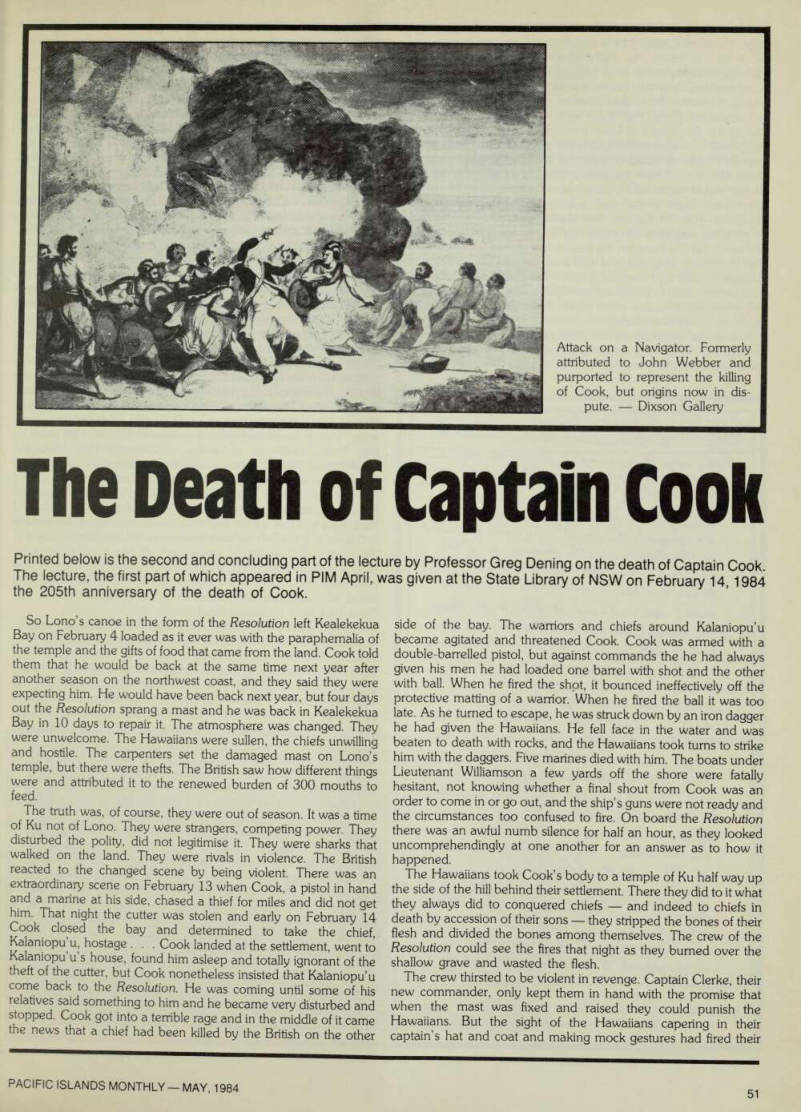
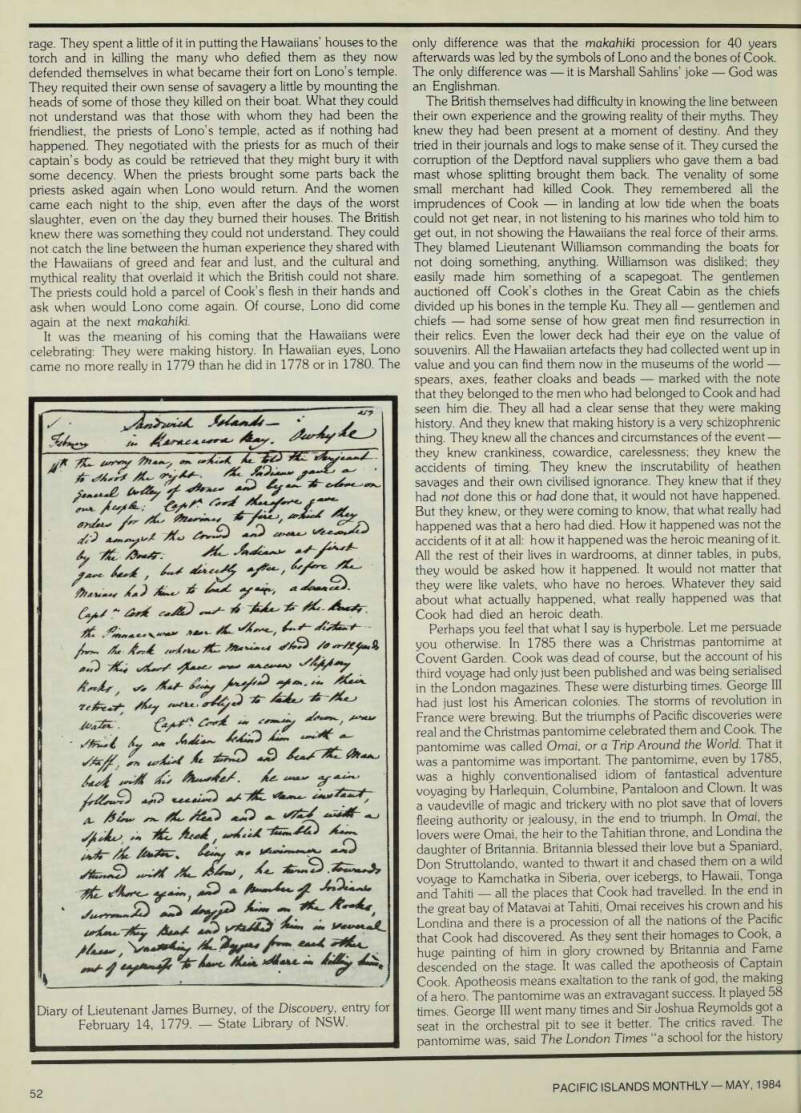
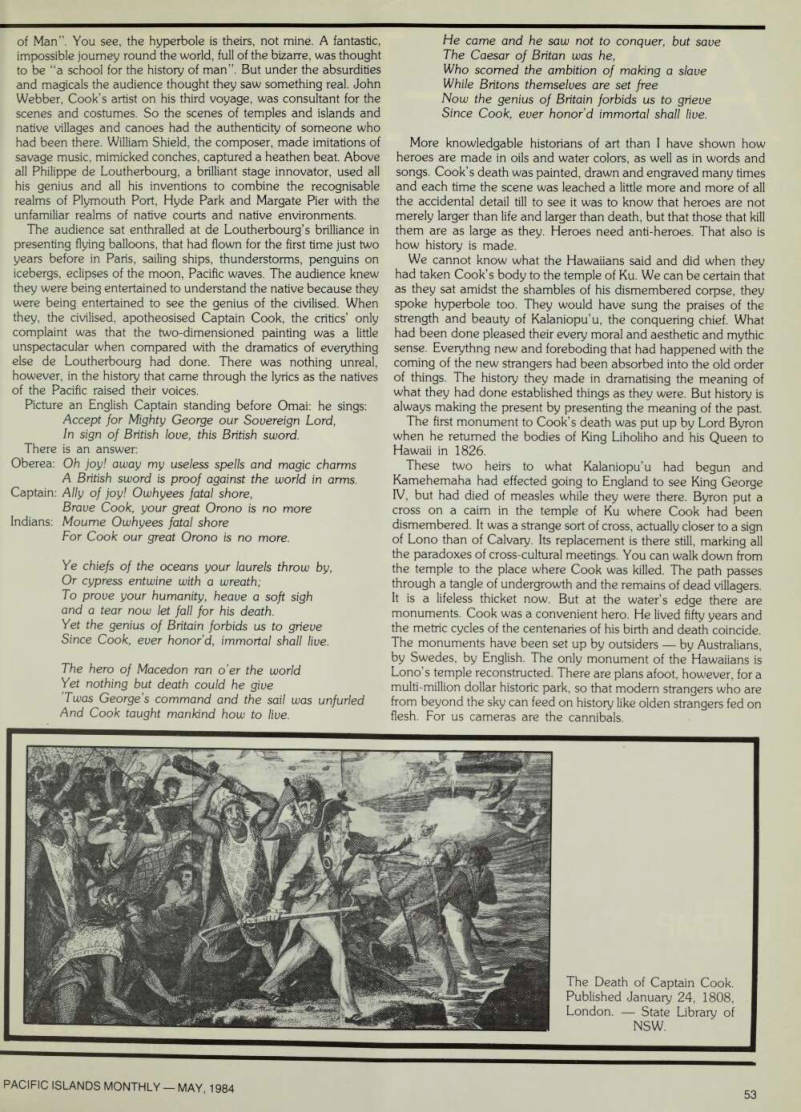
side of the bay. The warriors and chiefs around Kalaniopu’u became agitated and threatened Cook. Cook was armed with a double-barrelled pistol, but against commands the he had always given his men he had loaded one barrel with shot and the other with ball. When he fired the shot, it bounced ineffectively off the protective matting of a warrior. When he fired the ball it was too late. As he turned to escape, he was struck down by an iron dagger he had given the Hawaiians. He fell face in the water and was beaten to death with rocks, and the Hawaiians took turns to strike him with the daggers. Five marines died with him. The boats under Lieutenant Williamson a few yards off the shore were fatally hesitant, not knowing whether a final shout from Cook was an order to come in or go out, and the ship’s guns were not ready and the circumstances too confused to fire. On board the Resolution there was an awful numb silence for half an hour, as they looked uncomprehendingly at one another for an answer as to how it happened.
The Hawaiians took Cook’s body to a temple of Ku half way up the side of the hill behind their settlement. There they did to it what they always did to conquered chiefs and indeed to chiefs in death by accession of their sons they stripped the bones of their flesh and divided the bones among themselves. The crew of the Resolution could see the fires that night as they burned over the shallow grave and wasted the flesh.
The crew thirsted to be violent in revenge. Captain Clerke, their new commander, only kept them in hand with the promise that when the mast was fixed and raised they could punish the Hawaiians. But the sight of the Hawaiians capering in their captain’s hat and coat and making mock gestures had fired their
Attack on a Navigator. Formerly attributed to John Webber and purported to represent the killing of Cook, but origins now in dis pute. - Dixson Gallery
rage. They spent a little of it in putting the Hawaiians’ houses to the torch and in killing the many who defied them as they now defended themselves in what became their fort on Lono’s temple.
They requited their own sense of savagery a little by mounting the heads of some of those they killed on their boat. What they could not understand was that those with whom they had been the friendliest, the priests of Lono’s temple, acted as if nothing had happened. They negotiated with the priests for as much of their captain’s body as could be retrieved that they might bury it with some decency. When the priests brought some parts back the priests asked again when Lono would return. And the women came each night to the ship, even after the days of the worst slaughter, even on the day they burned their houses. The British knew there was something they could not understand. They could not catch the line between the human experience they shared with the Hawaiians of greed and fear and lust, and the cultural and mythical reality that overlaid it which the British could not share.
The priests could hold a parcel of Cook’s flesh in their hands and ask when would Lono come again. Of course, Lono did come again at the next makahiki.
It was the meaning of his coming that the Hawaiians were celebrating: They were making history. In Hawaiian eyes, Lono came no more really in 1779 than he did in 1778 or in 1780. The
only difference was that the makahiki procession for 40 years afterwards was led by the symbols of Lono and the bones of Cook.
The only difference was it is Marshall Sahlins’ joke God was an Englishman.
The British themselves had difficulty in knowing the line between their own experience and the growing reality of their myths. They knew they had been present at a moment of destiny. And they tried in their journals and logs to make sense of it. They cursed the corruption of the Deptford naval suppliers who gave them a bad mast whose splitting brought them back. The venality of some small merchant had killed Cook. They remembered all the imprudences of Cook in landing at low tide when the boats could not get near, in not listening to his marines who told him to get out, in not showing the Hawaiians the real force of their arms.
They blamed Lieutenant Williamson commanding the boats for not doing something, anything. Williamson was disliked; they easily made him something of a scapegoat. The gentlemen auctioned off Cook’s clothes in the Great Cabin as the chiefs divided up his bones in the temple Ku. They all gentlemen and chiefs had some sense of how great men find resurrection in their relics. Even the lower deck had their eye on the value of souvenirs. All the Hawaiian artefacts they had collected went up in value and you can find them now in the museums of the world spears, axes, feather cloaks and beads marked with the note that they belonged to the men who had belonged to Cook and had seen him die. They all had a clear sense that they were making history. And they knew that making history is a very schizophrenic thing. They knew all the chances and circumstances of the event they knew crankiness, cowardice, carelessness; they knew the accidents of timing. They knew the inscrutability of heathen savages and their own civilised ignorance. They knew that if they had not done this or had done that, it would not have happened.
But they knew, or they were coming to know, that what really had happened was that a hero had died. How it happened was not the accidents of it at all: how it happened was the heroic meaning of it.
All the rest of their lives in wardrooms, at dinner tables, in pubs, they would be asked how it happened. It would not matter that they were like valets, who have no heroes. Whatever they said about what actually happened, what really happened was that Cook had died an heroic death.
Perhaps you feel that what I say is hyperbole. Let me persuade you otherwise. In 1785 there was a Christmas pantomime at Covent Garden. Cook was dead of course, but the account of his third voyage had only just been published and was being serialised in the London magazines. These were disturbing times. George 111 had just lost his American colonies. The storms of revolution in France were brewing. But the triumphs of Pacific discoveries were real and the Christmas pantomime celebrated them and Cook. The pantomime was called Omai, or a Trip Around the World. That it was a pantomime was important. The pantomime, even by 1785, was a highly conventionalised idiom of fantastical adventure voyaging by Harlequin, Columbine, Pantaloon and Clown. It was a vaudeville of magic and trickery with no plot save that of lovers fleeing authority or jealousy, in the end to triumph. In Omai, the lovers were Omai, the heir to the Tahitian throne, and Londina the daughter of Britannia. Britannia blessed their love but a Spaniard, Don Struttolando, wanted to thwart it and chased them on a wild voyage to Kamchatka in Siberia, over icebergs, to Hawaii, Tonga and Tahiti all the places that Cook had travelled. In the end in the great bay of Matavai at Tahiti, Omai receives his crown and his Londina and there is a procession of all the nations of the Pacific that Cook had discovered. As they sent their homages to Cook, a huge painting of him in glory crowned by Britannia and Fame descended on the stage. It was called the apotheosis of Captain Cook. Apotheosis means exaltation to the rank of god, the making of a hero. The pantomime was an extravagant success. It played 58 times. George 111 went many times and Sir Joshua Reymolds got a seat in the orchestral pit to see it better. The critics raved. The pantomime was, said The London Times “a school for the history
Diary of Lieutenant James Burney, of the Discovery, entry for February 14, 1779. State Library of NSW.
of Man”. You see, the hyperbole is theirs, not mine. A fantastic, impossible journey round the world, full of the bizarre, was thought to be “a school for the history of man”. But under the absurdities and magicals the audience thought they saw something real. John Webber, Cook’s artist on his third voyage, was consultant for the scenes and costumes. So the scenes of temples and islands and native villages and canoes had the authenticity of someone who had been there. William Shield, the composer, made imitations of savage music, mimicked conches, captured a heathen beat. Above all Philippe de Loutherbourg, a brilliant stage innovator, used all his genius and all his inventions to combine the recognisable realms of Plymouth Port, Hyde Park and Margate Pier with the unfamiliar realms of native courts and native environments.
The audience sat enthralled at de Loutherbourg’s brilliance in presenting flying balloons, that had flown for the first time just two years before in Paris, sailing ships, thunderstorms, penguins on icebergs, eclipses of the moon, Pacific waves. The audience knew they were being entertained to understand the native because they were being entertained to see the genius of the civilised. When they, the civilised, apotheosised Captain Cook, the critics’ only complaint was that the two-dimensioned painting was a little unspectacular when compared with the dramatics of everything else de Loutherbourg had done. There was nothing unreal, however, in the history that came through the lyrics as the natives of the Pacific raised their voices.
Picture an English Captain standing before Omai: he sings: Accept for Mighty George our Sovereign Lord, In sign of British love, this British sword.
There is an answer: Oberea: Oh joy! away my useless spells and magic charms A British sword is proof against the world in arms.
Captain: Ally of joy! Owhyees fatal shore, Brave Cook, your great Orono is no more Indians: Moume Owhyees fatal shore For Cook our great Orono is no more.
Ye chiefs of the oceans your laurels throw by, Or cypress entwine with a wreath; To prove your humanity, heave a soft sigh and a tear now let fall for his death.
Yet the genius of Britain forbids us to grieve Since Cook, ever honor’d, immortal shall live.
The hero of Macedon ran o’er the world Yet nothing but death could he give ’Twas George’s command and the sail was unfurled And Cook taught mankind how to live.
He came and he saw not to conquer, but save The Caesar of Britan was he, Who scorned the ambition of making a slave While Britons themselves are set free Now the genius of Britain forbids us to grieve Since Cook, ever honor’d immortal shall live.
More knowledgable historians of art than I have shown how heroes are made in oils and water colors, as well as in words and songs. Cook’s death was painted, drawn and engraved many times and each time the scene was leached a little more and more of all the accidental detail till to see it was to know that heroes are not merely larger than life and larger than death, but that those that kill them are as large as they. Heroes need anti-heroes. That also is how history is made.
We cannot know what the Hawaiians said and did when they had taken Cook’s body to the temple of Ku. We can be certain that as they sat amidst the shambles of his dismembered corpse, they spoke hyperbole too. They would have sung the praises of the strength and beauty of Kalaniopu’u, the conquering chief. What had been done pleased their every moral and aesthetic and mythic sense. Everything new and foreboding that had happened with the coming of the new strangers had been absorbed into the old order of things. The history they made in dramatising the meaning of what they had done established things as they were. But history is always making the present by presenting the meaning of the past.
The first monument to Cook’s death was put up by Lord Byron when he returned the bodies of King Liholiho and his Queen to Hawaii in 1826.
These two heirs to what Kalaniopu’u had begun and Kamehemaha had effected going to England to see King George IV, but had died of measles while they were there. Byron put a cross on a caim in the temple of Ku where Cook had been dismembered. It was a strange sort of cross, actually closer to a sign of Lono than of Calvary. Its replacement is there still, marking all the paradoxes of cross-cultural meetings. You can walk down from the temple to the place where Cook was killed. The path passes through a tangle of undergrowth and the remains of dead villagers.
It is a lifeless thicket now. But at the water’s edge there are monuments. Cook was a convenient hero. He lived fifty years and the metric cycles of the centenaries of his birth and death coincide.
The monuments have been set up by outsiders by Australians, by Swedes, by English. The only monument of the Hawaiians is Lono’s temple reconstructed. There are plans afoot, however, for a multi-million dollar historic park, so that modern strangers who are from beyond the sky can feed on history like olden strangers fed on flesh. For us cameras are the cannibals.
The Death of Captain Cook.
Published January 24, 1808, London. - State Library of