Abraham longs for a "knife
pp. 49-68 · Read in the full issue
that stays shiny all the time’
In the fourth extract from the Melanesian travel diary of ROBERTO PETTINI, he and brother MARCO enjoy the last of their journey through the Calvados Chain, in Papua New Guinea’s Milne Bay Province and see many things to set them to wondering.
February 17, 1981: The Sun day morning religious service at Kuanak Village began with one of those powerful blasts from a huge white conch shell. In the local catechist’s hut, the Gospel was read and the people sang, shook hands, and listened in an “official” way to the same bits of news and gossip that were circulating from hut to hut yesterday. Who are the two “dim-dim”? Where do they come from? What are they doing here, and where are they going?
In the afternoon we went to meet a wood-carver who lives on a nearby island less than an hour away by rowing canoe.
With him there were many sick people his wife and children, and other people from the village who had come to see us with their infected sores.
Those with larger sores, espe cially if they are on the feet or legs, don’t move any more, they spend their time sitting around chasing off flies and other insects. All the sores started off as small scratches and have been getting bigger and filling with pus.
Yet in this country medicines and medical services are entire ly free, and it’s not even neces sary to make the effort of going somewhere else to get them. It would be enough to have medi cines like penicillin delivered every two months, when the mission’s medical patrol goes through. Instead, there isn’t one Band-aid in the village, and whoever is sick just waits . . .
Laziness? Superstition? Lack of trust in white medicine? We wish we could understand this strange attitude, but how long would we have to stay on one of these islands before we did?
We told everybody we had medicines with us, and to come to Kuanak to get them.
February 18: There are many pigs around the village and we’ve reached the point where everytime we see one pass by, our eyes turn it automatically
into grilled chops . . .
So with the excuse that tonight it’s full moon, we de cided to organise a feast. We waited until the village pigs came back from the bush at dinner time, we lit a fire on the beach, and, after we’d bought a pig we roasted it on the fire.
The whole village enthusias tically joined in the unexpected banquet.
With the music, the songs, and the roast pig, there was also dancing, so funny that we could kill ourselves laughing... a sort of hopping zombie dance up and down a narrow space, much smaller than the area actually available. Men, women, boys, girls, Marco and I, the catechist, all together dancing! Then the moon set slowly behind the palms, and
there still was someone happily dancing when we closed our eyes to sleep.
February 20: The people of Kuanak said a very warm good bye to us this morning. “We’ll remember your footprints in the sand . . . ” a woman said before we boarded the canoe. She pointed out that she could tell my footprints from Marco’s, in the same way as everyone here can recognise everyone else’s footprints.
It took us all day to get to Pana-Umale. Today the weath er was really beautiful, the sea was calm, we had lots of sugar cane on board to be sucked.
More than once large flocks of birds approached, making a round dance and much noise around the canoe.
We even stopped for lunch in Pana-Tania, a small uninha bited island that is cultivated intermittently like many other uninhabited islands especially to allow canoe travellers to find something there to drink and eat. We even put together an omlette. There are lots of birds’ eggs in the island, and half a coconut shell replaced the frying pan with no problems.
February 21: Parakel is the only village on Pana-Umale, and there are few people. To day I spent hours collecting shells without hearing a sound apart from the wind and the sea. Here too, as in every other village we’ve visited along the Calvados Chain, there is a “Commiti” that is, a man elected by the local population who links the small community with the rest of the country on a social and administrative level.
The “Commiti” in Parakel is named Abraham and lives in a hut furnished with old gear from a sailing boat wrecked a few hundred metres away. It
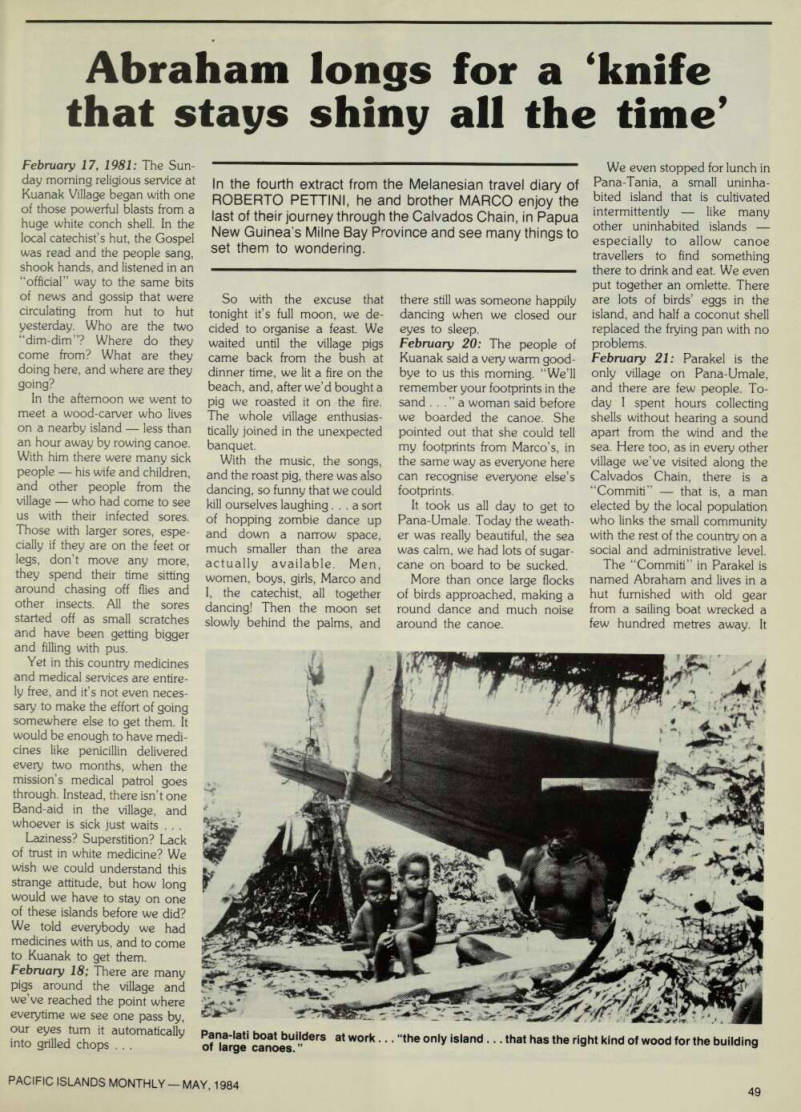
Pana-lati boat builders at work... "the only island ... that has the right kind of wood for the building of large canoes."
has a rusty stove with no gas, a sink without water pipes, and revolving chairs which to him are much less comfortable than a mat. He points out that still today little boys in Parakel copy the shape of that boat, making little models of it, and playing with them in the island’s more protected coves.
After we had eaten and chatted together tonight, I’m sure this is what Abraham would have liked to say to me: It’s easy to see you have lots of money. You have come here all the way from your country, which is on the other side of the world, from the place where it's night-time when it's day-time here, where sometimes it’s cold, and other times it’s hot, where the days grow shorter and longer, who knows why.
You’ve been able to pay to travel in the big aeroplane you’ve been talking about, an aeroplane so big it cou d fit in all the people in this village, and which flies high and fast, by day and by night.
I wonder what you’ve got in those colored bags, and in that big white trunk? Lots of money? Things to eat? Many photgraphs? Many T-shirts?
When I brought you the mat to sleep on I saw that you have books, medicines, those things that go underwater, and a new shiny knife, the kind that always stays shiny, 1 really wish I could have one like that February 23: We’ve been told repeatedly that the Brooker Islanders are the best and fastest sailors in the chain. Today the nor’westerly wasn’t any stronger than usual, but we
seemed to arrive extraordinarily quickly at our destination, In Kivina, everybody had gone to the gardens except a few old folk and children and the Brookers wanted to wait with us for their return. So we pulled the canoe ashore and, after having completely emptied it of water, we started plugging the cracks with the little tube of fibreglass that we had bought especially in Port Moresby. Considering the sur prise on their faces and the aut hentic gestures of apprecia tion from the sailors we cou l dn ’ t h had a better idea . , nA .. ...
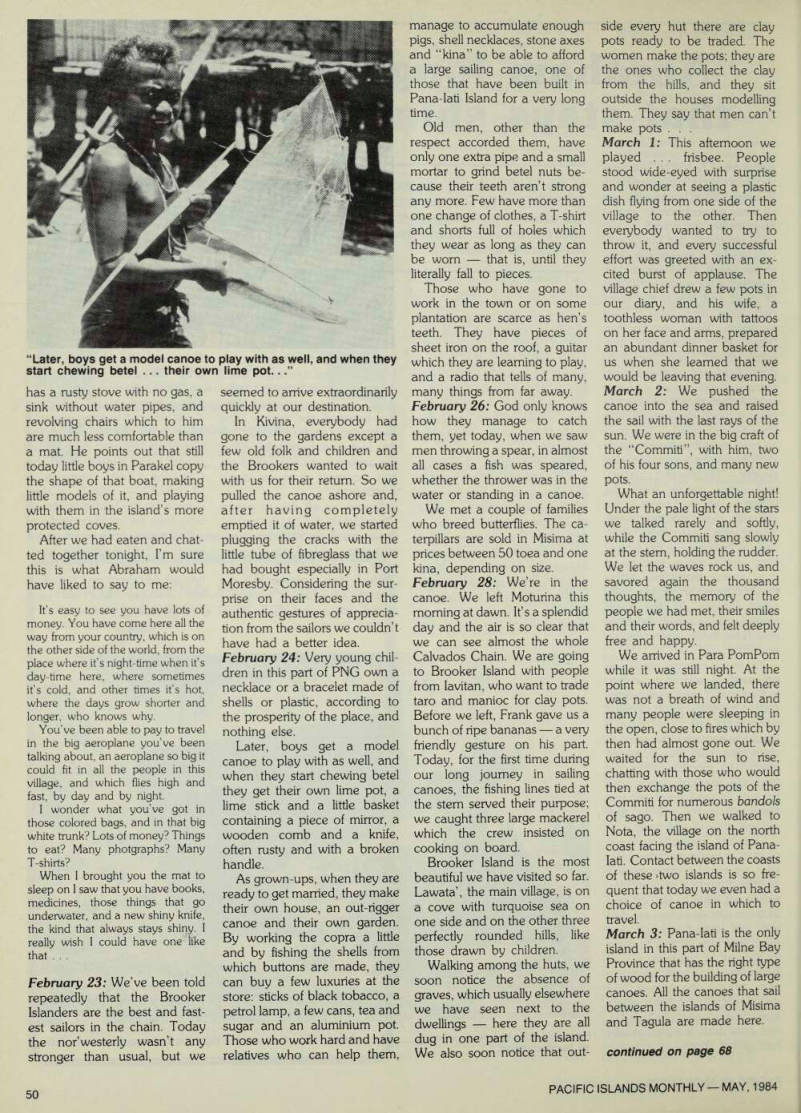
February 24: Very young chil dren in this part of PNG own a necklace or a bracelet made of shells or plastic, according to the prosperity of the place, and nothing else, Later boys get a model canoe (o , as well> and , . nii . 1.1 hen start ch< r w,n S b f tel the Y S«* their own lime pot a lime stick and a little basket containing a piece of mirror, a wooden comb and a knife, often rusty and with a broken handle.
A s grow n-ups, when they are reac [y to get married, they make Qwn h an out . ri ger , T„ canoe and their own garden, By working the copra a little and by fishing the shells from which buttons are made, they can buy a few luxuries at the store: sticks of black tobacco, a petrol lamp, a few cans, tea and sugar and an aluminium pot.
Those who work hard and have relatives who can help them,
manage to accumulate enough pigs, shell necklaces, stone axes and “kina” to be able to afford a large sailing canoe, one of those that have been built in Pana-lati Island for a very long time.
Old men, other than the respect accorded them, have only one extra pipe and a small mortar to grind betel nuts be cause their teeth aren’t strong any more. Few have more than one change of clothes, a T-shirt and shorts full of holes which they wear as long as they can be worn that is, until they literally fall to pieces.
Those who have gone to work in the town or on some plantation are scarce as hen’s teeth. They have pieces of sheet iron on the roof, a guitar which they are learning to play, and a radio that tells of many, many things from far away.
February 26: God only knows how they manage to catch them, yet today, when we saw men throwing a spear, in almost all cases a fish was speared, whether the thrower was in the water or standing in a canoe.
We met a couple of families who breed butterflies. The ca terpillars are sold in Misima at prices between 50 toea and one kina, depending on size.
February 28: We’re in the canoe. We left Moturina this morning at dawn. It’s a splendid day and the air is so clear that we can see almost the whole Calvados Chain. We are going to Brooker Island with people from lavitan, who want to trade taro and manioc for clay pots.
Before we left, Frank gave us a bunch of ripe bananas a very friendly gesture on his part.
Today, for the first time during our long journey in sailing canoes, the fishing lines tied at the stern served their purpose; we caught three large mackerel which the crew insisted on cooking on board.
Brooker Island is the most beautiful we have visited so far.
Lawata’, the main village, is on a cove with turquoise sea on one side and on the other three perfectly rounded hills, like those drawn by children.
Walking among the huts, we soon notice the absence of graves, which usually elsewhere we have seen next to the dwellings here they are all dug in one part of the island.
We also soon notice that out
side every hut there are clay pots ready to be traded. The women make the pots; they are the ones who collect the clay from the hills, and they sit outside the houses modelling them. They say that men can’t make pots . . .
March 1: This afternoon we played .. . frisbee. People stood wide-eyed with surprise and wonder at seeing a plastic dish flying from one side of the village to the other. Then everybody wanted to try to throw it, and every successful effort was greeted with an ex cited burst of applause. The village chief drew a few pots in our diary, and his wife, a toothless woman with tattoos on her face and arms, prepared an abundant dinner basket for us when she learned that we would be leaving that evening.
March 2: We pushed the canoe into the sea and raised the sail with the last rays of the sun. We were in the big craft of the “Commiti”, with him, two of his four sons, and many new pots.
What an unforgettable night!
Under the pale light of the stars we talked rarely and softly, while the Commiti sang slowly at the stem, holding the rudder.
We let the waves rock us, and savored again the thousand thoughts, the memory of the people we had met, their smiles and their words, and felt deeply free and happy.
We arrived in Para PomPom while it was still night. At the point where we landed, there was not a breath of wind and many people were sleeping in the open, close to fires which by then had almost gone out. We waited for the sun to rise, chatting with those who would then exchange the pots of the Commiti for numerous bandols of sago. Then we walked to Nota, the village on the north coast facing the island of Pana lati. Contact between the coasts of these ‘two islands is so fre quent that today we even had a choice of canoe in which to travel.
March 3: Pana-lati is the only island in this part of Milne Bay Province that has the right type of wood for the building of large canoes. All the canoes that sail between the islands of Misima and Tagula are made here.
continued on page 68
“Later, boys get a model canoe to play with as well, and when they start chewing betel ... their own lime pot..
There are many canoes under construction in Pana-lati there is no common ship yard but many private yards.
Whoever decides to build a canoe must first of all gather enough provisions to feed the people who will work with him; so for about a year he must prepare a good garden of pota toes and banana palms.
Apart from using a handful of copper nails, and sails made of cloth rather than woven leaves, all craft are built in the traditio nal manner: every piece of wood is cut and shaped by axe, fastened with vegetable fibres, and then finished with resin and cloth.
What’s the price of a com plete canoe? It depends ... It depends on the person who has organised its construction, on the number of those who have helped him, on the wealth of the person buying it, and, obviously, on its size. Someone paid 200 pigs for an 11-metre canoe just last week, and the guy from Para PomPom who brought us here told me that for his canoe he had to pay 100
pigs, 500 kina and 20 stone axes, besides plenty of shell money.
March 5: Never before have we travelled as fast in a canoe as we did this morning. We had been told that tomorrow a small plane would come from Alotau and so today we looked for a lift to get us to the landing strip in Misima on time. In the canoe this time there were at least 20 of us, including a number of children, yet we had to lower the sails twice, to ease the pressure of the wind on the stern.
March 6: Alotau Misurina Lodge. A hot shower, a dinner worthy of the “Thousand and One Nights,” a room with a floor, and beds with perfumed sheets . . .
Tonight ended the first chap ter of our journey. Tomorrow we’ll fly to Port Moresby, to apply for an extension to our visitors’ visas. We don’t know if we’ll get it. So we don’t know where our next story will begin.
Next month: To the Trob rionds.