Possible futures
pp. 47-48 · Read in the full issue
of Norfolk Island
The Winds of Change: Nor folk Island 1950-1982. ByMer val Hoare. Published by the Institute of Pacific Studies of the University of the South Pacific, Suva, 1983. No price shown.
Which Future for Norfolk Is land? By Christopher Nobbs.
Published by Norfolk Market ing, Box 114, Norfolk Island, 1983. $6.95.
Some time soon the Australian Government will be reviewing the constitutional situation of Norfolk Island, the Australian territory off the coast north-east of Sydney. One of the things it will have to decide together with the Norfolk Islanders is whether there should be moves towards greater political auton omy for Norfolk.
Merval Hoare, in her small, new book updating the recent history of the island, believes that its close ties with Australia, are “more likely to be strengthened than weakened in the foreseeable future”, even though Norfolk may continue to look towards the Pacific Islands community.
As a long-time resident of Norfolk Island, and author of a number of works on the island, Mrs Hoare’s views have to be listened to.
But there have always been pressures on the island favoring something like a Cook Islands style autonomy or certainly for some kind of “arm’s length association” with Australia rather than the full political and financial integration of the kind its neighbor, Lord Howe Island, has.
As one would expect from an
island whose population springs from the descendants of the Bounty mutineers, there is a fiercely independent spirit on Norfolk Island never far below the surface, and outside observers can’t hope to understand Norfolk without recognising that spirit.
Merval Hoare is no outside observer, and her new book is a useful extension to her original Norfolk Island An Outline of its History 1774-1977. It deals
in far more detail with the postwar political and economic pressures that have faced the island with the increase in migration and tourism, and pulls together many facts and dates not otherwise easily avail able. As a reference book it needs to be on the shelf of anybody interested in Austra lian history, Where I would quibble a little is that Mrs Hoare’s bias seems to be towards a Norfolk Island
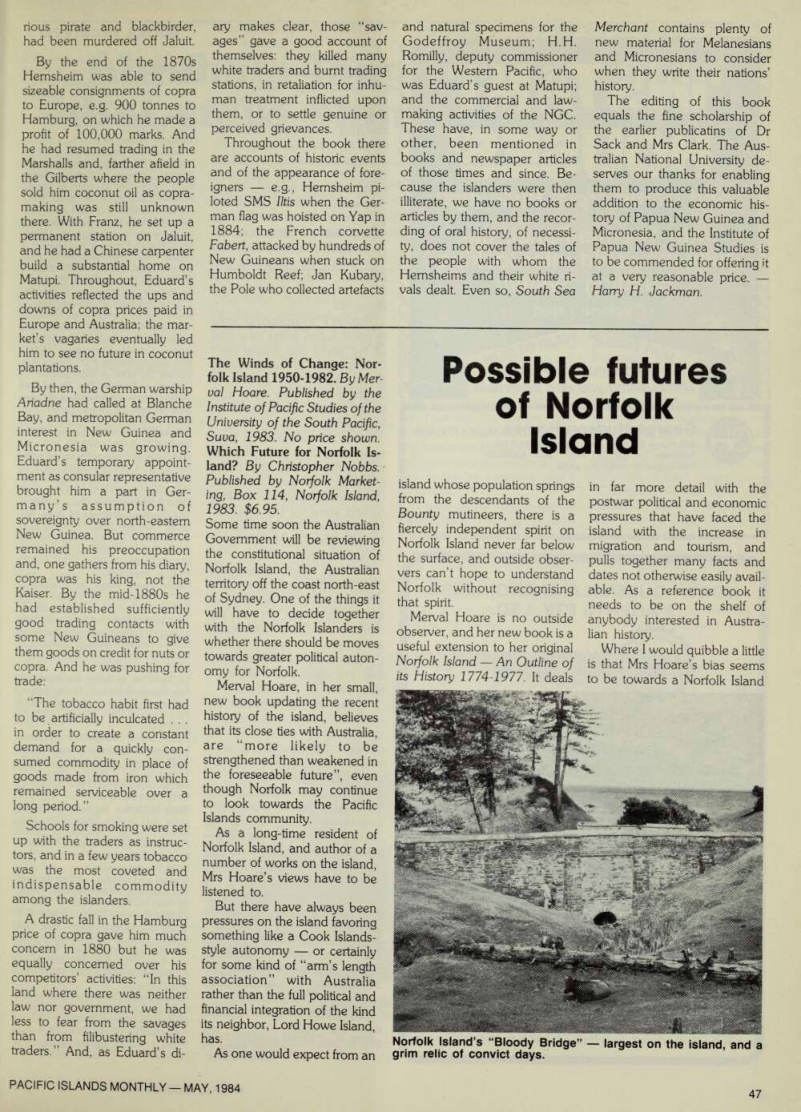
Norfolk Island’s “Bloody Bridge” - largest on the island, and a grim relic of convict days.
integrated with Australia with “goodies” and “baddies” the baddies being those who see an alternative.
Nobody should object to her taking a stand as an historian she has that privilege but nowhere in her book that I can see is there any real study of the reasons why there has always been this strong alternative view; why, for instance, there was such a fierce groundswell of opinion against the findings of the Nimmo royal commis sion, which proposed that Nor folk should be integrated into Australia, with the island be coming part of the Canberra electorate.
Norfolk’s independent state of mind is part of the very soul of the island and simply can’t be explained as being due to the machinations of occasional “mainlanders” who from time to time exert an influence on local politics.
I would have liked to have seen Mrs Hoare provide more insight into this aspect of island character, so that we could better understand the thinking behind some of the close in fighting that has gone on in Norfolk Island in the 30 years covered by her book.
Although brief, Christopher Nobbs’ 33-page thesis adds something to the Norfolk de bate. Nobbs was bom on the island and describes his booklet as “an essay to open informed discussion on the sort of future that the people of Norfolk Is land want for themselves.”
In fact he concentrates on economic issues, not social or constitutional ones, and he doesn’t pretend that it is a well-rounded study of the prob lems that face the island.
Some of it gets unnecessarily technical and rather pompously academic, but there is nevertheless some useful in formation on the economy.
Generally the author’s argu ment is that there is an un satisfactory absence of any long-term plan for the island.
The emphasis to date has been on short-term profit, and little legislation exists to ensure orderly land use or commercial development. Immigration con trol “remains unsatisfactory”.
He presses for public discus sion that could lead to an overall plan of development.
Stuart Inder