Hernsheim: His king was copra,
pp. 46-47 · Read in the full issue
not Kaiser
South Sea Merchant. By Eduard Hernsheim. Edited and translated by Peter Sack and Dymphna Clark. Pub lished by the Institute of Papua New Guinea Studies, Boroko, Papua New Guinea.
Price K 9.50.
In South Sea Merchant, their edition of Eduard Hemsheim’s typewritten reminiscences, di ary and pamphlets, translated by them into English, Dr Peter Sack and Mrs Dymphna Clark offer a detailed picture of “one of the most important mer chants in the Pacific Islands in the late 19th century . . . who also played a significant role in the political events leading to the acquisition of German col onies in the area”.
Eduard Hemsheim, bom in 1847 into a cultured German family of Jewish descent, gained his master mariner’s ticket at 20. He reached the Pacific in 1872, in charge of a small ship. Eduard and his brother Franz developed a trad ing enterprise, its main base on Matupi Island near what is now Rabaul. J.C. Godeffroy & Sohn and the Neu Guinea Compag nie (NGC) were their main competitors. Eduard returned to Germany in 1892 and 17 years later converted their en terprise into a joint-stock com
pany. He died in 1917. While Franz published a book, mainly on his experiences in Mic ronesia, Eduard published only a few pamphlets, mostly directed against the NGC, and some devoted entirely to sailing instructions. He also left a type script, about 500 pages, of his reminiscences, containing many repetitive technical de tails, and a diary. Sack and Clark have selected readable excerpts constituting a series of self-explanatory close-ups, to illuminate Hernsheim’s personality and tell us some thing of the islands’ trade in the 1880 s.
Foreign traders in Micronesia and New Guinea mostly sailed in vessels that would not pass today’s harbor masters’ inspec tion, and they underwent even greater physical hardships ashore. Many were killed by islanders. While the handful of foreigners at the helm of the trading enterprises were bourgeois none more so than Emma Forsayth, later Kolbe, “Queen Emma” their agents and other white em ployees were mostly misfits in their homelands; drunkards, swindlers, loafers and brawlers abounded. Whatever value they may have placed on their own lives, they placed very little
on those of the islanders with whom they traded, and often treated their employees badly too.
J.C. Godeffroy & Sohn had already established trading sta tions before Hemsheim made his headquarters on Matupi Is land, but they had left those at Nodup and Matupi after New Guineans had killed one of their agents and burnt the stations.
By 1875 quite a number of villagers in the archipelago had had dealings with whites: with American whalers, trepang fishermen, coconut oil buyers, and missionaries. The Hemsheims began to operate in the Marshalls, on Ponape and Yap, as well as in the archipelago, with occasional trips as far as Manila and Sydney for supplies, and to sell copra and other produce. And Eduard had walked across New Ireland, from Namatanai to Ulupatur, in 1876. A year later, the Hemsheims closed their New Guinea trading station be cause of stiff competition from the Godeffroys, and traded at Jaluit in the Marshalls, where a local girl became Eduard’s mis tress. She later saved his life twice from a shark and from Hermit Islanders. He returned to Makada near Rabaul in 1878, after Bully Hayes, noto
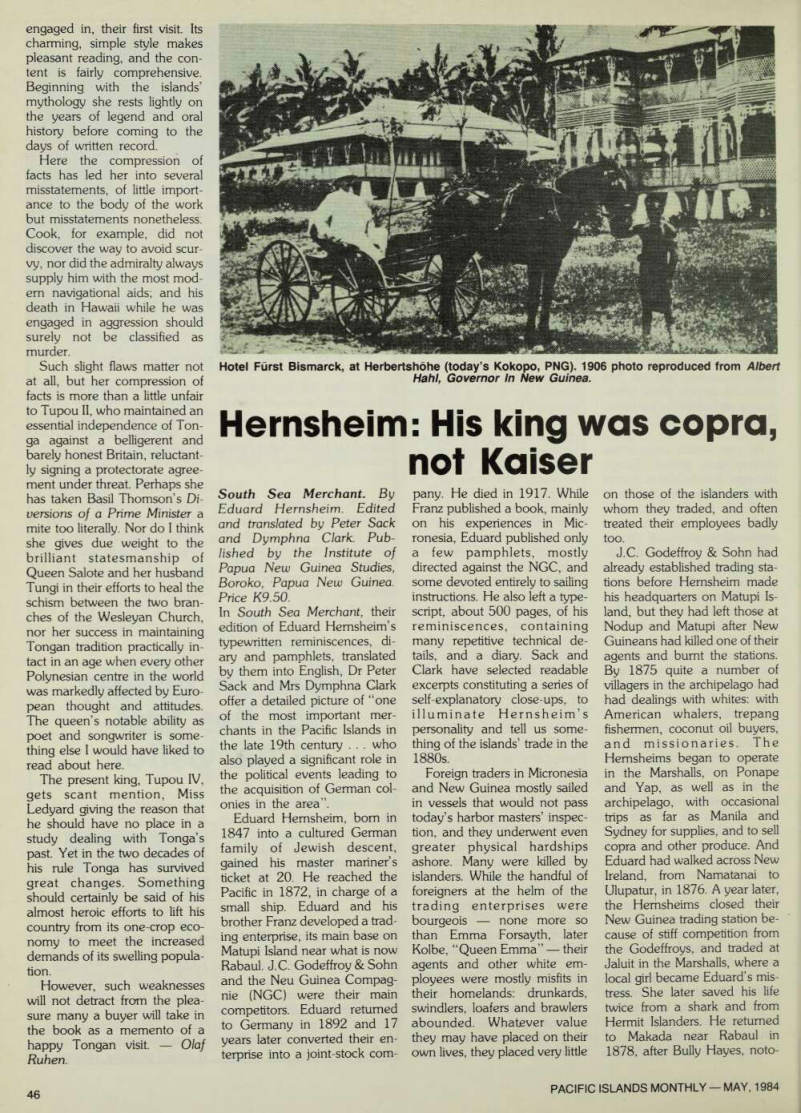
Hotel Furst Bismarck, at Herbertshbhe (today’s Kokopo, PNG). 1906 photo reproduced from Albert Hahl, Governor In New Guinea.
rious pirate and blackbirder, had been murdered off Jaluit.
By the end of the 1870 s Hemsheim was able to send sizeable consignments of copra to Europe, e.g. 900 tonnes to Hamburg, on which he made a profit of 100,000 marks. And he had resumed trading in the Marshalls and, farther afield in the Gilberts where the people sold him coconut oil as copra making was still unknown there. With Franz, he set up a permanent station on Jaluit, and he had a Chinese carpenter build a substantial home on Matupi. Throughout, Eduard’s activities reflected the ups and downs of copra prices paid in Europe and Australia; the mar ket’s vagaries eventually led him to see no future in coconut plantations.
By then, the German warship Ariadne had called at Blanche Bay, and metropolitan German interest in New Guinea and Micronesia was growing.
Eduard’s temporary appoint ment as consular representative brought him a part in Ger many’s assumption of sovereignty over north-eastern New Guinea. But commerce remained his preoccupation and, one gathers from his diary, copra was his king, not the Kaiser. By the mid-1880s he had established sufficiently good trading contacts with some New Guineans to give them goods on credit for nuts or copra. And he was pushing for trade: “The tobacco habit first had to be artificially inculcated . . . in order to create a constant demand for a quickly con sumed commodity in place of goods made from iron which remained serviceable over a long period.”
Schools for smoking were set up with the traders as instruc tors, and in a few years tobacco was the most coveted and indispensable commodity among the islanders.
A drastic fall in the Hamburg price of copra gave him much concern in 1880 but he was equally concerned over his competitors’ activities; “In this land where there was neither law nor government, we had less to fear from the savages than from filibustering white traders.” And, as Eduard’s di
ary makes clear, those “sav ages” gave a good account of themselves: they killed many white traders and burnt trading stations, in retaliation for inhu man treatment inflicted upon them, or to settle genuine or perceived grievances.
Throughout the book there are accounts of historic events and of the appearance of fore igners e.g., Hemsheim pi loted SMS litis when the Ger man flag was hoisted on Yap in 1884; the French corvette Fabert, attacked by hundreds of New Guineans when stuck on Humboldt Reef; Jan Kubary, the Pole who collected artefacts
and natural specimens for the Godeffroy Museum; H.H.
Romilly, deputy commissioner for the Western Pacific, who was Eduard’s guest at Matupi; and the commercial and law making activities of the NGC.
These have, in some way or other, been mentioned in books and newspaper articles of those times and since. Be cause the islanders were then illiterate, we have no books or articles by them, and the recor ding of oral history, of necessi ty, does not cover the tales of the people with whom the Hemsheims and their white ri vals dealt. Even so, South Sea
Merchant contains plenty of new material for Melanesians and Micronesians to consider when they write their nations’ history.
The editing of this book equals the fine scholarship of the earlier publicatins of Dr Sack and Mrs Clark. The Aus tralian National University de serves our thanks for enabling them to produce this valuable addition to the economic his tory of Papua New Guinea and Micronesia, and the Institute of Papua New Guinea Studies is to be commended for offering it at a very reasonable price.
Harry H. Jackman.