people
pp. 58-59 · Read in the full issue
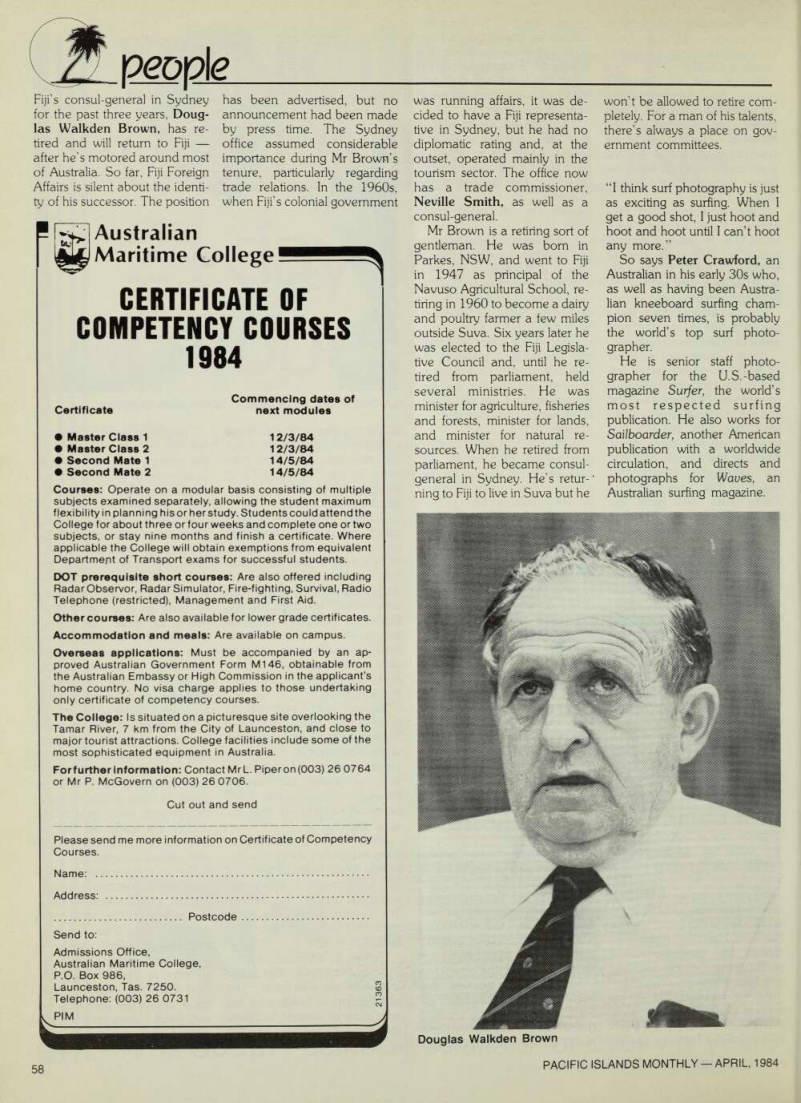
Fiji’s consul-general in Sydney for the past three years, Doug las Walkden Brown, has re tired and will return to Fiji after he’s motored around most of Australia. So far, Fiji Foreign Affairs is silent about the identi ty of his successor. The position
has been advertised, but no announcement had been made by press time. The Sydney office assumed considerable importance during Mr Brown’s tenure, particularly regarding trade relations. In the 19605, when Fiji’s colonial government
was running affairs, it was de cided to have a Fiji representa tive in Sydney, but he had no diplomatic rating and, at the outset, operated mainly in the tourism sector. The office now has a trade commissioner, Neville Smith, as well as a consul-general.
Mr Brown is a retiring sort of gentleman. He was born in Parkes, NSW, and went to Fiji in 1947 as principal of the Navuso Agricultural School, re tiring in 1960 to become a dairy and poultry farmer a few miles outside Suva. Six years later he was elected to the Fiji Legisla tive Council and, until he re tired from parliament, held several ministries. He was minister for agriculture, fisheries and forests, minister for lands, and minister for natural re sources. When he retired from parliament, he became consul general in Sydney. He’s retur-’ ning to Fiji to live in Suva but he
won’t be allowed to retire com pletely. For a man of his talents, there’s always a place on gov ernment committees.
“I think surf photography is just as exciting as surfing. When I get a good shot, I just hoot and hoot and hoot until I can’t hoot any more.”
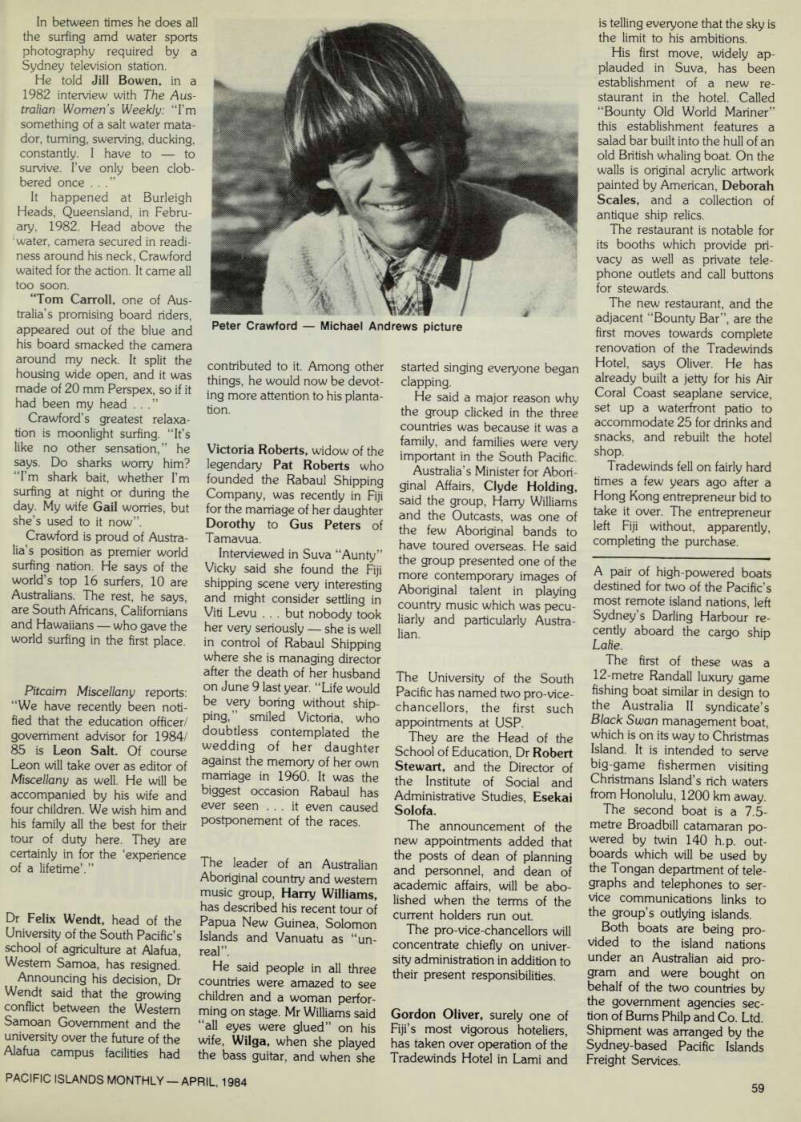
So says Peter Crawford, an Australian in his early 30s who, as well as having been Austra lian kneeboard surfing cham pion seven times, is probably the world’s top surf photo grapher.
He is senior staff photo grapher for the U.S.-based magazine Surfer, the world’s most respected surfing publication. He also works for Sailboarder, another American publication with a worldwide circulation, and directs and photographs for Waves, an Australian surfing magazine.
Douglas Walkden Brown
In between times he does all the surfing amd water sports photography required by a Sydney television station.
He told Jill Bowen, in a 1982 interview with The Aus tralian Women’s Weekly: “I’m something of a salt water mata dor, turning, swerving, ducking, constantly. I have to to survive. I’ve only been clob bered once ...”
It happened at Burleigh Heads, Queensland, in Febru ary, 1982. Head above the water, camera secured in readi ness around his neck, Crawford waited for the action. It came all too soon.
“Tom Carroll, one of Aus tralia’s promising board riders, appeared out of the blue and his board smacked the camera around my neck. It split the housing wide open, and it was made of 20 mm Perspex, so if it had been my head ...”
Crawford’s greatest relaxa tion is moonlight surfing. “It’s like no other sensation,” he says. Do sharks worry him?
“I’m shark bait, whether I’m surfing at night or during the day. My wife Gail worries, but she’s used to it now”.
Crawford is proud of Austra lia’s position as premier world surfing nation. He says of the world’s top 16 surfers, 10 are Australians. The rest, he says, are South Africans, Californians and Hawaiians who gave the world surfing in the first place.
Pitcairn Miscellany reports: “We have recently been noti fied that the education officer/ government advisor for 1984/ 85 is Leon Salt. Of course Leon will take over as editor of Miscellany as well. He will be accompanied by his wife and four children. We wish him and his family all the best for their tour of duty here. They are certainly in for the ‘experience of a lifetime’.”
Dr Felix Wendt, head of the University of the South Pacific’s school of agriculture at Alafua, Western Samoa, has resigned.
Announcing his decision, Dr Wendt said that the growing conflict between the Western Samoan Government and the university over the future of the Alafua campus facilities had
contributed to it. Among other things, he would now be devot ing more attention to his planta tion.
Victoria Roberts, widow of the legendary Pat Roberts who founded the Rabaul Shipping Company, was recently in Fiji for the marriage of her daughter Dorothy to Gus Peters of Tamavua.
Interviewed in Suva “Aunty”
Vicky said she found the Fiji shipping scene very interesting and might consider settling in Viti Levu . . . but nobody took her very seriously she is well in control of Rabaul Shipping where she is managing director after the death of her husband on June 9 last year. “Life would be very boring without ship ping,” smiled Victoria, who doubtless contemplated the wedding of her daughter against the memory of her own marriage in 1960. It was the biggest occasion Rabaul has ever seen ... it even caused postponement of the races.
The leader of an Australian Aboriginal country and western music group, Harry Williams, has described his recent tour of Papua New Guinea, Solomon Islands and Vanuatu as “un real”.
He said people in all three countries were amazed to see children and a woman perfor ming on stage. Mr Williams said “all eyes were glued” on his wife, Wilga, when she played the bass guitar, and when she
started singing everyone began clapping.
He said a major reason why the group clicked in the three countries was because it was a family, and families were very important in the South Pacific.
Australia’s Minister for Abori ginal Affairs, Clyde Holding, said the group, Harry Williams and the Outcasts, was one of the few Aboriginal bands to have toured overseas. He said the group presented one of the more contemporary images of Aboriginal talent in playing country music which was pecu liarly and particularly Austra lian.
The University of the South Pacific has named two pro-vice chancellors, the first such appointments at USP.
They are the Head of the School of Education, Dr Robert Stewart, and the Director of the Institute of Social and Administrative Studies, Esekai Solofa.
The announcement of the new appointments added that the posts of dean of planning and personnel, and dean of academic affairs, will be abo lished when the terms of the current holders run out.
The pro-vice-chancellors will concentrate chiefly on univer sity administration in addition to their present responsibilities.
Gordon Oliver, surely one of Fiji’s most vigorous hoteliers, has taken over operation of the Tradewinds Hotel in Lami and
is telling everyone that the sky is the limit to his ambitions.
His first move, widely ap plauded in Suva, has been establishment of a new re staurant in the hotel. Called “Bounty Old World Mariner” this establishment features a salad bar built into the hull of an old British whaling boat. On the walls is original acrylic artwork painted by American, Deborah Scales, and a collection of antique ship relics.
The restaurant is notable for its booths which provide pri vacy as well as private tele phone outlets and call buttons for stewards.
The new restaurant, and the adjacent “Bounty Bar”, are the first moves towards complete renovation of the Tradewinds Hotel, says Oliver. He has already built a jetty for his Air Coral Coast seaplane service, set up a waterfront patio to accommodate 25 for drinks and snacks, and rebuilt the hotel shop.
Tradewinds fell on fairly hard times a few years ago after a Hong Kong entrepreneur bid to take it over. The entrepreneur left Fiji without, apparently, completing the purchase.
A pair of high-powered boats destined for two of the Pacific’s most remote island nations, left Sydney’s Darling Harbour re cently aboard the cargo ship Lahe.
The first of these was a 12-metre Randall luxury game fishing boat similar in design to the Australia II syndicate’s Black Swan management boat, which is on its way to Christmas Island. It is intended to serve big-game fishermen visiting Christmans Island’s rich waters from Honolulu, 1200 km away.
The second boat is a 7.5metre Broadbill catamaran po wered by twin 140 h.p. out boards which will be used by the Tongan department of tele graphs and telephones to ser vice communications links to the group’s outlying islands.
Both boats are being pro vided to the island nations under an Australian aid pro gram and were bought on behalf of the two countries by the government agencies sec tion of Bums Philp and Co. Ltd.
Shipment was arranged by the Sydney-based Pacific Islands Freight Services.
Peter Crawford - Michael Andrews picture