song unheeded
pp. 55-57 · Read in the full issue
A Tenorio siren song unheeded
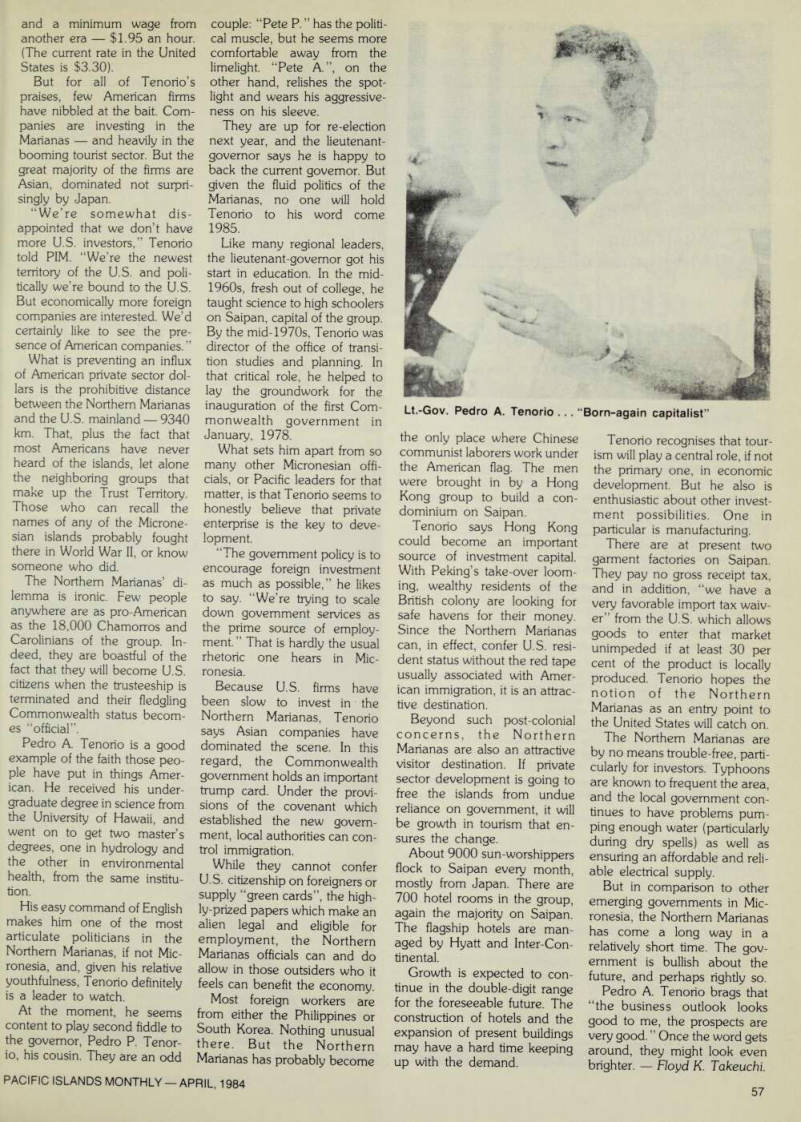
Pedro A. Tenorio wants to unleash American private en terprise in the U.S. Common wealth of the Northern Marianas and as lieutenant governor of the 16-island chain, what Tenorio wants is of some consequence.
Like a born-again capitalist, the 43-year-old leader has a gleam in his eye when he talks about the economic virtues of the Northern Marianas.
What do the islands offer?
Tenorio says: good weather, a favorable tax structure, a poli tically stable government in timately tied to the United States, a reliable work force,
Notes from the North
Floyd K.
Takeuchi on Micronesia
and a minimum wage from another era $1.95 an hour. (The current rate in the United States is $3.30).
But for all of Tenorio’s praises, few American firms have nibbled at the bait. Com panies are investing in the Marianas and heavily in the booming tourist sector. But the great majority of the firms are Asian, dominated not surpri singly by Japan.
“We’re somewhat dis appointed that we don’t have more U.S. investors,” Tenorio told PIM. “We’re the newest territory of the U.S. and poli tically we’re bound to the U.S.
But economically more foreign companies are interested. We’d certainly like to see the pre sence of American companies. ”
What is preventing an influx of American private sector dol lars is the prohibitive distance between the Northern Marianas and the U.S. mainland 9340 km. That, plus the fact that most Americans have never heard of the islands, let alone the neighboring groups that make up the Trust Territory.
Those who can recall the names of any of the Microne sian islands probably fought there in World War 11, or know someone who did.
The Northern Marianas’ di lemma is ironic. Few people anywhere are as pro-American as the 18,000 Chamorros and Carolinians of the group. In deed, they are boastful of the fact that they will become U.S. citizens when the trusteeship is terminated and their fledgling Commonwealth status becom es “official”.
Pedro A. Tenorio is a good example of the faith those peo ple have put in things Amer ican. He received his under graduate degree in science from the University of Hawaii, and went on to get two master’s degrees, one in hydrology and the other in environmental health, from the same institu tion.
His easy command of English makes him one of the most articulate politicians in the Northern Marianas, if not Mic ronesia, and, given his relative youthfulness, Tenorio definitely is a leader to watch.
At the moment, he seems content to play second fiddle to : the governor, Pedro P. Tenor io, his cousin. They are an odd
i couple; “Pete P. ” has the politi cal muscle, but he seems more comfortable away from the limelight. “Pete A.”, on the other hand, relishes the spot light and wears his aggressive ness on his sleeve.
They are up for re-election next year, and the lieutenant governor says he is happy to back the current governor. But given the fluid politics of the Marianas, no one will hold Tenorio to his word come 1985.
Like many regional leaders, the lieutenant-governor got his start in education. In the mid -19605, fresh out of college, he taught science to high schoolers on Saipan, capital of the group.
By the mid-19705, Tenorio was director of the office of transi tion studies and planning. In that critical role, he helped to lay the groundwork for the inauguration of the first Com monwealth government in January, 1978.
What sets him apart from so many other Micronesian offi cials, or Pacific leaders for that matter, is that Tenorio seems to honestly believe that private enterprise is the key to deve lopment.
“The government policy is to encourage foreign investment as much as possible,” he likes to say. “We’re trying to scale down government services as the prime source of employ ment.” That is hardly the usual rhetoric one hears in Mic ronesia.
Because U.S. firms have been slow to invest in the Northern Marianas, Tenorio says Asian companies have dominated the scene. In this regard, the Commonwealth government holds an important trump card. Under the provi sions of the covenant which established the new govern ment, local authorities can con trol immigration.
While they cannot confer U.S. citizenship on foreigners or supply “green cards”, the high ly-prized papers which make an alien legal and eligible for employment, the Northern Marianas officials can and do allow in those outsiders who it feels can benefit the economy.
Most foreign workers are from either the Philippines or South Korea. Nothing unusual there. But the Northern Marianas has probably become
the only place where Chinese communist laborers work under the American flag. The men were brought in by a Hong Kong group to build a con dominium on Saipan.
Tenorio says Hong Kong could become an important source of investment capital.
With Peking’s take-over loom ing, wealthy residents of the British colony are looking for safe havens for their money.
Since the Northern Marianas can, in effect, confer U.S. resi dent status without the red tape usually associated with Amer ican immigration, it is an attrac tive destination.
Beyond such post-colonial concerns, the Northern Marianas are also an attractive visitor destination. If private sector development is going to free the islands from undue reliance on government, it will be growth in tourism that en sures the change.
About 9000 sun-worshippers flock to Saipan every month, mostly from Japan. There are 700 hotel rooms in the group, again the majority on Saipan.
The flagship hotels are man aged by Hyatt and Inter-Con tinental.
Growth is expected to con tinue in the double-digit range for the foreseeable future. The construction of hotels and the expansion of present buildings may have a hard time keeping up with the demand.
Tenorio recognises that tour ism will play a central role, if not the primary one, in economic development. But he also is enthusiastic about other invest ment possibilities. One in particular is manufacturing.
There are at present two garment factories on Saipan.
They pay no gross receipt tax, and in addition, “we have a very favorable import tax waiv er” from the U.S. which allows goods to enter that market unimpeded if at least 30 per cent of the product is locally produced. Tenorio hopes the notion of the Northern Marianas as an entry point to the United States will catch on.
The Northern Marianas are by no means trouble-free, parti cularly for investors. Typhoons are known to frequent the area, and the local government con tinues to have problems pum ping enough water (particularly during dry spells) as well as ensuring an affordable and reli able electrical supply.
But in comparison to other emerging governments in Mic ronesia, the Northern Marianas has come a long way in a relatively short time. The gov ernment is bullish about the future, and perhaps rightly so.
Pedro A. Tenorio brags that “the business outlook looks good to me, the prospects are very good. ” Once the word gets around, they might look even
brighter.
Floyd K. Takeuchi.
Lt.-Gov. Pedro A. Tenorio ... “Born-again capitalist”