Rioting ex-soldiers
p. 50 · Read in the full issue
Cook Islands After World War I
Rioting ex-soldiers create a ‘most trying fortnight ..'
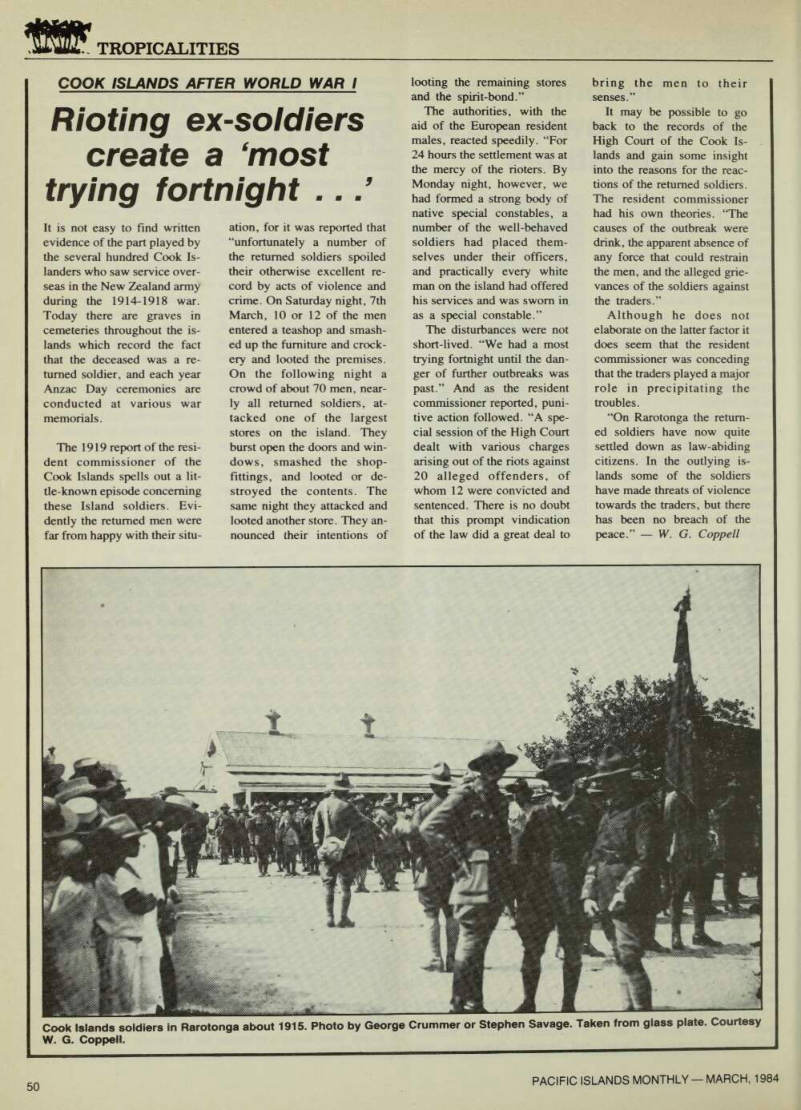
It is not easy to find written evidence of the part played by the several hundred Cook Is landers who saw service over seas in the New Zealand army during the 1914-1918 war.
Today there are graves in cemeteries throughout the is lands which record the fact that the deceased was a re turned soldier, and each year Anzac Day ceremonies are conducted at various war memorials.
The 1919 report of the resi dent commissioner of the Cook Islands spells out a lit
tle-known episode concerning
these Island soldiers. Evi dently the returned men were far from happy with their situ
looting the remaining stores
and the spirit-bond.”
The authorities, with the aid of the European resident males, reacted speedily. “For 24 hours the settlement was at the mercy of the rioters. By
Monday night, however, we
had formed a strong body of native special constables, a number of the well-behaved soldiers had placed them selves under their officers, and practically every white man on the island had offered his services and was sworn in as a special constable.”
The disturbances were not short-lived. “We had a most trying fortnight until the dan ger of further outbreaks was past.” And as the resident
commissioner reported, puni
tive action followed. “A spe cial session of the High Court dealt with various charges arising out of the riots against 20 alleged offenders, of whom 12 were convicted and sentenced. There is no doubt that this prompt vindication of the law did a great deal to
bring the men to their senses.”
It may be possible to go back to the records of the High Court of the Cook Is lands and gain some insight into the reasons for the reac tions of the returned soldiers.
The resident commissioner had his own theories. “The causes of the outbreak were drink, the apparent absence of any force that could restrain the men, and the alleged grie vances of the soldiers against the traders.”
Although he does not elaborate on the latter factor it does seem that the resident commissioner was conceding that the traders played a major role in precipitating the troubles.
“On Rarotonga the return ed soldiers have now quite settled down as law-abiding citizens. In the outlying is lands some of the soldiers have made threats of violence towards the traders, but there has been no breach of the
ation, for it was reported that “unfortunately a number of the returned soldiers spoiled their otherwise excellent re cord by acts of violence and crime. On Saturday night, 7th March, 10 or 12 of the men entered a teashop and smash ed up the furniture and crock ery and looted the premises.
On the following night a crowd of about 70 men, near ly all returned soldiers, at tacked one of the largest stores on the island. They burst open the doors and win dows, smashed the shop fittings, and looted or de stroyed the contents. The same night they attacked and looted another store. They an nounced their intentions of
peace.”
W. G. Coppell
Cook Islands soldiers in Rarotonga about 1915. Photo by George Crummer or Stephen Savage. Taken from glass plate. Courtesy W. G. Coppell.