Raro becomes Java
p. 49 · Read in the full issue
Tropicalities
Raro becomes Java for Mr Lawrence’s Christmas
The other day I went to see the film Merry Christmas Mr Lawr ence, not to watch the antics of David Bowie and Tom Conti, but because I had been told that the film was shot in Rarotonga. I knew that the story concerned the
interplay of relationships bet
ween inmates and guards in a
Japanese prisoner-of-war camp
in World War n. I was intrigued to discover how the film-makers would adapt the Rarotongan en vironment to the demands of such a script.
My memories of Rarotonga
are of a place where violence, if it should occur, is a brief lapse by individuals into the baser emotions, and is generally abhorred by the local people.
Institutionalised enmities effec
tively vanished under missionary
influences, and today the rugby field is the place where aggres sions are worked out.
I suppose I can best illustrate the pacific quality of the
Rarotongan scene by going back
to the celebrations which pre ceded and accompanied the at tainment of internal self government in 1965.
It was decided that a guard of honor should be mounted to greet the governor-general when he arrived to attend the ceremonies.
Officially, no Cook Islanders were recruited to fight in World War II the few who did battle enlisted in New Zealand. The only men who could claim to have local military experience in that war were a couple of dozen who, during the war, had mount
ed the high peaks of Rarotonga
as coast watchers. They became the ceremonial guard of honor.
There were no military un iforms on hand so local seam stresses turned their hands to making khaki drill tunics, trous ers and forage caps. Boots also presented a problem. This was solved by decking the men out in brown plastic sandals.
Two other obstacles had to be faced. No honor guard is com plete without firearms. In those
days the only official firearm on the island was a small pistol used by the police for the despatch of female dogs, which were then proscribed animals. Fortunately there was an air link with West ern Samoa, and it was possible to borrow from that country a cou ple of dozen old .303 Lee- Enfield rifles.
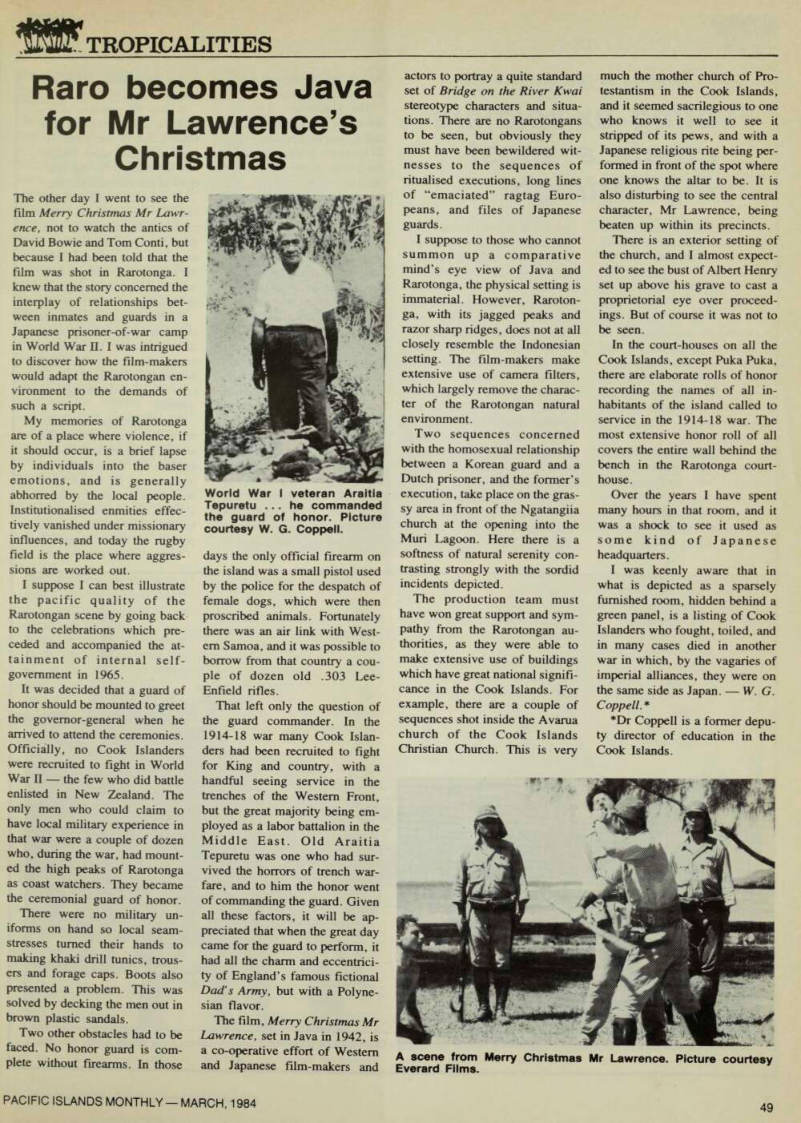
That left only the question of the guard commander. In the 1914-18 war many Cook Islan ders had been recruited to fight for King and country, with a handful seeing service in the trenches of the Western Front, but the great majority being em ployed as a labor battalion in the Middle East. Old Araitia Tepuretu was one who had sur vived the horrors of trench war fare, and to him the honor went of commanding the guard. Given all these factors, it will be ap preciated that when the great day came for the guard to perform, it had all the charm and eccentrici ty of England’s famous fictional Dad’s Army, but with a Polyne sian flavor.
The film, Merry Christmas Mr Lawrence, set in Java in 1942, is a co-operative effort of Western and Japanese film-makers and
actors to portray a quite standard set of Bridge on the River Kwai stereotype characters and situa tions. There are no Rarotongans to be seen, but obviously they must have been bewildered wit nesses to the sequences of ritualised executions, long lines of “emaciated” ragtag Euro peans, and files of Japanese guards.
I suppose to those who cannot summon up a comparative mind’s eye view of Java and
Rarotonga, the physical setting is
immaterial. However, Raroton ga, with its jagged peaks and razor sharp ridges, does not at all closely resemble the Indonesian setting. The film-makers make extensive use of camera filters, which largely remove the charac ter of the Rarotongan natural environment.
Two sequences concerned with the homosexual relationship between a Korean guard and a Dutch prisoner, and the former’s execution, take place on the gras sy area in front of the Ngatangiia church at the opening into the Muri Lagoon. Here there is a softness of natural serenity con trasting strongly with the sordid
incidents depicted.
The production team must have won great support and sym pathy from the Rarotongan au thorities, as they were able to make extensive use of buildings which have great national signifi cance in the Cook Islands. For example, there are a couple of sequences shot inside the Avarua church of the Cook Islands Christian Church. This is very
much the mother church of Pro testantism in the Cook Islands, and it seemed sacrilegious to one who knows it well to see it stripped of its pews, and with a
Japanese religious rite being per
formed in front of the spot where one knows the altar to be. It is also disturbing to see the central character, Mr Lawrence, being beaten up within its precincts.
There is an exterior setting of the church, and I almost expect ed to see the bust of Albert Henry set up above his grave to cast a
proprietorial eye over proceed
ings. But of course it was not to be seen.
In the court-houses on all the Cook Islands, except Puka Puka, there are elaborate rolls of honor recording the names of all in habitants of the island called to service in the 1914-18 war. The most extensive honor roll of all covers the entire wall behind the bench in the Rarotonga court house.
Over the years I have spent many hours in that room, and it was a shock to see it used as some kind of Japanese
headquarters.
I was keenly aware that in what is depicted as a sparsely furnished room, hidden behind a green panel, is a listing of Cook Islanders who fought, toiled, and in many cases died in another war in which, by the vagaries of imperial alliances, they were on the same side as Japan. W. G.
Coppell. *
*Dr Coppell is a former depu ty director of education in the Cook Islands.
World War I veteran Araitia Tepuretu ... he commanded the guard of honor. Picture courtesy W. G. Coppell.
A scene from Merry Christmas Mr Lawrence. Picture courtesy Everard Films.