Camping holiday
pp. 51-53 · Read in the full issue
Vanuatu pig is really a “dig”
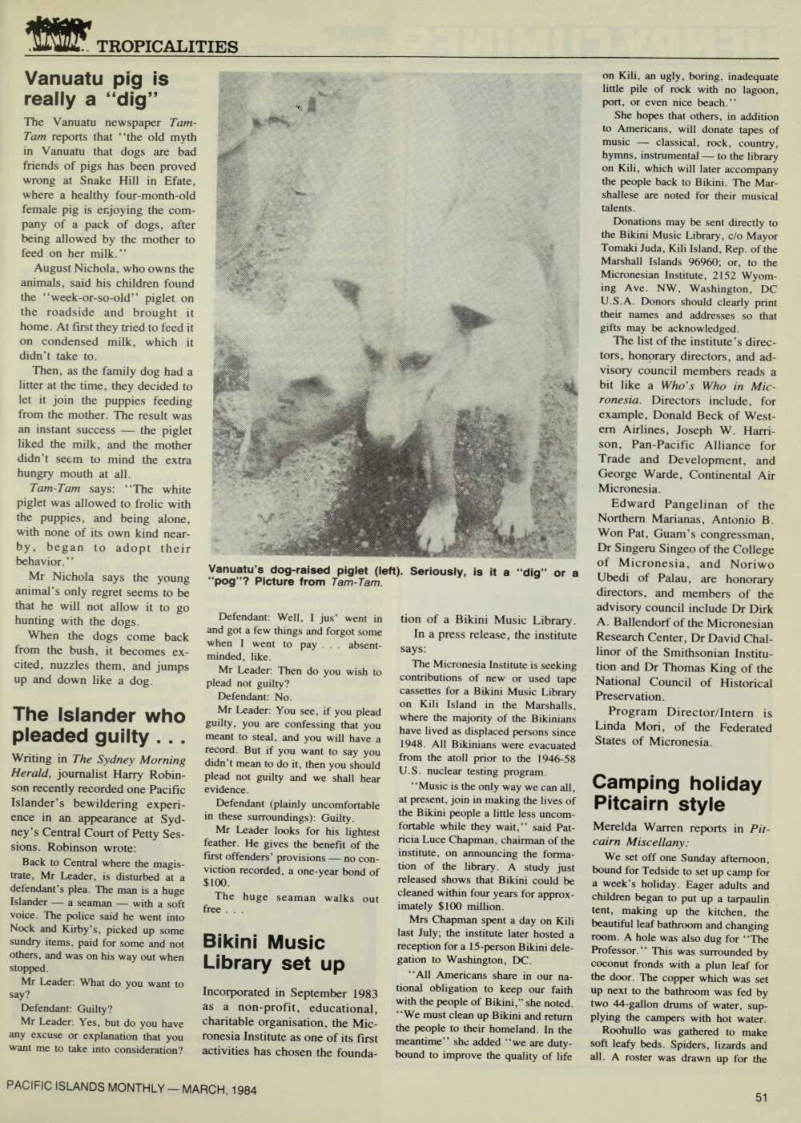
The Vanuatu newspaper Tam- Tam reports that “the old myth in Vanuatu that dogs are bad friends of pigs has been proved wrong at Snake Hill in Efate, where a healthy four-month-old female pig is enjoying the com pany of a pack of dogs, after being allowed by the mother to feed on her milk.”
August Nichola, who owns the animals, said his children found the “week-or-so-old” piglet on the roadside and brought it home. At first they tried to feed it on condensed milk, which it didn’t take to.
Then, as the family dog had a litter at the time, they decided to
let it join the puppies feeding
from the mother. The result was an instant success the piglet liked the milk, and the mother didn’t seem to mind the extra hungry mouth at all.
Tam-Tam says: “The white piglet was allowed to frolic with the puppies, and being alone, with none of its own kind near
by, began to adopt their
behavior.”
Mr Nichola says the young animal’s only regret seems to be that he will not allow it to go
hunting with the dogs.
When the dogs come back from the bush, it becomes ex cited, nuzzles them, and jumps up and down like a dog.
The Islander who
pleaded guilty .. .
Writing in The Sydney Morning
Herald, journalist Harry Robin son recently recorded one Pacific
Islander’s bewildering experi
ence in an appearance at Syd ney’s Central Court of Petty Ses sions. Robinson wrote: Back to Central where the magis trate, Mr Leader, is disturbed at a defendant’s plea. The man is a huge Islander a seaman with a soft voice. The police said he went into Nock and Kirby’s, picked up some sundry items, paid for some and not others, and was on his way out when stopped.
Mr Leader: What do you want to say?
Defendant: Guilty?
Mr Leader: Yes, but do you have any excuse or explanation that you want me to take into consideration?
Defendant; Well, I jus’ went in and got a few things and forgot some when I went to pay . . . absent minded, like.
Mr Leader: Then do you wish to plead not guilty?
Defendant: No.
Mr Leader: You see, if you plead guilty, you are confessing that you meant to steal, and you will have a record. But if you want to say you didn’t mean to do it, then you should plead not guilty and we shall hear evidence.
Defendant (plainly uncomfortable in these surroundings): Guilty.
Mr Leader looks for his lightest feather. He gives the benefit of the first offenders’ provisions no con viction recorded, a one-year bond of $lOO.
The huge seaman walks out free . . .
Bikini Music
Library set up
Incorporated in September 1983
as a non-profit, educational,
charitable organisation, the Mic ronesia Institute as one of its first activities has chosen the founda
tion of a Bikini Music Library.
In a press release, the institute says: The Micronesia Institute is seeking contributions of new or used tape cassettes for a Bikini Music Library on Kili Island in the Marshalls, where the majority of the Bikinians have lived as displaced persons since 1948. All Bikinians were evacuated from the atoll prior to the 1946-58 U.S. nuclear testing program.
“Music is the only way we can all, at present, join in making the lives of the Bikini people a little less uncom fortable while they wait,” said Pat ricia Luce Chapman, chairman of the institute, on announcing the forma tion of the library. A study just released shows that Bikini could be cleaned within four years for approx imately $lOO million.
Mrs Chapman spent a day on Kili last July; the institute later hosted a reception for a 15-person Bikini dele gation to Washington, DC.
“All Americans share in our na tional obligation to keep our faith with the people of Bikini,” she noted.
“We must clean up Bikini and return the people to their homeland. In the meantime” she added “we are duty bound to improve the quality of life
on Kili, an ugly, boring, inadequate little pile of rock with no lagoon, port, or even nice beach.”
She hopes that others, in addition to Americans, will donate tapes of music classical, rock, country, hymns, instrumental to the library on Kili, which will later accompany the people back to Bikini. The Mar shallese are noted for their musical talents.
Donations may be sent directly to the Bikini Music Library, c/o Mayor Tomaki Juda, Kili Island, Rep. of the Marshall Islands 96960; or, to the Micronesian Institute, 2152 Wyom ing Ave. NW, Washington, DC U.S.A. Donors should clearly print their names and addresses so that gifts may be acknowledged.
The list of the institute’s direc tors, honorary directors, and ad visory council members reads a bit like a Who’s Who in Mic ronesia. Directors include, for example, Donald Beck of West ern Airlines, Joseph W. Harri son, Pan-Pacific Alliance for Trade and Development, and George Warde, Continental Air Micronesia.
Edward Pangelinan of the Northern Marianas, Antonio B.
Won Pat, Guam’s congressman.
Dr Singeru Singeo of the College
of Micronesia, and Noriwo Übedi of Palau, are honorary directors, and members of the advisory council include Dr Dirk A. Ballendorf of the Micronesian Research Center, Dr David Chal linor of the Smithsonian Institu tion and Dr Thomas King of the National Council of Historical Preservation.
Program Director/Intern is Linda Mori, of the Federated States of Micronesia.
Camping holiday
Pitcairn style
Merelda Warren reports in Pit
cairn Miscellany:
We set off one Sunday afternoon, bound for Tedside to set up camp for a week’s holiday. Eager adults and children began to put up a tarpaulin tent, making up the kitchen, the beautiful leaf bathroom and changing room. A hole was also dug for “The Professor. ’ ’ This was surrounded by coconut fronds with a plun leaf for the door. The copper which was set up next to the bathroom was fed by two 44-gallon drums of water, sup plying the campers with hot water.
Roohullo was gathered to make soft leafy beds. Spiders, lizards and all. A roster was drawn up for the
Vanuatu’s dog-raised piglet (left). Seriously, is it a “dig" or a “pog”? Picture from Tam-Tam.
cooks and dishwashers. Some snazzy meals came out of that kitchen.
Monday came and with enough provisions for the week the two trac tors and three wheel Hondas set off with all the holiday-makers. By lunch time the campsite was con sidered to be a palace, so off to Water Valley we all trooped to catch and spear fresh fish for dinner. Dinner was washed down with Dean’s brewed coffee while eyes feasted on the setting sun.
For the rest of the week campers explored and collected food and meat from the land, and collected scraped and balled the prickly pandanus thatch. Some funny looking Niau baskets materialised from the coconut fronds. The brooms were made from scraping the green leaf from the fronds, leaving the centre stem bare. Evenings were spent play ing cards and singing. “Coffee” whispered was all that was needed and “Spuds” (Dean) would have it by your side in a flash. His constant cry was “Anyone for coffee?” By six o’clock everyone was up and about finding new things to do and play.
For exercise goats were chased from one valley to the next. One little kid was caught which was soon tamed and named “George.” The old Turpin was found and the poor thing got poked and ridden on most of that day. Swims were taken in the pool called “Cabin.” The little kids enjoyed the little rock pools to paddle in and the sand to build castles.
Visitors from town checked out our palace and Rester on the balcony under the coconut palms on Saturday and had dinner with us that night.
Sad faces lined the breakfast table as we all looked at the porridge and realised that by dark we would be home and the camping would be over. Everyone dug in and packed in
their possessions and then pulled the tent down. The night before Jay had almost brought the tent down with his noisy snoring, and Steve, Clarice and Olive poured a bucket of water over his head.
Time to say Good Bye Campsite it was most enjoyable.
Hawaii monarchs
remembered
Ceremonies honoring the 147th anniversary of the birth of King David Kalakaua took place late last year at the Royal Mausoleum and lolani Palace in Honolulu.
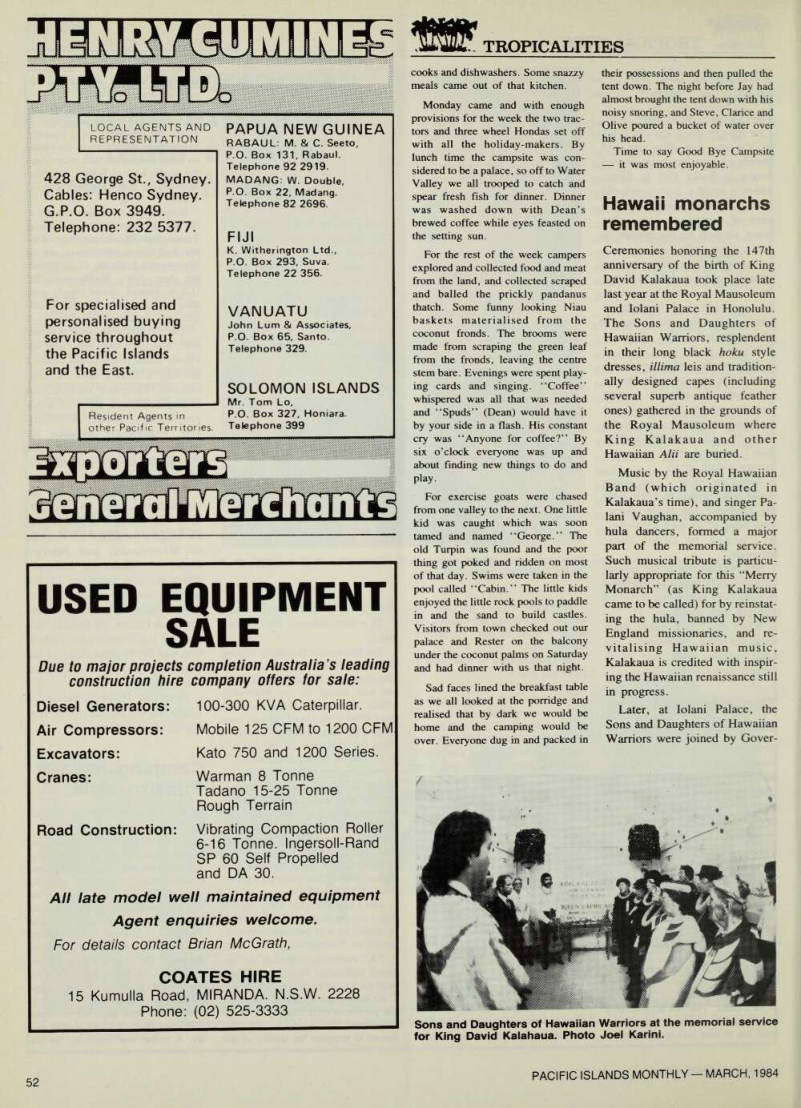
The Sons and Daughters of Hawaiian Warriors, resplendent in their long black hoku style dresses, illima leis and tradition
ally designed capes (including
several superb antique feather
ones) gathered in the grounds of the Royal Mausoleum where King Kalakaua and other Hawaiian Alii are buried.
Music by the Royal Hawaiian Band (which originated in Kalakaua’s time), and singer Pa
lani Vaughan, accompanied by
hula dancers, formed a major part of the memorial service.
Such musical tribute is particu
larly appropriate for this “Merry
Monarch” (as King Kalakaua came to be called) for by reinstat ing the hula, banned by New England missionaries, and re vitalising Hawaiian music, Kalakaua is credited with inspir ing the Hawaiian renaissance still in progress.
Later, at lolani Palace, the Sons and Daughters of Hawaiian Warriors were joined by Gover-
Sons and Daughters of Hawaiian Warriors at the memorial service for King David Kalahaua. Photo Joel Karini.
nor Ariyoshi and descendants of Hawaiian Alii. They all par ticipated in festivities culminat ing in the blessing of a royal coat of arms plaque on the lolani Palace gate used exclusively by the royal family in the days of the
monarchy. The original plaque
was torn out when the last Hawaiian monarch. Queen Liliuokalani, was overthrown in 1893. Caroline Yacoe in Honolulu.
Bullet-proof?
Just watch this!
Friends of Fiji, and of the United States Embassy in Suva, will be relieved to hear that the massive crack in the bullet-proof glass protecting the ground floor re ceptionist from terrorist attack, and which threatened to become one of the lesser wonders of the Suva scene, is now no longer on view. The panel has been
replaced.
It should be noted, of course, that terrorists continue to be ab sent from the Suva environs and that it was not a bullet that cracked the panel. It was, so we are rather reliably informed, the head of a large messenger who, not noticing the glass, bobbed forward the better to hear the
receptionist’s voice.
If this report is true Fiji may unknowingly be in possession of a singularly effective home grown weapon.
Of Outrigger
and Reef
Hardly an Australian, and not a few from the Pacific Islands, can pass through Honolulu without calling at one of the Outrigger chain of hotels.
It’s an association which goes back many years, to the days when the father of the present owner. Dr Richard Kelley, was running the Edgewater Hotel.
As Dr Kelley said recently: “Our hotels have always been popular with visitors from Down Under, and we want to keep it that way.”
The Kelley organisation has there fore appointed a special executive representative for Australia and New Zealand. He is Matt Lurie, one of the best known of Australian names in the international travel industry.
Mr Lurie was the first British Commonwealth Pacific Airlines manager resident in Fiji when that historic airline ran its DC-6 services
right across the Pacific linking Aust ralia, New Zealand and North Ameri ca before the days of Qantas.
From Fiji he went to Honolulu and then to the U.S. mainland, becom ing, in succession, a vice-president of the Matson Shipping Company, a senior executive with the Travelodge hotel group, and general manager of Avis before retiring and returning to Australia several years ago.
In Sydney he operates a specialised travel consultancy and maintains close contact with the Pacific Area Travel Association of which he was international president in 1966 and 1967.
The Outrigger organisation is made up of seven major hotels, the Waikiki Outrigger Hotel, the Outrig ger Surf, the Outrigger East, the Outrigger West, the Waikiki Surf, Waikiki Village and, the most recent acquisition and Dr Kelley’s “flag ship”, the Outrigger Prince Kuhio.
Together they have 3500 rooms.
The Reef Group, also part of the
Kelley organisation, comprises the
Reef Hotel, Reef Towers, Waikiki Tower of the Reef, the Reef Lanais and the Edgewater Hotel, foundation of the chain and still very well known.
PNG Highlands
Oz bow-wave?
The following exchange recently
took place in “Column 8”, a
gossip-type feature appearing re
gularly on the front page of The
Sydney Morning Herald.
Gangway Papua New Guinea!
Under the Australian Research Grant Scheme, $57,000 has been given to Dr A. Stolz of NSW for the investi gation of crustal movement. Informa tion about this project says: “Al though the concept of continental drift was unpopular only a few de cades ago, most geophysicists today would agree that the continental plates are moving at a few cen timetres a year or about as fast as your toenails grow. Australia is mov ing steadily north at 10 centimetres a year and is also being squeezed from each side”.
And, the next day:
“Dear Column 8, re your leading story in today’s Herald, Gangway Papua New Guinea; Fancy your not knowing that New Guinea, in na ture’s grand scheme of things, is part of Australia. Torres Strait is a mere transient puddle and was dry land as recently as 7000 years ago. New Guinea is Australia’s leading edge, and its mountains are our geological bow-wave. Gangway Japan? Yours sincerely. Dr J. M. B. Smith, senior
lecturer, Department of Geography,
University of New England”.
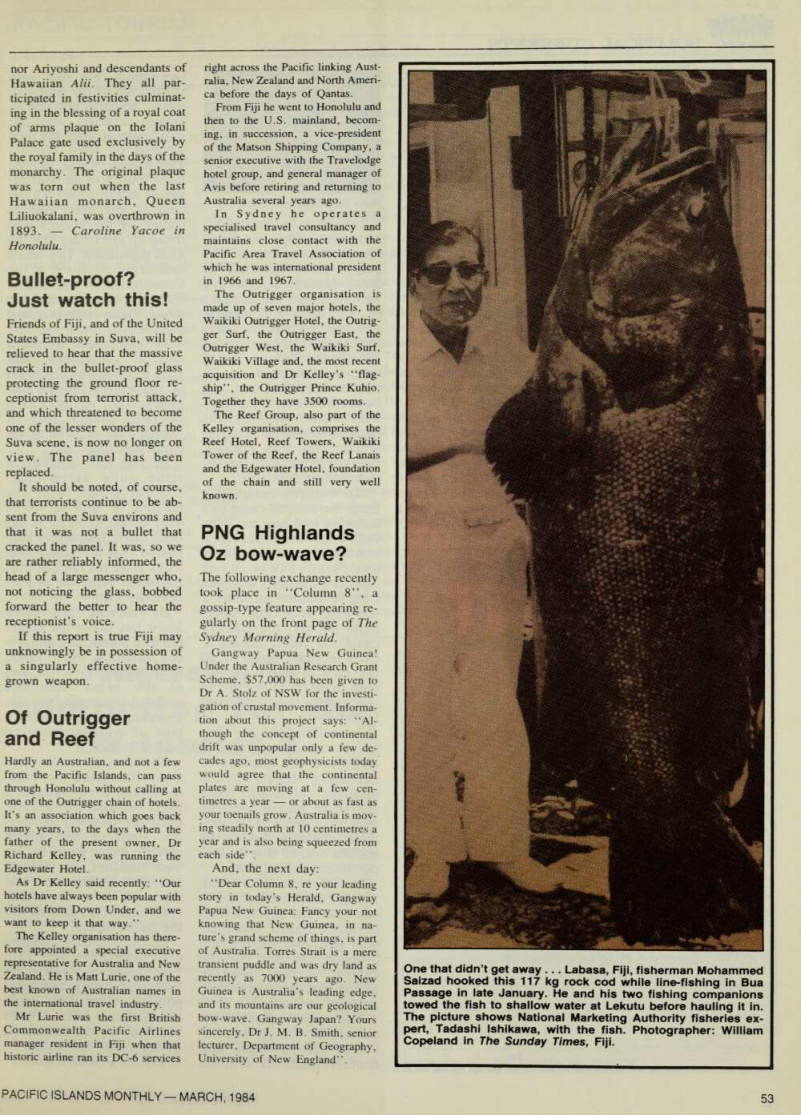
One that didn’t get away . . . Labasa, Fiji, fisherman Mohammed Saizad hooked this 117 kg rock cod while line-fishing in Bua Passage in late January. He and his two fishing companions towed the fish to shallow water at Lekutu before hauling it in.
The picture shows National Marketing Authority fisheries ex pert, Tadashi Ishikawa, with the fish. Photographer: William Copeland in The Sunday Times, Fiji.