History retold, with new
pp. 39-41 · Read in the full issue

Christian Churches In The Pacific
History retold, with new zest, new insights
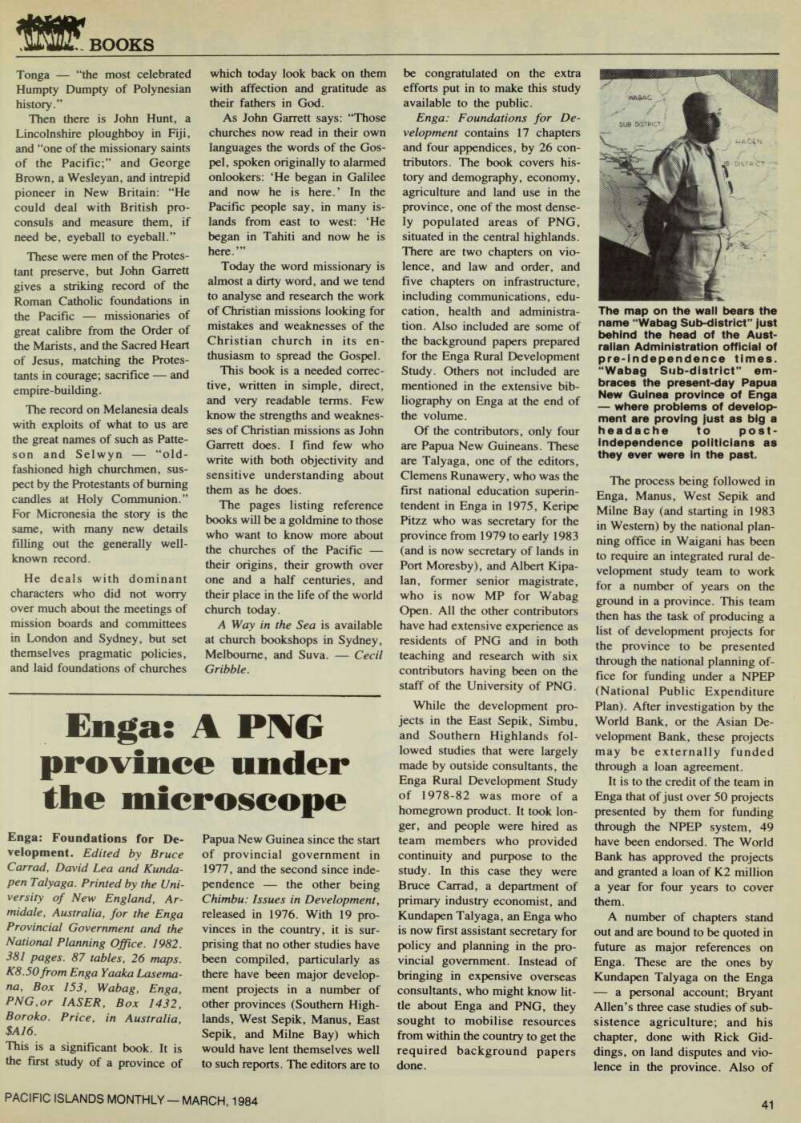
A Way in the Sea: Aspects of Pacific Christian History with Reference to Australia. By John Garrett. The J. D. Northey Memorial Lectures, 1980. Pub lished by Spectrum Publications, Melbourne, 1982. No price.
ISBN provided.
J. D. Northey was one of the outstanding churchmen of the Australian state of Victoria, and, as one closely linked with the Melbourne College of Divinity, left his mark on many of the ministers of our day, especially those from the Presbyterian, Congregational, and Methodist Churches.
John Garrett came from Fiji to give this set of memorial lectures honoring his memory. Garrett is one of the best informed of the modem historians of the Pacific churches. His recent work To Live Among the Stars Chris tian Origins in Oceania will pro bably stand for some time as the definitive work on church history in the Pacific.
A Way in the Sea does not profess to be a profound piece of Christian church history, but I venture to say that, as a readable record of the main currents of Christian missionary endeavor in the Pacific over the past 150 years, it will be for many both informative and entertaining.
The book is made up of four chapters, each dealing with Christian communities and some of the outstanding missionary personalities Polynesia, Melanesia, Micronesia, and then A Family of Island Churches.
John Garrett as a writer has the art and skill behind which must lie a welter of research of filling out with fascinating new details the main outlines of situations known to many of us from the missionary records of the Pacific.
For example, we knew that the first missionary effort of the Pro testant churches was through the London Missionary Society (LMS) in the little ship, the Duff.
But very few of us knew that Joseph Banks, and perhaps even the wife of William Bligh, could have had a part in this venture, even if a very indirect one.
Nor have many been aware that this early missionary adven ture ended in failure: “The initial joy on the deck of the Duff collapsed on shore before 1797 ended. This was what we were not told in Sunday School.”
The book takes great names and incidents in Pacific church history and presents well-known facts in a new and lively manner.
Marsden, “the friend of the Ma ori people and a founder of mod
em New Zealand,” was a martyr to seasickness and yet made se ven voyages to New Zealand in a decade. (This is a paper on mis sionary history, so 1 suppose it is reasonable to omit references to the less desirable aspects of Marsden’s work in early Aust ralia and New Zealand.) Then there is a very readable account of the early church in Tonga Taufa’ahau, the shrewd, warrior Christian king for nearly a century; John Thomas, the blacksmith pioneer
Wesleyan missionary; and “king
maker” Shirley Baker, the clever politician of mid-19th century
Tonga “the most celebrated Humpty Dumpty of Polynesian history.”
Then there is John Hunt, a Lincolnshire ploughboy in Fiji, and “one of the missionary saints of the Pacific;” and George Brown, a Wesleyan, and intrepid pioneer in New Britain: “He could deal with British pro consuls and measure them, if need be, eyeball to eyeball.”
These were men of the Protes tant preserve, but John Garrett gives a striking record of the Roman Catholic foundations in the Pacific missionaries of great calibre from the Order of the Marists, and the Sacred Heart of Jesus, matching the Protes tants in courage; sacrifice and
empire-building.
The record on Melanesia deals with exploits of what to us are the great names of such as Patte son and Selwyn “old fashioned high churchmen, sus pect by the Protestants of burning candles at Holy Communion.”
For Micronesia the story is the same, with many new details filling out the generally well known record.
He deals with dominant characters who did not worry over much about the meetings of mission boards and committees in London and Sydney, but set themselves pragmatic policies, and laid foundations of churches
which today look back on them with affection and gratitude as their fathers in God.
As John Garrett says: “Those churches now read in their own languages the words of the Gos
pel, spoken originally to alarmed
onlookers: ‘He began in Galilee and now he is here.’ In the Pacific people say, in many is lands from east to west: ‘He began in Tahiti and now he is here.’”
Today the word missionary is almost a dirty word, and we tend to analyse and research the work of Christian missions looking for mistakes and weaknesses of the Christian church in its en thusiasm to spread the Gospel.
This book is a needed correc tive, written in simple, direct, and very readable terms. Few know the strengths and weaknes ses of Christian missions as John Garrett does. I find few who write with both objectivity and sensitive understanding about them as he does.
The pages listing reference books will be a goldmine to those who want to know more about the churches of the Pacific their origins, their growth over one and a half centuries, and their place in the life of the world
church today.
A Way in the Sea is available at church bookshops in Sydney,
Melbourne, and Suva.
Cecil.
Gribble.