Rennell and
pp. 37-39 · Read in the full issue

Folk tales of Rennell and Bellona
Na Tautupu’a O Mugaba Ma Mungiki (Tales from Rennell and Bellona.) Edited by Torben Monberg and Rolf Kuschel. Pub lished by the National Museum of Denmark, 1981. 78 pp.
Bilingual.
This is the eighth in a series of publications sponsored by vari ous bodies in Denmark on the Solomon Islands’ Polynesian outliers, Rennell and Bellona, which were under British rule during the period 1898-1978.
Mugaba is Rennell, while Bel lona is Mungiki. Oral history is still being gathered on these is lands for publication. Thanks to
Torben Monberg and Rolf Kus chel, at least some of the myths and stories are now available in written form for use in local schools.
The volume is really intended as supplementary reading, since English-language texts form the curriculum core in the schools of the Solomons. But simple tales that are clearly told and easily absorbed in the local language are certainly regarded as a neces sary teaching tool.
It is just over 40 years since Mugaba and Mungiki “began” their first regular contacts with European i.e., English culture. The editors state: “We
have witnessed how generations are growing up without much knowledge of the local traditions of the two islands.”
The book is divided into three sections: “The Creation” (four tales), “Mautikitiki and Other Culture Heroes” (the longest sec tion, with 13 tales), and “The Immigrants” (four tales).
Three pages of clear notes, and a list of seven other books on these outliers, complete the text.
While the oral literature of Rennell and Bellona is vast, this book “contains only a minor ex cerpt from the myths and tales known by middle-aged people”.
Many of the stories are self explanatory in the sense that they give a rational explanation of the “emergence of life as it is today”.
Rennell and Bellona only re ceived formal Christianity in 1938. Pre-Christian animist stories are among the more im portant oral traditions that had to be omitted from the work, pre sumably for reasons of space.
The language of Rennell and Bellona has a number of dialectal variations, and this is noted in the texts, with an indication of the island where the tale was collected.
A special joy for this reviewer was the discovery of anew Poly nesian hero, Mautikitiki a great folk leader, bold and brave.
The few basic sketches are by three Solomon Islanders and two Danes.
The book is a “must” for every collection of folk tales, whether in schools or institutions of high
er learning.
W. Sharpe-Dunn.
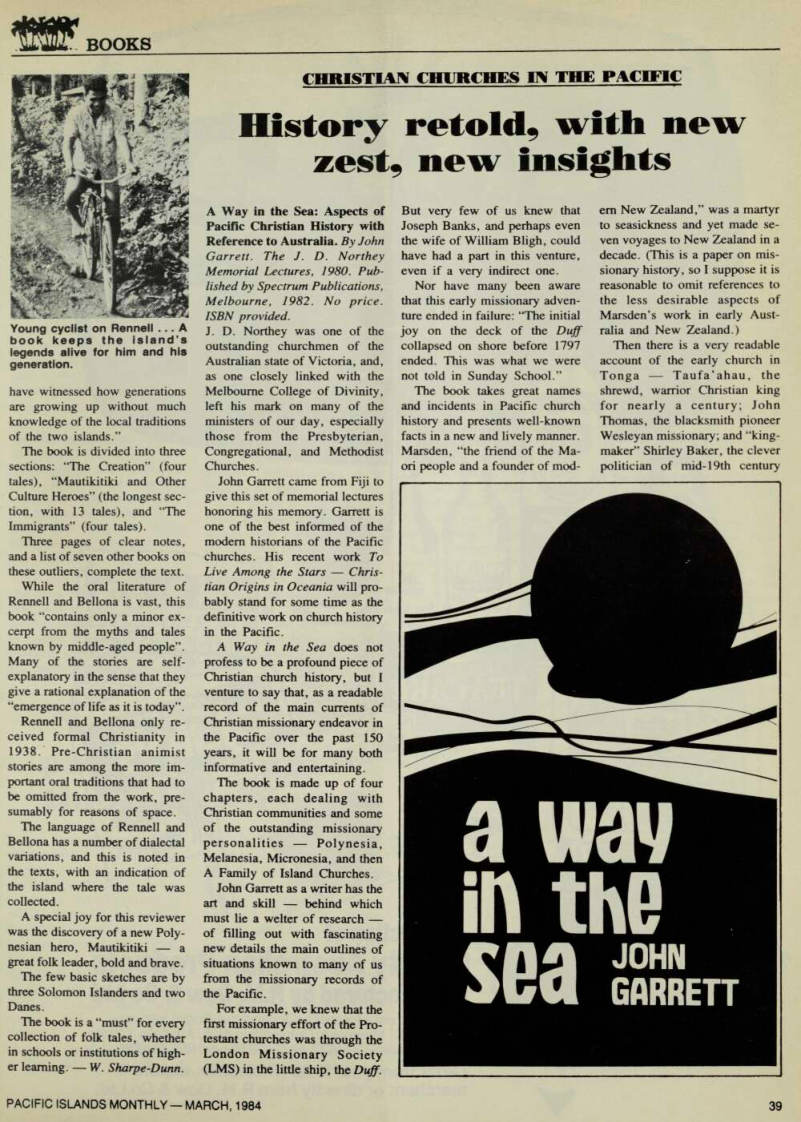
Young cyclist on Rennell ... A book keeps the island’s legends alive for him and his
generation.