the microscope
pp. 41-42 · Read in the full issue
Enga: A PAG province under the microscope
Enga: Foundations for Development. Edited by Bruce Carrad, David Lea and Kundapen Talyaga. Printed by the Universify of New England, Armidale, Australia, for the Enga Provincial Government and the National Planning Office. 1982. 381 pages. 87 tables, 26 maps.
K 8.50 from Enga Yaaka Lasemana, Box 153, Wabag, Enga, PNG,or lASER, Box 1432, Boroko. Price, in Australia,
Sai6.
This is a significant book. It is the first study of a province of
Papua New Guinea since the start of provincial government in 1977, and the second since inde pendence the other being Chimbu: Issues in Development, released in 1976. With 19 pro vinces in the country, it is sur prising that no other studies have been compiled, particularly as there have been major develop ment projects in a number of other provinces (Southern High lands, West Sepik, Manus, East Sepik, and Milne Bay) which would have lent themselves well to such reports. The editors are to
be congratulated on the extra efforts put in to make this study available to the public.
Enga: Foundations for De
velopment contains 17 chapters
and four appendices, by 26 con tributors. The book covers his tory and demography, economy, agriculture and land use in the province, one of the most dense ly populated areas of PNG, situated in the central highlands.
There are two chapters on vio lence, and law and order, and five chapters on infrastructure, including communications, edu cation, health and administra tion. Also included are some of
the background papers prepared
for the Enga Rural Development Study. Others not included are mentioned in the extensive bib liography on Enga at the end of the volume.
Of the contributors, only four are Papua New Guineans. These are Talyaga, one of the editors, Clemens Runawery, who was the first national education superin tendent in Enga in 1975, Keripe Pitzz who was secretary for the province from 1979 to early 1983 (and is now secretary of lands in Port Moresby), and Albert Kipa lan, former senior magistrate, who is now MP for Wabag Open. All the other contributors have had extensive experience as residents of PNG and in both teaching and research with six contributors having been on the staff of the University of PNG.
While the development pro jects in the East Sepik, Simbu, and Southern Highlands fol lowed studies that were largely made by outside consultants, the
Enga Rural Development Study
of 1978-82 was more of a homegrown product. It took lon ger, and people were hired as team members who provided continuity and purpose to the study. In this case they were Bruce Carrad, a department of
primary industry economist, and
Kundapen Talyaga, an Enga who
is now first assistant secretary for policy and planning in the pro vincial government. Instead of
bringing in expensive overseas
consultants, who might know lit tle about Enga and PNG, they sought to mobilise resources from within the country to get the
required background papers
done.
The process being followed in Enga, Manus, West Sepik and Milne Bay (and starting in 1983 in Western) by the national plan ning office in Waigani has been to require an integrated rural de velopment study team to work for a number of years on the ground in a province. This team then has the task of producing a list of development projects for the province to be presented through the national planning of fice for funding under a NPEP (National Public Expenditure Plan). After investigation by the World Bank, or the Asian De velopment Bank, these projects may be externally funded through a loan agreement.
It is to the credit of the team in Enga that of just over 50 projects presented by them for funding through the NPEP system, 49 have been endorsed. The World Bank has approved the projects and granted a loan of K 2 million a year for four years to cover them.
A number of chapters stand out and are bound to be quoted in future as major references on Enga. These are the ones by Kundapen Talyaga on the Enga a personal account; Bryant Allen’s three case studies of sub sistence agriculture; and his chapter, done with Rick Gid dings, on land disputes and vio lence in the province. Also of
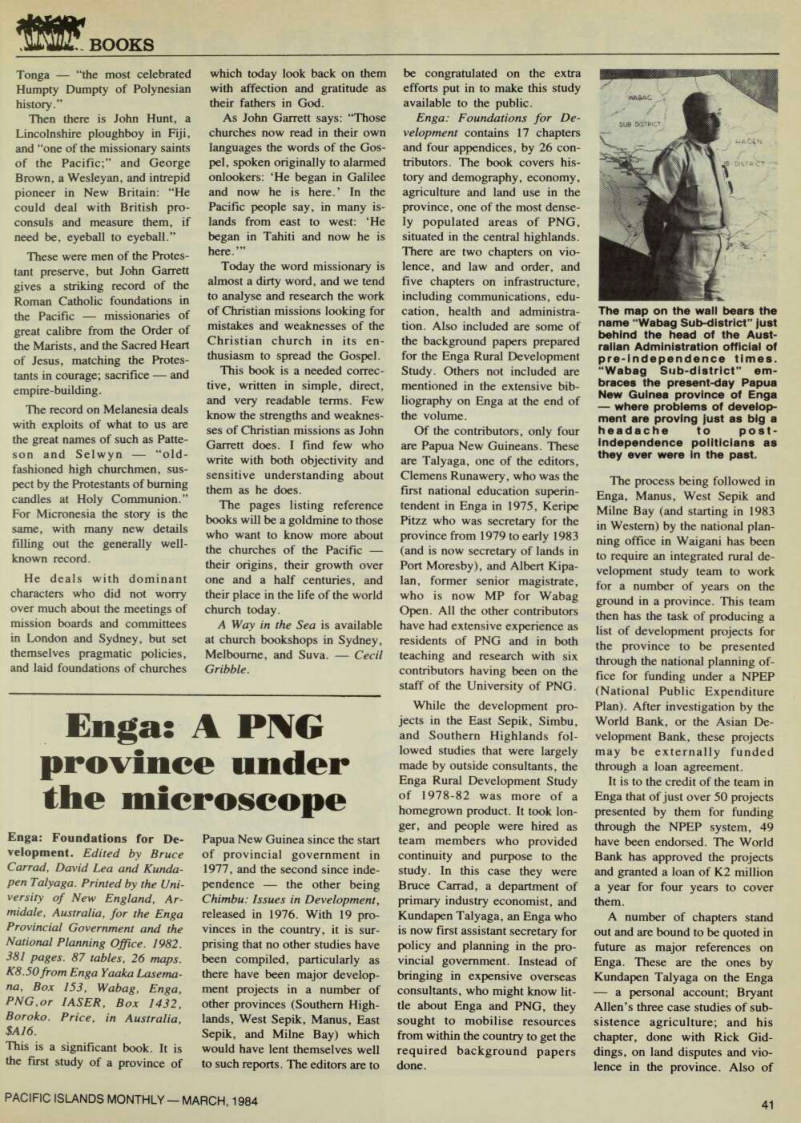
The map on the wail bears the name “Wabag Sub-district” just behind the head of the Aust ralian Administration official of pre-independence times.
“Wabag Sub-district” em braces the present-day Papua New Guinea province of Enga where problems of develop ment are proving just as big a headache to post independence politicians as they ever were in the past.
special significance are Mervyn
Meggitt’s contribution on local government and councils, and Michael Bourke’s pioneering study of institutional food pro duction and consumption. The latter demonstrates how hospit als, schools, and prisons depend on imported rice and tinned food when they could be relying on food produced in Enga to the benefit of Engans. Another chap ter that will be frequently referr ed to is the one by Roger Gordon and Kipalan on law and order.
At issue here is the whole
approach to provincial develop
ment. Can it be integrated? Ori ginally the study teams were meant to result in “integrated”
provincial rural development
studies. But all the staff have carefully dropped the word “in tegrated” from their title. Why?
It would have been helpful if the editors had tied their volume
together with a concluding chap
ter in which they presented their views on the future of Enga, the
meaning of rural development,
and whether or not it could be “integrated”. Bruce Carrad has done this to some small extent in his chapter on the economy, but one ends up with a rather depres
sing picture, suggesting that de velopment will not be integrated, and that if the Pogera Gold Mine does not go ahead then Enga will find itself in dire straits by 1986, when the Enga provincial de velopment program, Enga Yaaka Lasemana, comes to an end.
The background papers for this study were done over the past four years, and so a number of them are dated. Two chapters were revised by current Enga Development Plan staff: Mel Jones, who is the co-ordinator of Enga Yaaka Lasemana, revised the chapter on infrastructure, and Tony Simonelli, the project’s so cial monitoring officer, revised the one on education. There are also four postscripts by the editors to update four chapters: on demography, because the 1980 census results were not available at the time the chapter was written; on local govern ment, law and order, and fruits, nuts and vegetables.
From this last postscript we learn that a number of projects which for many years received extensive investments from the Lutheran Church, the Depart ment of Primary Industry, and the national government, have all
collapsed. These are WASO in Wapenemanda, Pumas near Laiagam, and the Food Market ing Corporation (FMC). If these three major efforts in growing and marketing highlands veget ables have all failed, what is the future for small-holder vegetable production in Enga and else where? It would have been help ful if the editors had commented on the significance of these fai lures for their own development program.
People who wish to learn more in depth about one province in PNG will get a great deal from this volume. But they won’t find the story of provincial govern ment in Enga.
In 1979 things were deteriorat ing so rapidly in Enga that the department of decentralisation brought in Keripe Pitzz as secret ary of the province, abolishing the old dual structure of provin cial and administrative sec retaries. It was either this or dissolve the interim provincial government altogether. This story is not told here.
The concern for “law and or der” in Enga goes beyond “tribal fighting” though that is the predominant concern. In 1980
police headquarters at Laiagam
were burned down, and there was a mass prison escape. A
revolutionary front of prisoners
claimed credit for the arson. A former parliamentarian, Tom Amaiu, held at Bomana, claims he has been unjustly punished because of alleged association with the events in Laiagam.
There is something underlying
all this that goes beyond mere clan conflicts.
It is often said in Enga that the future development of the pro vince will depend on some semblance of law and order be ing maintained. That this may not be completely so is suggested by progress in education in the province since 1980.
In 1980 the province could not recruit and hold teachers, and had 34 vacancies in 66 communi ty schools. But by 1982, the province had a full complement of 426 teachers in 79 community schools. These improvements
took place during a period of
increasing clan fighting, and are said to have resulted from special programs launched in Enga to attract and hold teachers. They
seem to have worked.
Shel-
don Weeks.