Yellow Submarine
p. 24 · Read in the full issue
The Month
Tahiti gets its Yellow Submarine
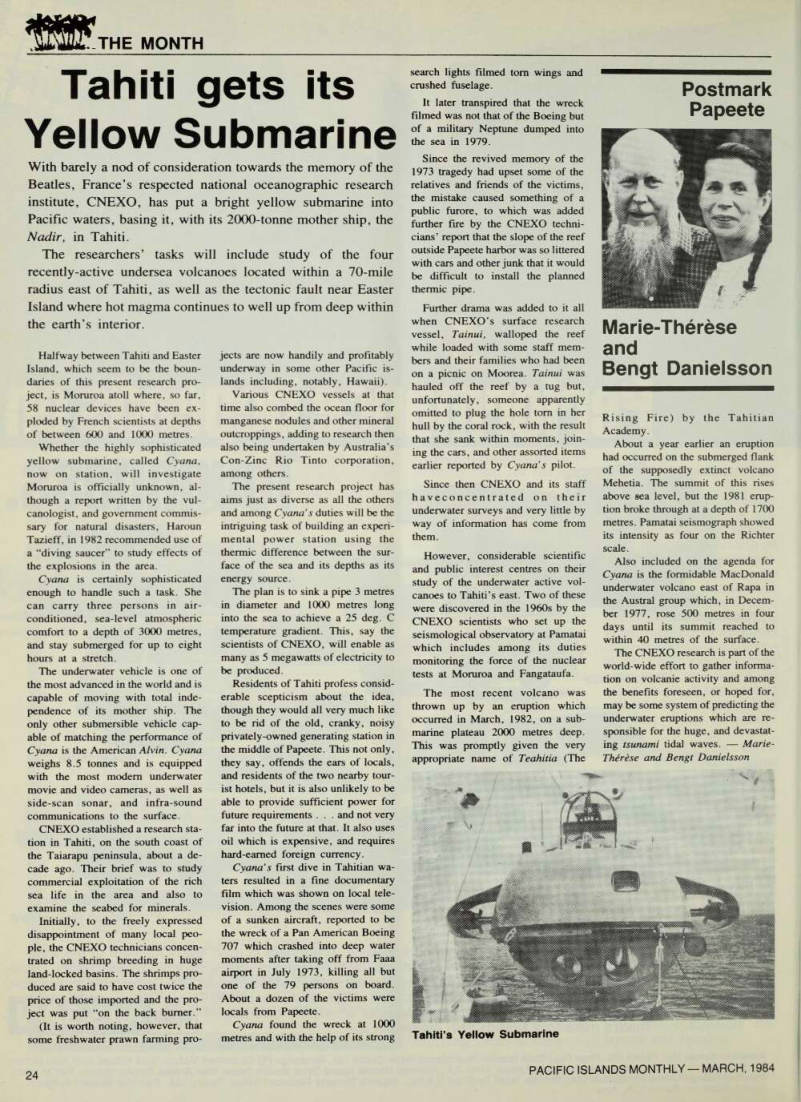
With barely a nod of consideration towards the memory of the Beatles, France’s respected national oceanographic research institute, CNEXO, has put a bright yellow submarine into Pacific waters, basing it, with its 2000-tonne mother ship, the Nadir , in Tahiti.
The researchers’ tasks will include study of the four recently-active undersea volcanoes located within a 70-mile radius east of Tahiti, as well as the tectonic fault near Easter Island where hot magma continues to well up from deep within the earth’s interior.
Halfway between Tahiti and Easter Island, which seem to be the boun daries of this present research pro ject, is Moruroa atoll where, so far, 58 nuclear devices have been ex ploded by French scientists at depths of between 600 and 1000 metres.
Whether the highly sophisticated
yellow submarine, called Cyana, now on station, will investigate Moruroa is officially unknown, al though a report written by the vul canologist, and government commis sary for natural disasters, Haroun Tazieff, in 1982 recommended use of a “diving saucer” to study effects of the explosions in the area.
Cyana is certainly sophisticated enough to handle such a task. She can carry three persons in air conditioned, sea-level atmospheric comfort to a depth of 3000 metres, and stay submerged for up to eight hours at a stretch.
The underwater vehicle is one of the most advanced in the world and is capable of moving with total inde pendence of its mother ship. The only other submersible vehicle cap able of matching the performance of Cyana is the American Alvin. Cyana weighs 8.5 tonnes and is equipped with the most modem underwater movie and video cameras, as well as side-scan sonar, and infra-sound communications to the surface.
CNEXO established a research sta tion in Tahiti, on the south coast of the Taiarapu peninsula, about a de cade ago. Their brief was to study commercial exploitation of the rich sea life in the area and also to examine the seabed for minerals.
Initially, to the freely expressed disappointment of many local peo ple, the CNEXO technicians concen trated on shrimp breeding in huge land-locked basins. The shrimps pro duced are said to have cost twice the price of those imported and the pro ject was put “on the back burner.” (It is worth noting, however, that some freshwater prawn farming pro
jects are now handily and profitably underway in some other Pacific is lands including, notably, Hawaii).
Various CNEXO vessels at that time also combed the ocean floor for manganese nodules and other mineral outcroppings, adding to research then also being undertaken by Australia’s Con-Zinc Rio Tinto corporation, among others.
The present research project has aims just as diverse as all the others and among Cyana’s duties will be the intriguing task of building an experi mental power station using the thermic difference between the sur face of the sea and its depths as its energy source.
The plan is to sink a pipe 3 metres in diameter and 1000 metres long into the sea to achieve a 25 deg. C temperature gradient. This, say the scientists of CNEXO, will enable as many as 5 megawatts of electricity to
be produced.
Residents of Tahiti profess consid erable scepticism about the idea, though they would all very much like to be rid of the old, cranky, noisy privately-owned generating station in the middle of Papeete. This not only, they say, offends the ears of locals, and residents of the two nearby tour ist hotels, but it is also unlikely to be able to provide sufficient power for future requirements . . . and not very far into the future at that. It also uses oil which is expensive, and requires hard-earned foreign currency.
Cyana’s first dive in Tahitian wa ters resulted in a fine documentary film which was shown on local tele vision. Among the scenes were some of a sunken aircraft, reported to be the wreck of a Pan American Boeing 707 which crashed into deep water moments after taking off from Faaa airport in July 1973, killing all but one of the 79 persons on board.
About a dozen of the victims were locals from Papeete.
Cyana found the wreck at 1000 metres and with the help of its strong
search lights filmed tom wings and
crushed fuselage.
It later transpired that the wreck filmed was not that of the Boeing but of a military Neptune dumped into the sea in 1979.
Since the revived memory of the 1973 tragedy had upset some of the relatives and friends of the victims, the mistake caused something of a public furore, to which was added further fire by the CNEXO techni cians’ report that the slope of the reef outside Papeete harbor was so littered with cars and other junk that it would be difficult to install the planned thermic pipe.
Further drama was added to it all when CNEXO’s surface research vessel, Tainui, walloped the reef while loaded with some staff mem bers and their families who had been on a picnic on Moorea. Tainui was hauled off the reef by a tug but, unfortunately, someone apparently omitted to plug the hole tom in her hull by the coral rock, with the result that she sank within moments, join ing the cars, and other assorted items earlier reported by Cyana’s pilot.
Since then CNEXO and its staff haveconcentrated on their underwater surveys and very little by way of information has come from them.
However, considerable scientific and public interest centres on their study of the underwater active vol canoes to Tahiti’s east. Two of these were discovered in the 1960 s by the CNEXO scientists who set up the seismological observatory at Pamatai which includes among its duties monitoring the force of the nuclear tests at Moruroa and Fangataufa.
The most recent volcano was thrown up by an eruption which occurred in March, 1982, on a sub marine plateau 2000 metres deep.
This was promptly given the very appropriate name of Teahitia (The
Rising Fire) by the Tahitian Academy.
About a year earlier an eruption had occurred on the submerged flank of the supposedly extinct volcano Mehetia. The summit of this rises above sea level, but the 1981 erup tion broke through at a depth of 1700 metres. Pamatai seismograph showed its intensity as four on the Richter scale.
Also included on the agenda for Cyana is the formidable MacDonald underwater volcano east of Rapa in the Austral group which, in Decem ber 1977, rose 500 metres in four days until its summit reached to within 40 metres of the surface.
The CNEXO research is part of the world-wide effort to gather informa tion on volcanic activity and among the benefits foreseen, or hoped for, may be some system of predicting the underwater eruptions which are re sponsible for the huge, and devastat
ing tsunami tidal waves.
Marie-
Therese and Bengt Danielsson
Postmark Papeete
Marie-Therese and Bengt Danielsson
Tahiti’s Yellow Submarine